Where automotive‑grade Android development fits into the evolving landscape of the global EV industry
The EV and autonomous mobility sectors continue to evolve quickly, with manufacturers and tech companies advancing new models, services, and production capabilities. As vehicles become more connected and increasingly automated, software plays a growing role in enabling everything from in‑car experiences to system safety. This shift is prompting many companies to broaden their technical capabilities and invest in specialized engineering expertise.
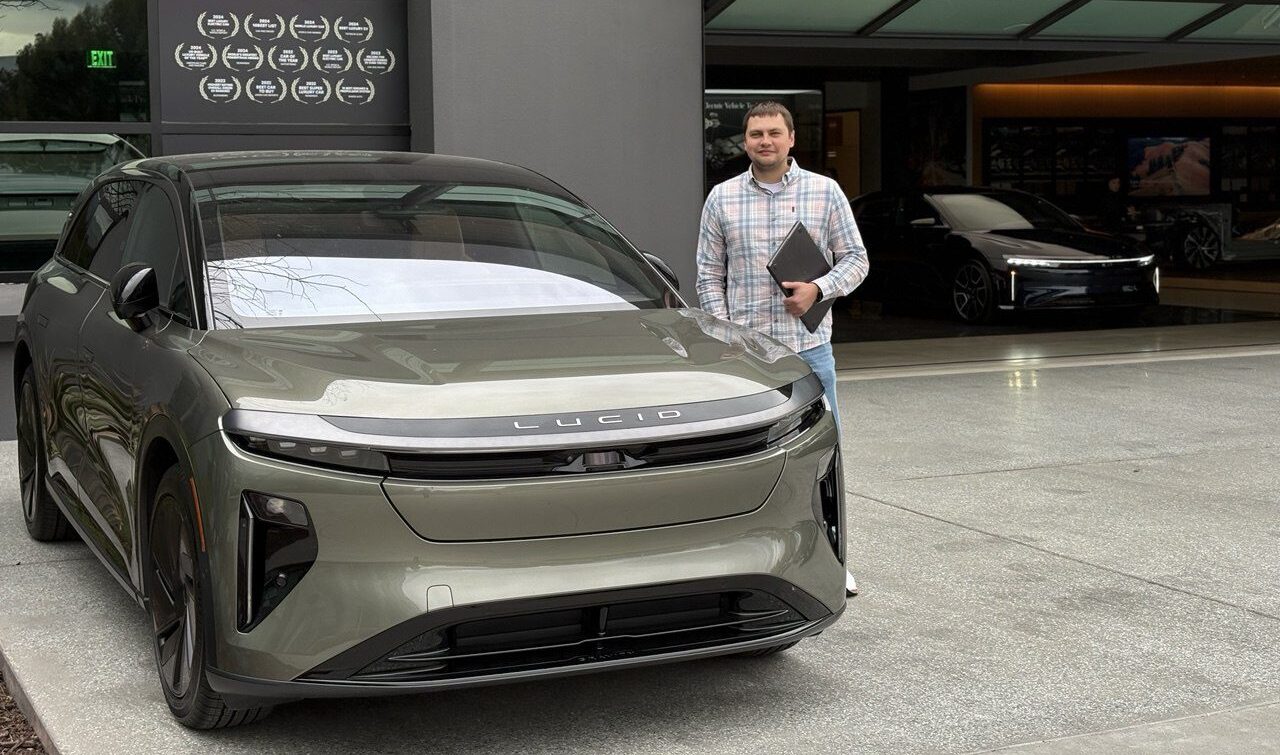
Heorhi Yemialyanau is a Staff Android Developer at Lucid Motors, where he builds the infotainment systems that power vehicle controls and energy management for the award‑winning Lucid Air sedan and Lucid Gravity SUV. In 2025, Lucid produced over 18,000 vehicles, all running software he helped create.
Before moving into the automotive industry, Heorhi spent more than 10 years in Android development, creating apps with millions of downloads, speaking at Mobius (Eastern Europe’s largest mobile development conference), and earning a Master’s degree in Software Engineering.
Across the global EV market, manufacturers are scaling production and competing on software capabilities as much as hardware. To meet this demand, the industry needs specialists who can drive innovation in vehicle‑system software. We asked Heorhi what that looks like.
What Automotive Software Actually Does
What does your software control?
Drive modes, regenerative braking levels, suspension height, charging state, and energy consumption tracking. When a driver activates efficiency mode, the software adjusts dozens of parameters: it lowers the suspension to reduce air resistance, maximizes regenerative braking, and configures the motor for optimal efficiency. It also calculates range projections based on route, weather, terrain, and traffic – even wind direction can affect energy consumption.
How is this different from regular mobile development?
There are three major differences. The first is the level of reliability required. In mobile apps, a crash is usually just an inconvenience – you reopen the app and continue. In automotive software, the systems often support driving functions, so they’re designed with much higher expectations for consistency and robustness to help ensure a safe driving experience.
The second is architecture. A phone is one device. An EV is a distributed system – multiple boards, multiple ECUs, and controllers, all reliably communicating. Debugging means tracing signals and messages across the entire vehicle.
The third key difference is data throughput. In most cases, mobile apps operate as thin clients, doing a minimal number of calculations, delegating computation to backend services. Automotive signals are emitted at high frequency – speed, charge, motor status – all continuously streaming. You need serious multithreading optimization to keep the UI smooth.
The Economics of EV Software
How do software-defined vehicles change the driving experience?
As vehicles become increasingly software-defined, they are beginning to resemble other connected technologies people rely on every day. Just as smartphones evolved from simple communication devices into powerful computers that fit in the palm of a hand, modern vehicles are increasingly described as computers on wheels – capable of adapting, updating, and improving through software. This transformation shapes how drivers interact with their vehicles, from the responsiveness of controls and clarity of information to how seamlessly features integrate into daily routines. At the same time, software-defined architectures give manufacturers greater flexibility to iterate, enhance functionality over time, and deliver long-term value beyond initial vehicle delivery. In this context, well-designed and reliable software plays an increasingly important role in supporting both user experience and ongoing innovation across the vehicle lifecycle.
How does software efficiency affect manufacturing costs?
Battery packs remain the most expensive component in electric vehicle manufacturing. As a result, even incremental improvements in software efficiency – such as better energy management, thermal optimization, or driving logic – can reduce the amount of battery capacity required per vehicle. At production scale, these reductions translate directly into meaningful cost savings. Software-driven efficiency works hand in hand with physical design choices, enabling smaller batteries, lower material usage, and improved margins without compromising range or performance.

Autonomy and the Expanding Role of Vehicle Software
As electric vehicles evolve toward higher levels of autonomy and increased fleet usage, the demands placed on in-vehicle software continue to expand. Vehicles designed for shared mobility, ride-hailing, or autonomous operation are expected to run for longer periods, serve a wider range of users, and operate reliably across diverse conditions. This shift increases the importance of software systems beyond driving automation itself.
In this context, core vehicle software – such as energy management, vehicle controls, and user-facing interfaces – plays an increasingly critical role in ensuring reliability, efficiency, and consistency across the vehicle lifecycle. Even as autonomous capabilities advance, these foundational software layers remain essential to enabling scalable, software-defined vehicle platforms that can adapt, update, and improve over time. As autonomy and utilization grow, so does the need for robust, well-architected software that supports both the vehicle and the broader mobility ecosystem.
Technical Contributions
What are you building that advances the field?
- Vehicle Signal API Infrastructure
My team developed an API layer for vehicle signal communication that replaces low-level, hard-to-read interfaces with a clear, human-readable abstraction. Instead of working with opaque identifiers, developers interact with meaningful, type-safe APIs that reflect the actual behavior of the vehicle. This approach makes the codebase self-documenting, shifts many classes of errors to compile time, and significantly reduces bugs caused by misinterpretation of system behavior. As a result, the infrastructure improves reliability and development speed across everything built on top of it.
- Rendering Engine
I developed a custom 2D graphics engine that enables dynamic, multi-layer rendering driven by vehicle configuration and application logic. The solution improves performance, flexibility, and visual consistency across infotainment systems, while reducing UI complexity and enabling faster iteration. The engine also allows graphics to be ported directly from design tools into production code, significantly narrowing the gap between designer intent and implementation.
- Core Electric Vehicle Control Applications
I contributed to the development of essential car controls applications. One of the most critical components is the Energy application, which monitors charging, energy consumption, and vehicle efficiency. My work involved implementing advanced algorithms to predict energy losses, optimize battery usage, and provide real-time insights to drivers. This contribution improved accuracy, reliability, and user experience in energy management systems, advancing software capabilities in electric vehicle systems.
Disclaimer: The views and opinions expressed in this article are those of the author and do not reflect the official policy or position of Lucid Motors.