AI agents are becoming more capable, but businesses still face a basic problem: how much freedom should they have? Giving an agent access to company tools can save time, yet it also creates new risks. Harnyss is addressing that issue with a platform built around governed autonomy. Its agents can carry out business work while following control levels set by the company. The aim is to let AI take on more responsibility without removing human oversight where it still matters.
Autonomy Needs Clear Boundaries
Many AI tools can now generate content, analyze data, and take actions across business software. The challenge starts when those actions move beyond simple assistance. Companies need to know when an agent can act alone and when a person should review the work first.
Harnyss uses three autonomy levels to manage that balance. Approve requires a human decision before an action can move forward. Review allows an agent to prepare or schedule work while giving someone time to step in. Autopilot lets trusted workflows run without a human checkpoint once the company is comfortable with the process.
This model gives teams more control over where autonomy is used. A routine content task may need less review than a legal or financial process. Instead of applying one rule to every agent, businesses can adjust the level of control for each workflow.
The Goal Is More Than Task Automation
Traditional automation usually follows fixed rules. A trigger happens, a set action runs, and the workflow repeats in the same way. That works well for simple processes, but it becomes harder when judgment, context, or changing conditions are involved.
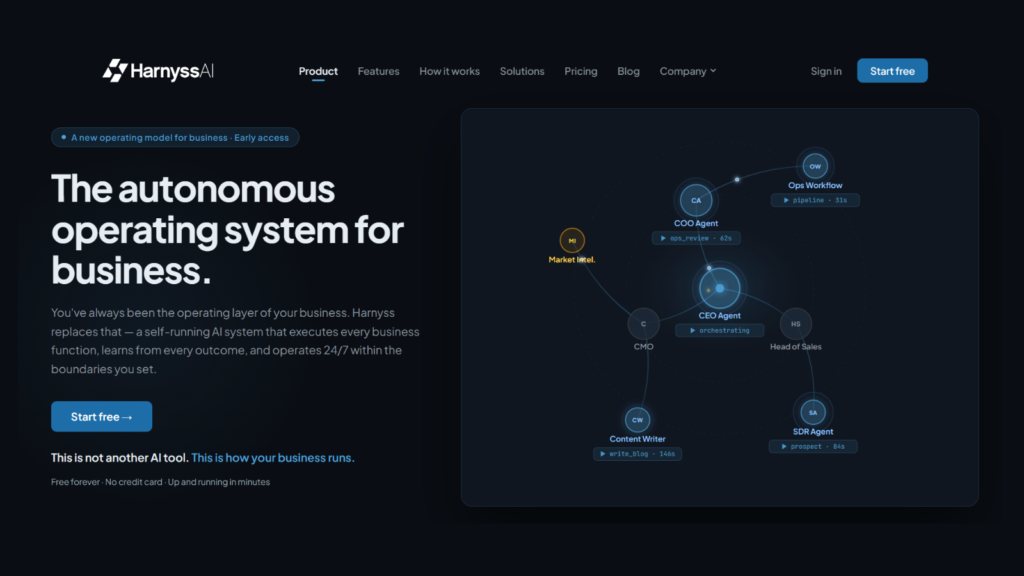
Harnyss is built around agents that can manage broader business workflows. The platform includes agents for functions such as marketing, sales, customer success, finance, legal, engineering, and operations. It also supports business-role agents including CMO, COO, SDR, and Content Writer. Companies can create additional agents and workflows by describing what they need in natural language.
The broader idea is to move AI beyond one-off tasks. Instead of asking an assistant to complete each step, a business can give an agent an ongoing role within a controlled system. This shifts AI closer to business operations rather than simple productivity support.
Governance Becomes Part of the Infrastructure
As agents take on more work, governance becomes more important. Businesses need visibility into what an agent did, which tools it used, and where human approval was required. Those controls become especially important when several agents are working across different departments.
Harnyss combines its autonomy settings with an operating layer that connects governed AI agents to existing business tools. The platform supports more than 25 integrations, including HubSpot, Salesforce, Slack, Notion, Webflow, Google Analytics, and Search Console. It is built on the Claude Agent SDK and supports a bring-your-own-model-key approach.
The platform also includes audit trails and is designed to keep customer data separate from model training. Harnyss says its system is built so companies can increase autonomy gradually instead of giving agents unrestricted access from the start.
That approach reflects a wider issue facing business AI. More capable agents can do more useful work, but capability alone is not enough for production use. For companies looking at autonomous systems, the real question may be how much control remains when the AI starts acting on its own.