Trying to decide between HappyHorse 1.0 and Seedance 2.0? Both tools have exploded in popularity in 2026, showing up in almost every AI video generator comparison and review. But despite the hype, they’re not built for the same type of user.
In this HappyHorse 1.0 vs Seedance 2.0 breakdown, we’ll cut through the noise and focus on what actually matters—so you can choose the right tool without wasting time.
Part 1: Quick Overview: HappyHorse 1.0 vs Seedance 2.0
In early 2026, two AI video models quickly took over the conversation: Seedance 2.0 and HappyHorse 1.0.
Seedance 2.0, released by ByteDance in February 2026, gained traction almost immediately thanks to its integration into tools like Dreamina and AIReel(with support for real human). Instead of being just a model, it became something people could actually use—making it one of the most widely adopted AI video tools in real workflows.
HappyHorse 1.0, which appeared in April 2026, took a very different path. It drew attention by climbing to the top of benchmark leaderboards and quickly became a hot topic in the AI community. Rather than focusing on productization, it stood out for its strong visual output and flexibility, often being discussed as a high-performance, open-model alternative.
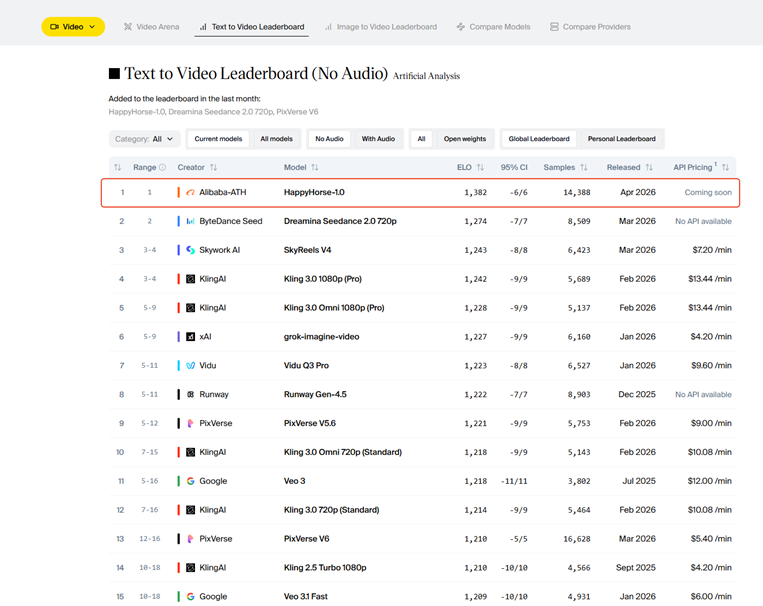
That’s why the HappyHorse vs Seedance 2.0 comparison has become so popular. At a high level, the difference is clear:
- HappyHorse is known for strong benchmark performance and visually impressive results, but remains harder to access and use in practice.
- Seedance 2.0 is more accessible and reliable in real workflows, making it a more practical choice for everyday content creation.
Part 2: How They Compare: Differences, Strengths and Limitations
While both are powerful AI video models, HappyHorse 1.0 and Seedance 2.0 are built with different priorities in mind. The biggest difference comes down to how each model is designed to be used.
HappyHorse 1.0 is often associated with strong benchmark performance and visually impressive outputs. It tends to perform well in stylized scenes, animations, and cases where visual impact matters more than strict realism. However, it is less accessible and usually requires more technical setup.
Seedance 2.0, in contrast, is built for usability and real-world workflows. It is already integrated into tools like Dreamina and AIReel, making it easy to use for everyday content creation. It generally delivers more stable and consistent results, especially in scenarios like human motion, product demos, and structured scenes.
Another key difference is reliability. Seedance 2.0 is designed for repeatable output and faster iteration, while HappyHorse is often more experimental, with results that can vary depending on the setup and use case.
HappyHorse 1.0 vs Seedance 2.0: Full Comparison Table
| Aspect | HappyHorse 1.0 | Seedance 2.0 |
| Output Style | More visually striking, strong in stylized and animated scenes | More realistic and consistent, better for structured scenes |
| Consistency | Can vary depending on setup and prompts | Generally stable and predictable |
| Ease of Use | Requires technical setup, not beginner-friendly | Easy to use through existing tools (Dreamina, AIReel) |
| Accessibility | Limited access, not widely available to general users | Widely accessible through integrated platforms |
| Workflow Fit | Better for experimentation and exploration | Better for regular content production |
| Flexibility | Higher flexibility and customization potential | More constrained but easier to control |
| Learning Curve | Steeper learning curve | Beginner-friendly |
| Best For | Developers, researchers, advanced users | Creators, marketers, general users |
| Main Limitation | Hard to use and access | Less flexibility and experimental freedom |
Part 3: Which One Should You Choose in 2026?
The right choice depends on how you plan to use it.
- Choose Seedance 2.0 if you want something easy to use and reliable.
It’s better for beginners, content creators, and teams who need to produce videos quickly and consistently. - Choose HappyHorse if you’re more technical or want more flexibility.
It’s a better fit for developers, researchers, or anyone interested in experimenting with higher-end visual output.
If you’re just getting started with AI video, Seedance 2.0 is the safer choice. But if you’re exploring the limits of what an AI video generator can do—and don’t mind the extra complexity—HappyHorse is worth paying attention to.
Part 4: FAQs
Is HappyHorse 1.0 better than Seedance 2.0?
Not necessarily. HappyHorse often performs better in terms of visual impact and flexibility, while Seedance 2.0 is more reliable and easier to use in real-world workflows. The better choice depends on your needs.
Can I use HappyHorse 1.0 right now?
Access to HappyHorse 1.0 is still limited and may require technical setup. It’s not as easy to use as mainstream tools yet.
Is Seedance 2.0 available to the public?
Yes. Seedance 2.0 is available through tools like Dreamina and AIReel. Dreamina is an official channel, but access may be limited in some regions. AIReel is generally more accessible and supports real human video generation.
Which one is better for beginners?
Seedance 2.0 is a better choice for beginners because it’s easier to use and doesn’t require technical setup.
Which AI video generator has better quality?
It depends on the use case. HappyHorse may produce more visually striking results, while Seedance 2.0 offers more consistent and reliable output.
Conclusion:
Looking at the current landscape, the HappyHorse 1.0 vs Seedance 2.0 debate is really about present vs potential. Seedance 2.0 is already usable, reliable, and integrated into real tools—making it a practical choice for creators and teams. HappyHorse, on the other hand, stands out for its strong performance and flexibility, but still comes with higher barriers to entry.
In this AI video generator comparison, the decision is simple: choose Seedance 2.0 if you want something that works today, and keep an eye on HappyHorse if you’re interested in what’s coming next.