‘AI’ is the hype topic at the moment and it seems this phenomenon is dove tailing well with a lot of hype around UV lasers amongst laser enthusiasts and its entry into the sub surface laser engraving (SSLE) industry.
I’ve therefore decided to publish this overview based on many questions raised in the last few weeks around UV lasers and their ability to engage in the sub-surface laser engraving process (also known as inner engraving) where designs can be etched within crystal while the surfaces appear completely untouched. This article is intended to help those evaluating entering the business of sub surface laser etching within transparent optic crystal (also referred to as the 3D Crystal business).
If you want to start this business, you’ll want to understand the lasers and choose the right type. The two most common technologies are:
-Green-beam YAG (532 nm) lasers (used for SSLE purposes for ~25+ years)
-UV (355 nm) lasers (used for SSLE purposes for the last couple years and becoming more widely known amongst hobbyists)
Both of these lasers can engrave within crystal. They both have value and strengths for what they can do however they are used in different segments of the laser engraving industry. Therefore it’s important to know the appropriate functions of each. The right choice depends on the business model, product size you wish to achieve, budget, and long term goals.
This article is meant to be for educational purposes and based on data fed to us from owners of both UV and green beam lasers who are seeking to make texture based point clouds from flat photos for their sub surface laser engravers.
I will dissect the topic into 6 areas of focus namely: Beam behaviour, Speed, Field of View, Cost of equipment, Quality (texture based burning), & AI integration.
Behavior of the Beam: Precise & Powerful
Green-beam YAG (532 nm)
-Strong to penetrate within crystal and the manufacturer auto sets refraction index keeping items centered correctly.
-Creates bright, consistent dots
-Excellent for large fields of view
-Very stable and consistent for laser power
-Produces dense and polished texture based point clouds
-Its fast for inner surface engravings
UV (355 nm)
-Extremely fine beam spot size
-Precise for delicate near-surface markings but getting better for deeper (at the time of writing this article).
-Great for small engravings, and materials sensitive to heat
-Able to create very sharp details on flat or shallow engravings
Summary:
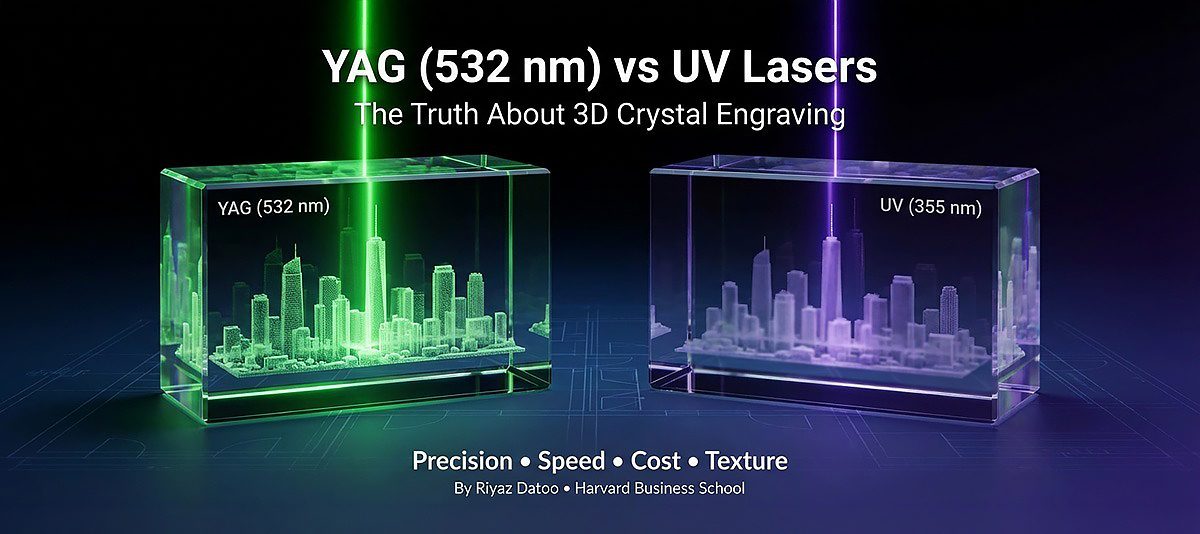
UV = finer detail for surface etching
Green 532 = consistent at wider fields of view and polished & dense texture-based 3D output within optic crystal for sub surface etching
Texture based means engraving not only the shape of the 3D model, but overlaying it with jpeg texture.
Speed: Is Green Beam YAG really faster than UV and if so why?
Since the UV beam produces a smaller / finer dot, it requires many more dots to fill the same 3D space that would be filled by a green beam laser when it comes to sub surface laser etching. At the
same time, UV offers strong efficiency on surface-oriented workloads.
So a project that requires 5–7 minutes on a green 532 nm laser may take upwards of 20–40 minutes on a UV laser when burning 3D inside crystal.
If you are requiring fast output and turnaround time matters (events, retail, high volume orders) this difference in production speed should be accounted for . UV may be faster in the following circumstances that are non SSLE related:
-Small, SURFACE engravings
-Single-layer FLAT images
-Surface decorative patterns
Its important to note that each laser has scenarios where they perform best and the laser that is optimal for you is based on your intended purpose.
Crystal Size & Depth: Understanding the flexibility of Green Beam YAG lasers
Green-beam 532 nm systems are optimized for powerful energy delivery deep into crystal and broadly with larger fields of view, allowing:
-Larger 3D Crystal pieces with greater surface area
-Multiple materials including glass (not just optic crystal)
-Full-volume 3D portraits with consistent texture not fading at edges that are further from center
UV systems generally perform best for smaller fields of view when it comes to SSLE. However this is rapidly changing.
Where UV is considered superior:
-Smaller crystals / smaller FOV (for now)
-Surface engraving of various materials
If seeking to run a full scaled 3D business, many operators report that the range of crystal sizes supported by green-beam 532 nm systems is versatile.
Cost Considerations: UV has an attractive lower entry cost.
UV machines generally cost less than green 532 nm machines. A stable UV laser may cost $4,000 – $10,000. A stable Green Beam laser may cost $9,000 – $40,000 (depending on the table size and whether it’s a production table capable of producing many pieces in one batch).
So it really depends on the versatility being sought and whether the purchase is being made more for hobby/learning OR for efficient production and real business cashflow.
UV is a better option if cost is the main factor:
-Lower upfront cost
-Great for hobby users on a low budget
-Suitable for smaller pieces of crystal OR surface etching.
Green Beam YAG (532 nm) is often selected by operators focused on higher-volume 3D engraving, due to speed, depth performance, and broader field-of-view options. Some manufacturers are starting to provide a professional 532 nm green beam system at an accessible price point closer to UV price points. They are also offering quieter and more portable event machines for real business cases. Software ecosystems across the industry increasingly support omni-channel workflows such as online, retail, and events.
Basically UV is more affordable upfront. However green-beam 532 nm systems may provide greater long-term capability for businesses focusing on higher volume 3D crystal production in less time.
Texture-Based 3D Models: Green Beam YAG Still Leads (For Now)
An important area to focus on is the ability for the laser to burn good quality 3D texture-based models and not just flat white pointclouds. Texture based models means that the pointcloud retains the realistic, vibrant, appearance baking in the jpeg image into the 3D engraving.
The current industry trends show:
-Green 532 nm lasers often produce accurate and brighter textures on the models that are burned inside crystal
-UV systems can produce fine detail, but operator-reported cases note challenges with dot brightness uniformity and smooth shading. While texture baking and optimizing is a challenge for UV lasers within crystal, they are ok for burning texture on surface materials such as wood and metal if that is the intended purpose.
UV sometimes also produces brown color within crystal due to the air within the bubble being burned. This results in mild smoke within the fractures. This effect varies by manufacturer but is improving as UV manufacturers continue development of the technology to reduce this less desirable effect.
AI software compatibility
High-quality 3D crystals rely on great hardware and great 2D to 3D conversion software.
AI-based conversion solutions that make digital photos 3D (2D to 3D conversion such as pipelines offered by Cockpit3D.com among others), are built for green-beam workflows. As such they offer:
-Accurate 3D results
-HD texture shading
-Dense 3D models (High point saturation)
-Optimal engraving path
This means:
-Consistent results
-Less wasted / rejected crystals
-More automation and less operator intervention
Final Thoughts
Both laser types have areas in which they are optimal for:
-UV is good for surface, hobby SSLE, and lower cost entry
-Green-beam 532 nm systems are good for quality SSLE, and production flows that are focused on cashflow from selling inner surface ething in crystal
Those seeking to purchase a laser etching machine for business purposes (and not so much for hobby related initiatives should evaluate after-sales support, training resources, youtube channel and video content, and public reviews. Consulting industry experts is always a great idea. We continue to receive feedback from UV and Green beam laser users and I will look forward to publishing more information for actual market results just I have in this article.
Author: Riyaz Datoo was educated at the Harvard School of Business (Boston) and the Schulich School of Business (Toronto). His area of study focused on strategic marketing and artificial intelligence. He is the founder of 3DCrystal.com and maker of software / hardware solutions in the 3D laser and SSLE technology sector. He is a public speaker and teacher. As of the date of this publication he has facilitated entrepreneurs to start their 3D laser business across 6 continents. Learn more on youtube.com/@3dcrystal