The modern active entertainment market demonstrates steady growth, and laser tag plays a key role in it thanks to several important advantages. Among such reasons and advantages are mobility, a high level of safety, and broad opportunities for further scaling.
The equipment used for Laser tag has long ceased to be exclusively a traditional gaming tool. Increasingly, it is viewed as a flexible platform for building various business models: from one-time events to permanent commercial facilities.
The Evolution of Laser Tag Equipment
Thanks to rapid technological development, it has been possible to significantly expand the practical applications of laser tag.
Modern kits often use:
- Equipment that can operate in different weather conditions.
- Wireless sensors and taggers.
- Elements of augmented and tactical reality.
- Systems responsible for conducting analytics and statistics.
- Programmable game scenarios.
Based on this, successful adaptation of laser tag occurs for specific business formats and models. At the same time, there is no need to implement radical changes in the features of the infrastructure used.
Mobile Model: Events and Mobile Games
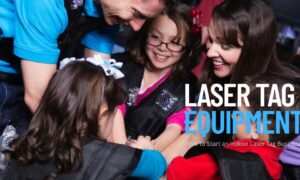
Mobile laser tag today is called one of the most accessible business models. This format is clearly oriented toward corporate events and team buildings, private celebrations, city festivals and mass events, and various brand marketing campaigns.
In this case, laser tag equipment is especially popular for several reasons:
- deployment speed;
- high profitability of one-time events;
- minimal list of requirements for a specific venue;
- low entry threshold for different entrepreneurs.
Mobility allows the business to scale geographically and work with multiple target audiences simultaneously.
Semi-Stationary Model: Seasonal Venues
Another equally popular model is temporary or seasonal laser tag venues in parks, at recreation centers, and in tourist zones. In this case, the equipment is operated at permanent locations but without capital construction.
The main advantages of this model:
- stable customer flow, which will be especially noticeable in high seasons;
- possibility of expanding services (for example, various escape rooms, children’s programs, team games);
- relatively low investments compared to stationary facilities;
- possibility of branding the venue and territory where games will take place.
In such models, it is advisable to use wear-resistant weapon variants that can be scalable, contributing to the support of various game scenarios.
Stationary Installations: Permanent Entertainment Business
Stationary outdoor laser tag arenas represent full-fledged commercial facilities. Such models often involve the use of specially designed game zones, shelters, bases, tactical routes, as well as waiting areas and service infrastructure.
Within this model, all laser tag equipment becomes a long-term asset that provides:
- the possibility of receiving regular income;
- conducting various tournaments and leagues;
- forming a loyal community of players.
In addition, it is possible to develop other additional sources of profit (memberships, training, franchise).
B2B and Institutional Applications
Outdoor laser tag equipment is also actively used beyond the entertainment industry. Such equipment is often used for corporate training and team building, for educational programs, and for training and simulation centers.
Thanks to the flexibility of all settings, it is possible to quickly adapt the equipment to a specific list of tasks. For this reason, it is often called a universal tool relevant for all kinds of directions and industries.
One of the key advantages of laser tag equipment is the ability to transition between business models. Beginners can start with mobile events, after which they can open a seasonal venue, and in the long term – a stationary facility, using previously acquired experience, knowledge, and existing equipment. This reduces risks, simplifies investment planning, and allows the business to grow organically.