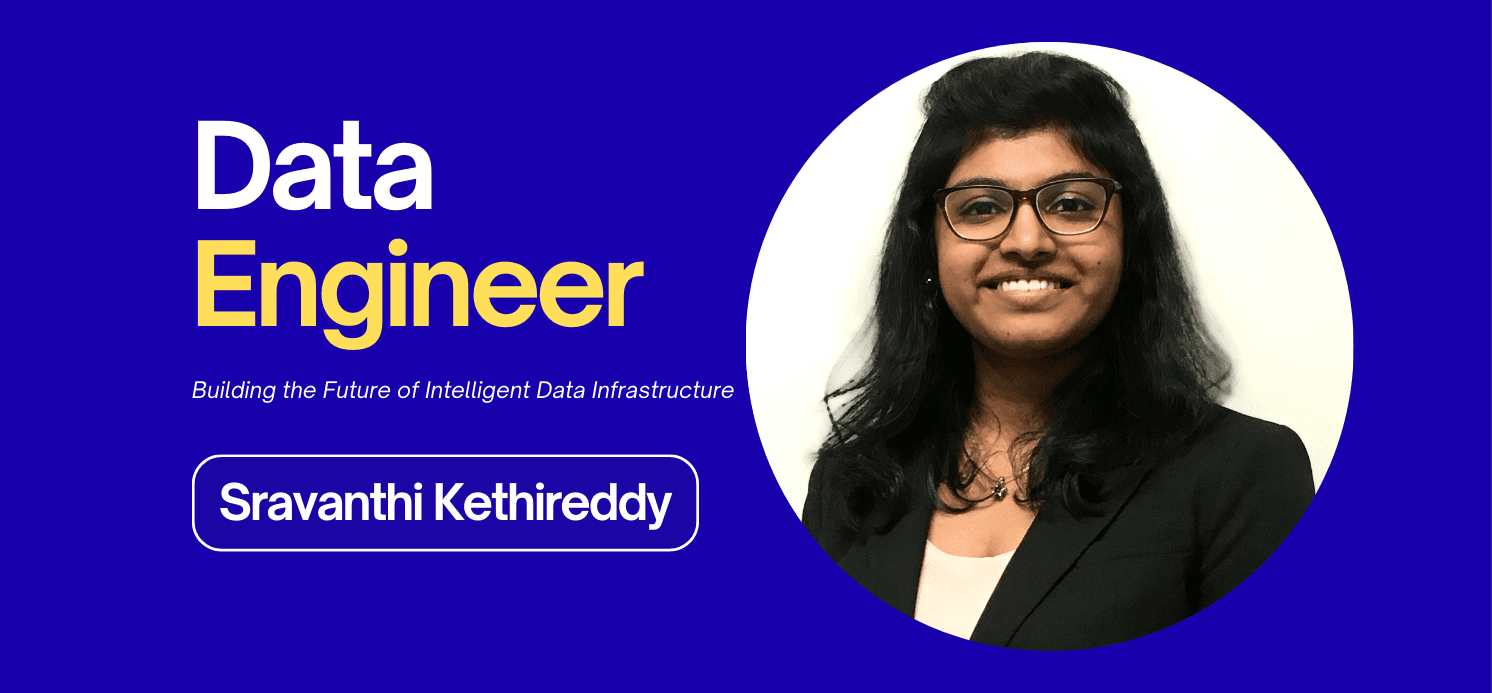
Sravanthi Kethireddy is a Staff Data Engineer and platform architect leading the development of scalable, real-time data systems for the world’s largest retailer. For more than a decade, she has specialized in architecting data-centric transformations and pioneering scalable data ingestion and transformation workflows for global organizations in a wide range of industries, with a focus on the retail and financial sectors.
Throughout her career, Sravanthi has designed solutions that bridge the gap between data engineering and data science by building predictive and prescriptive analytics layers into data workflows that empower cross-functional teams with actionable intelligence. Among her many significant engineering achievements, in her current role she developed a comprehensive, one-stop solution that automated the entire lifecycle of data workflows. These innovations established her company as a leader in real-time, intelligent data transformation, driving her framework to be adopted across several lines of business, established as internal best practices within their enterprise data engineering teams, and positioned as a central component in the organization’s enterprise data modernization initiative.
Sravanthi received her bachelor’s degree from the Institute of Aeronautical Engineering in Hyderabad, India, and earned a master’s degree in Computer Science from Northeastern University in Boston, Massachusetts (US). Her ongoing professional development includes advanced credentials in multi-cloud AI and Machine Learning solutions.
I spoke with Sravanthi about her approach to data engineering transformations, how she designs automation-first infrastructure to help data teams optimize friction, cost, and analytics, and her insights about the future of AI-powered data engineering solutions.
Ellen Warren: Let’s start with a little background. How did you come to focus your data engineering career on developing scalable, real-time data frameworks? What excites you about designing analytics solutions that empower actionable intelligence?
Sravanthi Kethireddy: My focus on scalable, real-time data frameworks has roots in my background as an aeronautical engineer. I knew early on that every modern aircraft generates terabytes of data per hour as it lands — streams used for maintenance, safety monitoring, operational efficiency, and troubleshooting. My imagination often extended beyond aircraft to even larger, more complex systems such as the International Space Station, where real-time data is literally mission-critical. That mindset shaped how I view any data system: as something vast, dynamic, and requiring reliability, speed, and foresight at every level.
When I entered the professional world, I quickly realized that many data tasks — whether small data processing jobs or larger workflows — often required manual intervention as loads grew or shrank. While I could complete the work, it was sometimes repetitive, inefficient, or brittle. Instead of just “getting the task done,” I asked how the framework itself could be designed to scale, self-correct, and reduce redundancy. I approach each problem from “35,000 feet” — whether it’s a workflow transforming a few gigabytes or an enterprise-scale system handling petabytes — my goal is to make the framework fast, dependable, and adaptable.
Over time, I refined this systems-level perspective by developing real-time pipelines and AI-enabled ETL frameworks that embed anomaly detection, NLP, and forecasting models directly within the data flows. These frameworks achieved measurable outcomes such as significant improvements in workflow success rates, major gains in developer productivity, and substantial reductions in manual interventions. By emphasizing configurability, automation, and machine learning–driven optimization, I was able to create platforms that scale seamlessly as data volumes shift and business needs evolve.
What excites me most about building analytics solutions is their ability to empower actionable intelligence. A well-designed data framework is like an aircraft’s avionics system: it continuously gathers, validates, and transmits signals that enable confident decisions at high speed. Whether it’s reducing waste through predictive models, uncovering insights from unstructured data, or providing real-time monitoring for critical operations, my passion lies in converting raw streams into signals that stakeholders can act on immediately. I build not just pipelines, but platforms that allow organizations to operate with the same reliability and responsiveness I once admired in aerospace systems.
EW: Your AI-powered Data Processing framework introduced reinforcement learning and evolutionary algorithms into data engineering. How did you approach integrating these AI techniques into a traditionally rule-based domain? Can you tell us about your key challenges and how you overcame them?
SK: Traditionally, data processing systems are built on static rules: transformations, error handling, and resource allocation are predefined, which makes pipelines brittle when data patterns change. My approach to integrating AI into this space was to replace static control with adaptive intelligence. I used reinforcement learning to let the system learn optimal scheduling and resource allocation strategies under varying workloads, and evolutionary algorithms to explore new combinations of transformation paths, indexing strategies, and workflow configurations that human engineers might not design manually. The objective was to create a self-optimizing data processing framework — one that adapts in real time rather than waiting for engineers to intervene.
One of the biggest challenges was stability. Reinforcement learning agents, for example, tend to overfit to short-term conditions or oscillate between strategies, which is unacceptable in production pipelines. To overcome this, I created a controlled simulation environment that replicated data workloads at scale, allowing agents to train safely before deployment. I also designed fallback logic so the system could revert to deterministic, rule-based flows if the AI decisions were ever suboptimal. Another challenge was transparency: data engineers and stakeholders needed to understand why the AI made certain decisions. To address this, I built monitoring dashboards that surfaced key signals — such as anomaly scores, resource usage, and decision rationales — so human operators could audit and trust the system’s outputs.
Integrating evolutionary algorithms presented its own difficulties. Search spaces for pipeline optimization are enormous, and naïve exploration is computationally expensive. I solved this by constraining the search using heuristics from domain expertise, so the evolutionary algorithm only explored transformations and scheduling strategies that were already technically valid. This hybrid of human insight and algorithmic search allowed the framework to generate novel yet practical solutions efficiently.
EW: You built a metadata-driven, automation platform that abstracts technical complexity for end users. How did this declarative design change the way teams build, deploy, and maintain data workflows?
SK: I designed a configuration-driven framework where workflows are defined through simple configurations rather than custom programming. This abstraction removed technical complexity, letting engineers and analysts specify “what” a workflow should do without worrying about “how” it executes. This approach turned workflow creation into a fast, intuitive process that significantly reduced engineering overhead.
The challenge was balancing flexibility with simplicity. Too much abstraction could make the system opaque, while too little would not add value. I solved this by building modular templates with clear configuration fields, automated validation checks, and self-documenting dashboards.
The impact was profound: development cycles dropped from weeks to hours, maintenance became easier thanks to standardized configurations, and upgrades could be applied across workflows by updating shared configuration definitions. By lowering the barrier to entry, the system empowered both junior engineers and domain experts to create robust workflows with confidence.
EW: Your original contributions to real-time systems include anomaly detection, fraud prevention, and urban infrastructure monitoring. How do you balance the competing demands of latency, accuracy, and scalability in real-time data pipelines?
SK: In real-time systems, latency, accuracy, and scalability often pull in different directions. My approach is to treat them as constraints to balance rather than trade-offs to sacrifice. For instance, I layer models: lightweight anomaly detection at the edge ensures sub-second responsiveness, while more complex models downstream enhance accuracy.
Scalability presented challenges around ordering and consistency. I used idempotent logic, consistent checkpointing, and stateful operators to preserve accuracy under high throughput. Auto-scaling was guided by workload metrics so the system could adjust seamlessly to demand surges.
To avoid blind spots, I integrated anomaly detection into the operational layer itself. Predictive monitoring identified bottlenecks or failures before they impacted latency.
The result was pipelines capable of handling millions of events per second with strict accuracy thresholds — robust enough for domains like fraud detection, anomaly monitoring, and infrastructure analytics.
EW: Across your career, you have successfully bridged the gap between data engineering and data science by embedding machine learning into ETL infrastructure. How do you ensure your platforms remain adaptable to evolving models, datasets, and business objectives?
SK: My philosophy is to merge data engineering and data science by embedding models directly into ETL infrastructure. Instead of static data handoffs, the pipelines themselves support model training, validation, and deployment.
Adaptability was the biggest challenge, since models evolve quickly. I addressed this with modular APIs and containerized deployments so models could be swapped or updated without pipeline rewrites. CI/CD pipelines automated versioning and rollbacks to maintain reliability.
I also accounted for diverse data types — structured, streaming, and unstructured — by using schema-on-read, dynamic resource allocation, and automated feature extraction. These design decisions ensured the system remained flexible for new use cases.
The outcome was unified platforms where models continuously evolve alongside datasets and objectives. This accelerated experimentation cycles while ensuring business needs were met in real time.
EW: In your previous role with a global technology organization, you led the design of a Spark-based financial reconciliation system using unsupervised learning. What led you to select those algorithms (like DBSCAN, k-means), and how did you validate their performance on financial data at scale?
SK: Financial reconciliation traditionally relies on rigid rules, which fail when transaction patterns evolve. I chose unsupervised learning algorithms like DBSCAN and k-means because they detect anomalies and clusters without requiring labeled data — ideal for financial streams where ground truth is rare.
A key challenge was model selection: DBSCAN handles variable density but struggles with high dimensionality, while k-means scales efficiently but assumes spherical clusters. I ran comparative experiments using subsets of financial data, benchmarking on both accuracy metrics (precision, recall) and operational metrics (latency, resource cost).
Validation was critical. I built a framework to test models against historical reconciliations, measuring not only anomaly detection rates but also business relevance of the flagged items. Outliers were further triaged with rule-based heuristics for explainability.
The final system reduced reconciliation times significantly, identified mismatches in real time, and minimized false positives, ensuring stakeholders trusted the AI-driven approach.
EW: You have modernized cloud-native data infrastructure across AWS, GCP, and Azure. What core principles guide your cloud architecture decisions, especially when balancing cost, security, and performance across hybrid or multi-cloud environments?
SK: My guiding principle for cloud architecture is to treat cost, performance, and security as interdependent levers. I design infrastructures that are modular, resilient, and vendor-agnostic so workloads can shift between clouds without friction.
For cost, I prioritize elasticity — auto-scaling, spot instances, and lifecycle policies to avoid over-provisioning. For performance, I use data locality, caching, and partitioning strategies to minimize latency across distributed systems. For security, I embed compliance-by-design: encryption at rest and in transit, role-based access, and audit logging.
A key challenge was balancing multi-cloud complexity. I solved this by standardizing IaC (Infrastructure-as-Code) templates, container orchestration, and monitoring dashboards so teams had a consistent operating model across platforms.
The result was cloud-native environments that scaled efficiently, minimized cost, and satisfied stringent governance requirements while staying adaptable to hybrid or multi-cloud setups.
EW: Your ASL-to-text translation system at one of the top four global consulting firms demonstrates a passion for accessible technology. What inspired this project, and how did you deliver robust real-time performance under diverse user and environmental conditions?
SK: This project grew out of my personal commitment to accessibility and inclusive technology. I wanted to apply my expertise in real-time systems to solve a human challenge: enabling seamless communication for the Deaf and hard-of-hearing community. The idea was to build a system that could translate American Sign Language (ASL) gestures into text in real time, allowing immediate comprehension during conversations, presentations, and collaborative work.
The first challenge was variability in input. Sign language is not uniform — speed, style, and regional variations differ from person to person. On top of this, environmental conditions such as poor lighting, camera angles, and background clutter introduce further complexity. To overcome these, I trained computer vision models on diverse, large-scale datasets and incorporated preprocessing techniques such as background normalization, temporal smoothing, and multi-angle input handling. These steps helped the system generalize across users and conditions.
Latency was another critical hurdle. For users, even a two-second lag could disrupt natural communication. To address this, I optimized the pipeline with GPU acceleration, parallelized model inference across multiple nodes, and used streaming inference techniques. The system produced partial results instantly and refined them on the fly, ensuring users always saw meaningful output in near-real time. Robust error-handling mechanisms prevented glitches from propagating through the translation layer.
To ensure trust and adoption, I worked closely with end users during development. Feedback sessions with diverse signers helped refine accuracy and usability.
The final system delivered robust real-time translation under a wide range of conditions, achieving both technical excellence and social impact. It demonstrated that accessibility challenges can be addressed with cutting-edge engineering, and it reinforced my belief that technology should expand human capabilities, not just business outcomes. This project remains a personal favorite because it combined my passion for building real-time, scalable systems with a mission to make communication more inclusive.
EW: In your career, you have applied predictive analytics to optimize everything from inventory management in retail to workforce analytics in HR. What frameworks or metrics do you use to measure the real-world impact of these AI-driven systems?
SK: When applying predictive analytics to areas like inventory or workforce management, I focus on measuring real-world impact rather than just model accuracy. My framework emphasizes three metrics: operational efficiency (cost savings, resource utilization), decision latency (time to actionable insight), and adoption (how often stakeholders actually use the predictions).
Challenges included aligning models with business realities — for example, a highly accurate forecast may still be useless if it’s too late to act. To address this, I prioritized timeliness, building pipelines that surfaced insights as close to real time as possible.
I also implemented continuous feedback loops: predictions were compared against outcomes, and models retrained regularly to prevent drift. Dashboards tracked KPIs such as cost reduction percentages, forecast accuracy, and waste reduction.
This focus on business-facing metrics ensured analytics were not just technically sound but also measurably impactful in real-world operations.
EW: You have also delivered innovations that were adopted as best practices across enterprise teams. What’s your approach to scaling a solution from a single-use case to cross-functional enterprise-wide adoption?
SK: A successful innovation must scale beyond a single use case. My approach is to design solutions as reusable frameworks from the start, with clear abstractions, documentation, and onboarding guides.
The challenge was often cultural rather than technical. Different teams resist adopting external tools. To overcome this, I invested in evangelism — demos, training sessions, and pilot projects that proved value quickly. Feedback was incorporated to make the frameworks more accessible.
Technically, I built modular APIs and configuration-driven architectures so solutions could adapt to multiple contexts without extensive rewrites. Monitoring and governance were centralized to ensure consistency across teams.
This approach turned one-off innovations into enterprise-wide standards, accelerating adoption and embedding best practices across the organization.
EW: As a mentor and thought leader, how do you guide junior engineers in understanding the intersection of data engineering, machine learning, and business strategy?
SK: As a mentor, I focus on helping junior engineers see the bigger picture: data engineering is not just about moving data, but about enabling business strategy through AI and analytics. I encourage them to think in terms of systems, scalability, and long-term maintainability.
The challenge is balancing theory with practice. I guide juniors through hands-on projects, pairing design reviews with code walkthroughs, so they learn both conceptual frameworks and implementation details.
I also emphasize interdisciplinary thinking. Understanding machine learning models, data governance, and business objectives allows engineers to design with empathy for end users. By framing engineering as part of a value chain, they see how their work impacts organizational outcomes.
This approach produces well-rounded engineers who can bridge silos, innovate responsibly, and eventually take leadership roles themselves.
EW: Looking ahead, how do you see AI and generative technologies continuing to transform the role of data engineering, particularly in creating autonomous data infrastructure or self-healing systems? How will you be exploring new technologies in your upcoming initiatives?
SK: I see AI — particularly generative and reinforcement learning technologies — transforming data engineering into a discipline of autonomous systems. Instead of manually tuning workflows, future pipelines will be self-healing, auto-optimizing, and capable of generating their own transformations.
The challenge today is trust and explainability. As AI takes on orchestration, stakeholders must understand how decisions are made. My approach is to combine generative technologies with transparent guardrails: dashboards that explain choices, fallback logic that ensures reliability, and governance that prevents drift.
In upcoming initiatives, I aim to explore AI-driven orchestration agents that design and deploy pipelines automatically based on high-level business objectives. I also see opportunities in “self-healing” systems where anomalies are not just detected but corrected autonomously, minimizing downtime.
This vision extends my lifelong focus: creating data frameworks that operate at scale, adapt in real time, and empower humans to focus on higher-level strategy rather than repetitive engineering tasks.