How Haarishkumar Bhaskar built and continues to operate an AI-enabled platform designed to connect founders with personalised expertise, guidance and investor-readiness support
This gap is the problem that Founder Edge, an AI-enabled founder support platform, addresses.
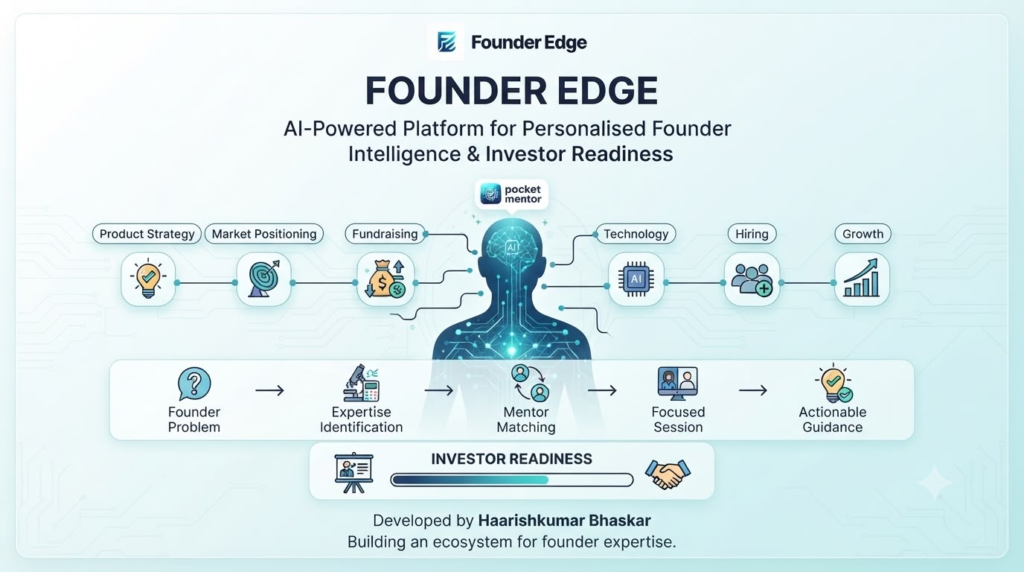
Founded and built by Haarishkumar Bhaskar, Founder Edge provides a structured environment where entrepreneurs can access personalised guidance from experienced operators and mentors while using artificial intelligence to make that support more relevant to their individual needs. Rather than positioning mentorship as generic networking, the platform is built around the idea of personalised founder intelligence.
The platform combines human experience with AI-assisted discovery, matching and preparation, creating a structured pathway for founders seeking practical support as their businesses develop, from idea to investment. Founder Edge is already built, operational and running with an active founder ecosystem and functioning product experience.
Moving Beyond Traditional Startup Mentorship
Startup mentorship often depends heavily on personal networks. A founder may know someone with fundraising experience but lack access to a product specialist. Another may need help with go-to-market strategy but have no direct connection to someone who has solved a similar problem.
Founder Edge approaches this challenge from a technology perspective. The platform connects founders with relevant mentors based on their requirements, startup context and areas where they need support. Instead of asking founders to search through a large pool of advisors, its technology helps narrow the gap between a founder’s problem and the expertise required to address it.
The AI Layer Behind Founder Edge
Artificial intelligence plays a central role in the platform rather than functioning simply as an additional chatbot feature.
One key capability is AI-powered mentor matching. A founder’s requirements can be translated into structured information about expertise, industry experience, business stage and problem-solving capability. AI can then help identify mentors whose experience is relevant.
The objective is not simply to match people according to job titles. A founder working on an early-stage SaaS product, for example, may need someone with experience in customer discovery and product-market fit rather than someone whose profile simply contains the word “technology.” This enables AI to make mentorship more contextual.
A Personalised “Pocket Mentor”
Founder Edge also incorporates the concept of an AI-enabled pocket mentor. This gives founders an intelligent support layer between formal mentor interactions.
A traditional mentorship session might last an hour, but startup decisions occur continuously. A founder may need to evaluate a product decision, refine a pitch and prepare for an investor conversation on the same day.
An AI support layer can help founders organise questions, explore alternatives and prepare for conversations with human mentors. This creates a hybrid model in which artificial intelligence provides continuous assistance while experienced people provide deeper contextual judgement.
Founder Edge is not intended to replace experienced entrepreneurs or operators. Instead, the platform combines AI scalability with human expertise in a product that is already built and available for use.
Investor Readiness as a Separate Capability
Founder Edge also extends beyond mentorship into investor preparation. For many early-stage founders, fundraising requires more than having a good idea. The founder must communicate the opportunity clearly through a pitch, business model, market narrative and investment proposition.
Founder Edge includes an investor pitch video space that forms part of this preparation process. The feature gives founders an environment where they can present their businesses and strengthen their investor-facing communication.
Combined with AI-enabled guidance, this creates a more structured investor-readiness journey. Instead of treating fundraising as a single event, founders can work progressively on how they explain their business, identify weaknesses in their pitch and prepare for investor conversations.
Designed Around Real Founder Problems
A significant challenge for any AI-enabled startup platform is avoiding technology for technology’s sake. Founder Edge’s proposition is therefore centred on a practical question: Can technology help founders make better decisions by connecting them with the right intelligence at the right time?
Rather than making artificial intelligence the headline feature in isolation, AI becomes an enabling layer across discovery, matching, preparation and ongoing founder support. These capabilities are integrated into a functioning platform that has been built to address real founder needs.
An Operational Approach to Entrepreneurial Support
Founder Edge is an operational AI-enabled platform with an active founder ecosystem and functioning product experience. It is not merely a concept or an early-stage proposal; it has been built, launched and is running.
The platform reflects a broader shift in entrepreneurship technology. As AI becomes increasingly capable of understanding context, analysing information and supporting decision-making, startup platforms are exploring how these capabilities can augment existing human networks rather than replace them.
For Haarishkumar Bhaskar, the opportunity lies in combining the two. Founder Edge is built around the idea that founders should not have to navigate every important decision alone, and that access to expertise can become more personalised, structured and technology-enabled.
About Haarishkumar Bhaskar
Haarishkumar Bhaskar is a technology entrepreneur and AI Product Developer working at the intersection of artificial intelligence, digital products and business innovation. He is the founder and builder of Founder Edge, an operational AI-enabled platform that connects founders with personalised expertise, mentorship and investor-readiness support. His work focuses on applying AI to practical product and decision-making challenges.