
First AI Game Index: Claude Dominates Game Development, but OpenAI Captures the Players

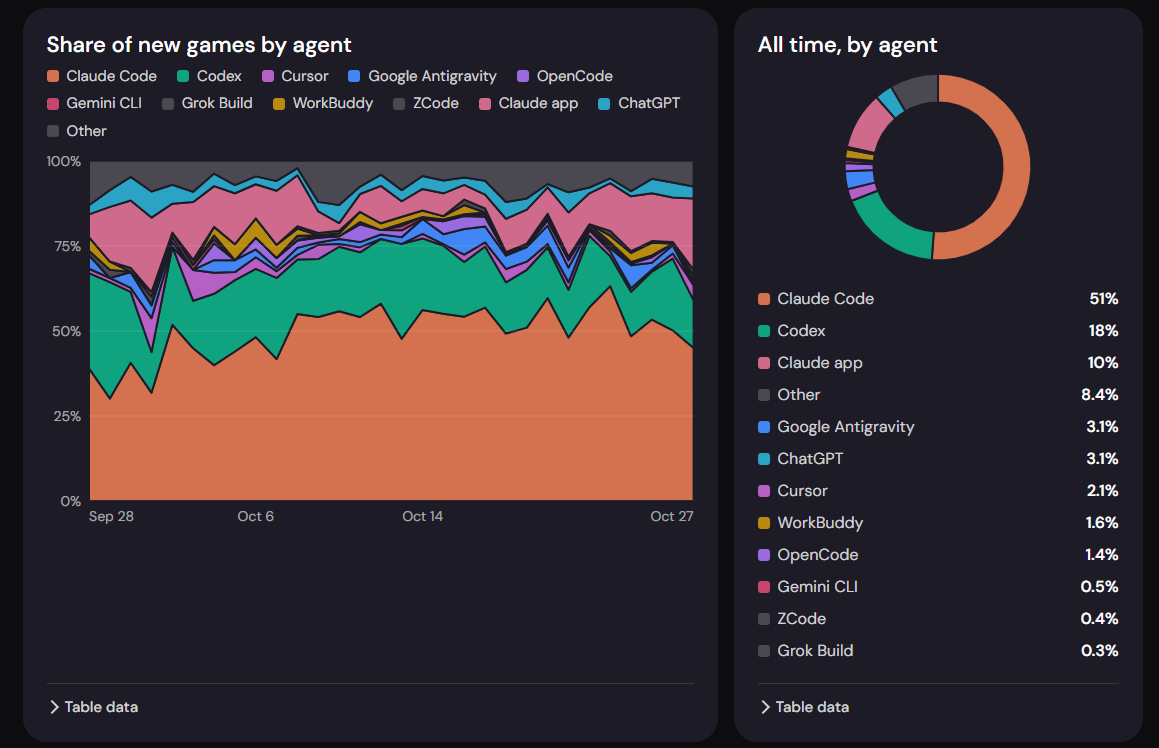
Image Credit: Playgama
Based on an industry-first analysis of over 4,200 AI-generated games and 1.1M launches, developers are showing a clear preference for Anthropic’s Claude Opus, which now accounts for 54% of new builds. Yet player behavior tells a different story: games built on OpenAI’s Astra and Sol earn up to 58% more likes per play.
Anthropic’s Claude is winning the volume race in AI-made games, while OpenAI’s models are winning players’ hearts, according to new data from the Playgama AI Game Index, a daily ranking of AI coding agents and LLMs based on how real players respond to the games they build.
Powered by live data from Playgama Sandbox, the platform for AI-built games, this index captures real-world user behavior instead of relying on code testing or synthetic benchmarks. It tracks frontier models across hard engagement metrics such as playtime, player likes, and market share of published builds, letting actual gameplay data speak for itself.
Unlike traditional benchmarks or judged competitions, the index captures how real players actually respond, drawing on in-game analytics rather than surveys or human judges. The month-long evaluation involved 506,000 users.
Key findings
1) The market shifted to Claude in four weeks. Since dropping on September 22, Claude Opus 5.5 has taken over the space, powering 54% of new AI-made games and climbing to 62% last week, while OpenAI Sol fell to 8%.
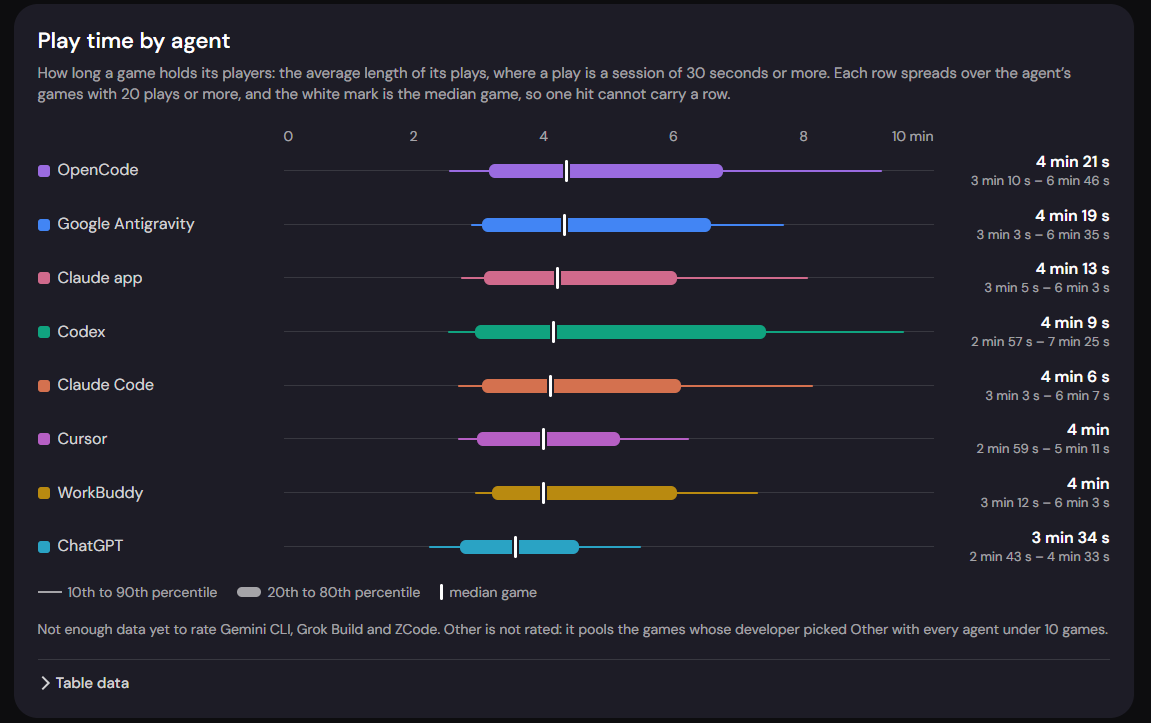
2) Most-used does not mean most-liked. Claude Opus ranks sixth of eight rated models on likes, at 39 per 1,000 plays against 65 for OpenAI Astra and 58 for OpenAI Sol. The same gap shows in the coding tools: the median Codex-built game earns 65 likes per 1,000 plays compared to 43 for Claude Code. All figures are for the median game, so one viral hit can’t carry an entire model.
3) OpenAI Astra leads on likes, but prices out builders. Astra tops the index with 65 likes per 1,000 plays and 4 min 58 sec of median play time. Yet its share of new builds fell from 11–17% in late September to just 4% in October.
4) DeepSeek and OpenCode outlast the giants on playtime. DeepSeek holds just 1.6% of the index, yet its median game keeps players for 4 min 32 sec, trailing only OpenAI Astra. Among coding tools, the open-source agent OpenCode is behind 1.6% of games but leads all rated tools on playtime at 5 min 14 sec.
“Look at the index as a thermometer, not a judge. A year ago, making a game required a team and months of work. Now, one person can build a game with an AI agent in one evening,” said Dmitry Kachmar, founder of Playgama. “What strikes me most is how quickly the picture changes. Sol replaced Astra in just two weeks. A model no one used in September leads the rankings in October. Every AI lab is shipping updates non-stop, and I expect the next release to redraw it. That’s why we’re updating the data every day.”
What comes next
Model versions change every few weeks, and the index will show each shift the day after it happens.
“You can use AI to ship viral hits, but you can just as easily build something nobody touches. AI speeds up development and cuts friction. For a pro, it naturally sharpens attention to detail. But that isn’t about the model or agent — it’s about the creator fine-tuning the game until it works. Production is no longer the filter. The winners will be those who can quickly test and separate games people play from games that simply exist, judging by real player behavior rather than juries or code checks.,” explained Dmitry Kachmar.
The index updates daily, offering a live view of how frontier models perform at building games by tracking real engagement, performance, and player feedback. Creators building with AI can enter the index simply by publishing to the Playgama Sandbox and tagging their model and agent. Games count toward overall market share from day one, and enter the playtime and like rankings as soon as they hit 20 plays.
About the company
Playgama is the nexus of web gaming, connecting developers, publishers, advertisers, and players. Its core services are trusted by 4,000+ game developers. In 2026, the company launched a suite of tools that lets AI agents analyze, refine, and update games on their own, along with Playgama Sandbox, a new environment for AI-built games whose data powers the AI Game Index.
Founded in 2023, Playgama raised $3M in venture funding in 2024. In 2025, it was a finalist at the Pocket Gamer Mobile Games Awards and the MENA Games Industry Awards. In 2026, Playgama was named to Deloitte’s Technology Fast 50 Rising Star list.







Comment