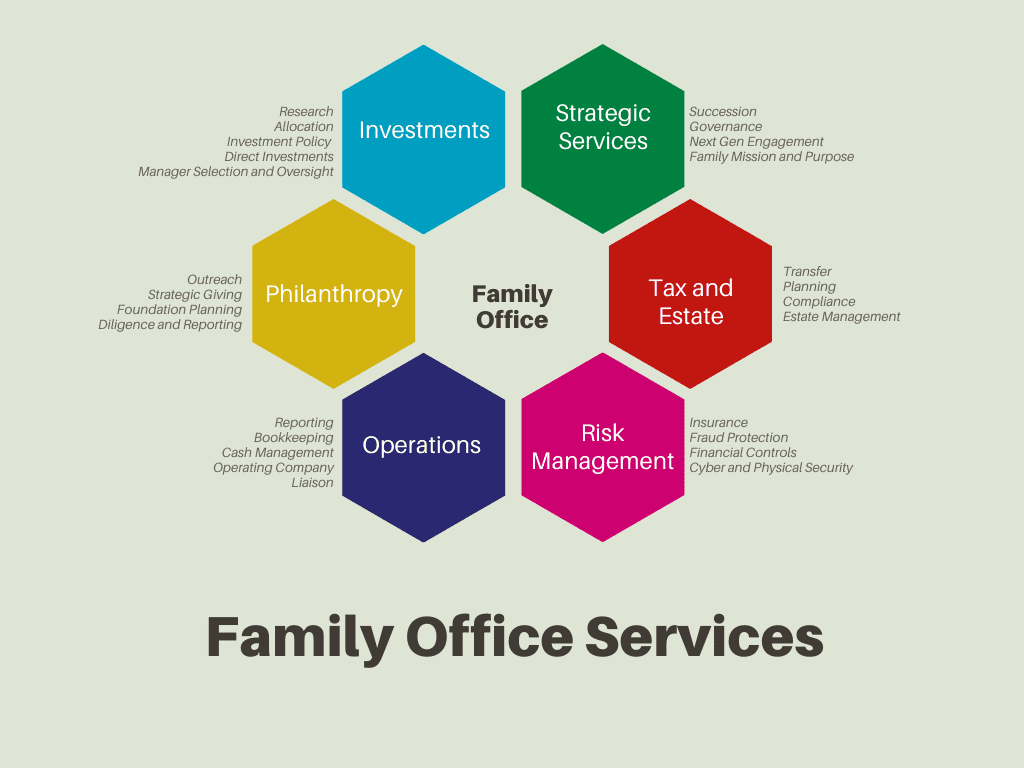
The term “family office services” is often used as shorthand for wealth management. In reality, it refers to a far broader ecosystem of advisory, operational and administrative support designed to serve the complex financial and personal needs of ultra-high-net-worth families.
Top-tier providers do far more than manage investments. They integrate advisory services, business services and specialist solutions across multiple disciplines, often spanning jurisdictions, asset classes and generations. Understanding what is typically included and what sits behind the scenes is essential for families considering professional support, as well as for advisers, candidates and counterparties working alongside family offices.
Below is a practical overview of what modern family office service providers actually deliver and what it takes to operate these services at a high standard.
Investment and Advisory Services
Investment oversight remains the most visible pillar of most family offices. This typically includes:
- Strategic asset allocation
- Portfolio construction across public and private markets
- Manager selection and due diligence
- Direct investments into private companies and real assets
- Consolidated performance and risk reporting
Unlike traditional wealth management, family office advisory services are usually tailored around long-term capital preservation, liquidity planning and intergenerational objectives rather than short-term performance.
Behind the scenes
Delivering this well requires more than a single adviser. Many top-tier providers rely on in-house investment leadership, supported by analysts, formal investment committees and robust reporting infrastructure. Data aggregation, reconciliations and technology platforms play a critical role in maintaining a clear, accurate view of global portfolios.
https://youtu.be/QVY1Q9xNlGA?si=s90uvIv0Fboz0oIW
Tax, Structuring and Estate Planning
Tax and structuring sit at the core of long-term wealth protection. Common services include:
- Cross-border tax coordination
- Trust and holding company design
- Estate and succession planning
- Business ownership and exit structuring
- Trustee and fiduciary oversight
As families operate across jurisdictions and asset classes, coordination between legal, tax and fiduciary advisers becomes increasingly complex.
Behind the scenes
This area depends on specialist external advisers alongside strong internal document management, compliance monitoring and entity administration. Without central oversight, even well-designed structures can become fragmented over time.
Governance and Family Advisory Services
As wealth transitions across generations, governance becomes just as important as technical planning. Modern family offices often support:
- Family charters and constitutions
- Family councils and governance committees
- Structured decision-making processes
- Conflict resolution frameworks
- Next-generation education and mentoring
These services help align family members around shared purpose and reduce the emotional risk that can undermine financial planning.
Behind the scenes
This work is usually led by a dedicated governance or family advisory lead, often supported by external facilitators. Reporting structures, meeting rhythms and clear documentation are essential to ensure governance remains active rather than symbolic.
https://youtu.be/PYHtf38Uz4A?si=zu1cNrRzIK20BCR7
Business and Administrative Services
The business services function is often described as the operational backbone of the family office. It typically covers:
- Accounting and bookkeeping
- Bill payment and cash management
- Payroll and employee administration
- Vendor management
- Property and estate administration
- Board support for operating companies
For families with multiple businesses, these administrative services often extend into management reporting and transactional support.
Behind the scenes
Controllers, operations managers and reporting teams carry much of the unseen workload in this area. Technology platforms increasingly support automation and data consistency, but human oversight remains critical. This is also where staffing and operational support decisions most directly affect risk and control.
It is common for families and multi-family offices to engage specialist advisers such as Cora Partners when strengthening these internal operational layers, particularly as complexity grows or structures evolve.

Lifestyle, Estate and Concierge Services
Beyond financial and business matters, many families require integrated lifestyle support. Typical services include:
- Travel coordination and global logistics
- Residential property oversight
- Household staff management
- Security planning
- Medical and wellbeing support
- Aviation, marine and specialist asset management
These services allow families to operate seamlessly across locations while maintaining privacy and control.
Behind the scenes
Lifestyle managers, estate managers and private support teams coordinate large networks of external providers. Discretion, reliability and rapid response capability are essential, particularly when services cross borders.
Philanthropy and Impact Services
Philanthropy has become a core service pillar for many modern family offices. This often includes:
- Foundation and donor-advised fund administration
- Impact investment strategy
- Grant-making governance
- Reporting and outcome measurement
- Long-term charitable planning
These services help families align capital with purpose and public responsibility.
Behind the scenes
Philanthropy teams combine governance, compliance, financial oversight and stakeholder engagement. Without proper structure, even well-intended giving programmes can become inefficient or misaligned with family values.
How Top-Tier Family Office Solutions Are Delivered
High-performing family office solutions are rarely delivered by a single firm operating in isolation. Instead, most top-tier providers operate through an integrated model that combines:
- A core in-house leadership team
- A trusted network of external legal, tax and fiduciary advisers
- Specialist operations and reporting platforms
- Clearly defined governance frameworks
Three broad delivery models are commonly used:
- Fully in-house single family office
- Outsourced or virtual family office
- Hybrid structures combining internal leadership with outsourced execution
The right model depends on asset complexity, geography, generational stage and the family’s appetite for control versus outsourcing.
Why Operational Depth Matters as Much as Strategy
Many families focus early attention on investment performance and structuring, but long-term resilience is often determined by operational depth. Weak reporting, unclear governance and under-resourced administration introduce hidden risk that may only surface during periods of stress, transition or intergenerational change.
As the family office sector continues to professionalise, the distinction between average and top-tier providers is increasingly defined by how well people, process and technology are aligned behind each service function.
Closing Perspective
Family office services now extend far beyond traditional wealth management. Today’s family office service providers operate at the centre of investment, governance, operations, lifestyle and legacy planning. For families evaluating their options, understanding both what is delivered and what it takes to deliver it properly is essential to building a structure that can endure across generations.