Hospitals that provide better patient experiences can earn net margins up to 50% greater than average performance, according to an Accenture study that examined U.S. hospital HCAHPS scores in conjunction with CMS margin data.
A patient experience platform transforms fragmented care into seamless journeys, blending innovative digital tools with data, workflows, and human-centered design for value-based, consumer-first healthcare.
What is a PEP, or Patient Experience Platform?
A true patient experience platform orchestrates the entire patient journey, from access and intake to care, billing, and follow-up, using patient experience improvement software to cut no-shows by up to 40% and improve patient satisfaction. Here’s a full guide on what patient experience platform is.
Patient Experience Platform vs. Engagement Tools, What is the difference?
At first glance, patient experience platforms and engagement tools can seem interchangeable, but they play very different roles in how a practice operates and how patients feel about their care.
A PEP orchestrates the experience, while engagement tools activate the patient within that experience.
Engagement improves communication. Experience improves outcomes, loyalty, and operations. Practices that rely only on engagement tools may improve touchpoints, but without a unified experience platform behind them, friction still shows up in workflows, service, and consistency.
The strongest patient strategies don’t choose one over the other; they use engagement tools as part of a broader patient experience platform that aligns people, processes, and technology around better care.
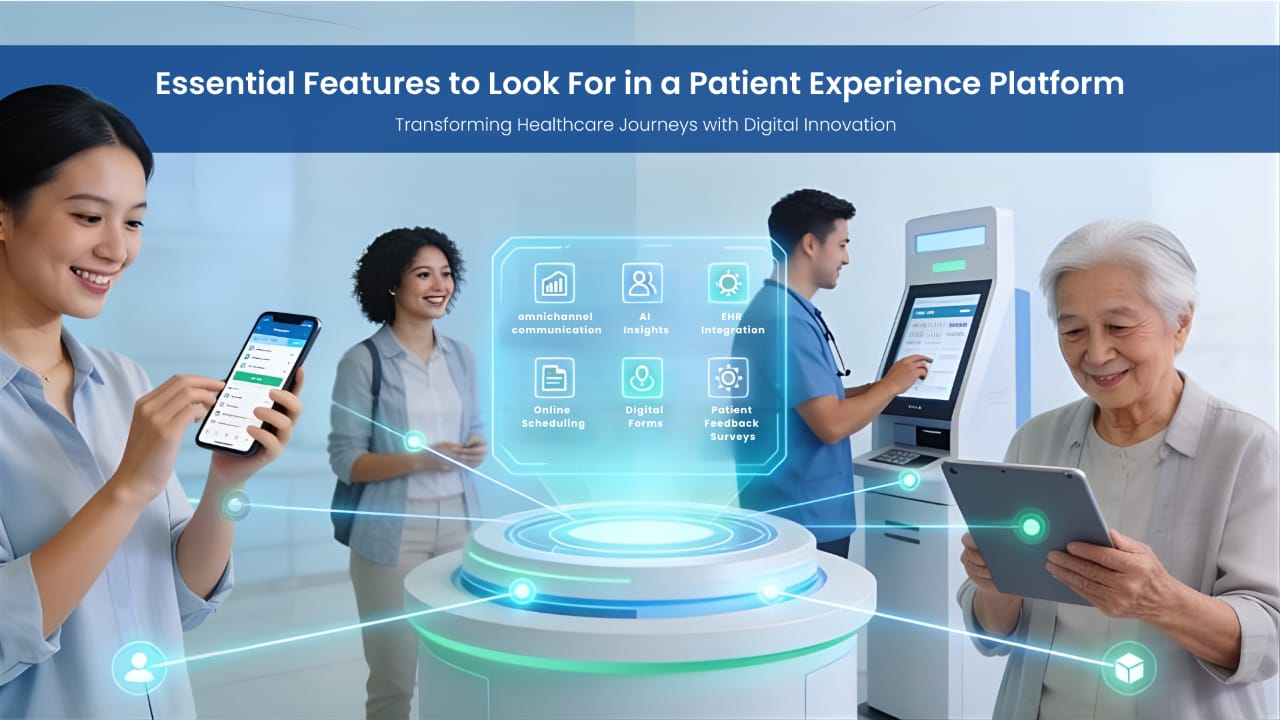
Core Capabilities Every Patient Experience Platform Must Have
Not all patient experience platforms are created equal, here’s what truly separates a patient experience platform from basic tools.
Omnichannel Communication & Self-Service
Imagine unified messaging via SMS, email, IVR, voice AI, and patient portals, your patient experience platform delivers 24/7 self-service access for inquiries.
Online scheduling (self-booking, cancellation & rescheduling), ASAP waitlists (for quick booking of an empty slot), kiosk check-in, and mobile check-in slash wait times.
Digital Intake & Real-Time Engagement
Multi-channel digital intake captures patient health data, insurance, photo ID, and runs eligibility checks with secure patient authentication.
A good patient experience platform also sends automated reminders, confirmations, reactivation nudges, multi-language messaging, and patient campaigns for real-time engagement that feels personal.
Interoperability & 360° Patient View
Deep integration with EHR, PMS, CRM and in-house systems via standards-based data exchange eliminates silos, your patient experience platform creates a unified patient timeline across visits.
This interoperability reduces duplication, with 20% better survival rates tied to such connected care per AHA data.
Personalization & AI-Driven Insights
Tailor education and care journeys with AI-driven insights that flag high-risk patients for proactive outreach.
Patient experience platforms use predictive analytics and automated follow-up to close gaps, personalizing every touchpoint.
Post-Visit Experience & Retention
Automated follow-ups, care summaries, patient feedback surveys, and loyalty workflows drive retention, your patient experience platform turns one-time visits into lifelong loyalty.
HFMA notes retaining patients costs 1/5th of acquiring new ones.
Innovative Features in Patient Experience Platforms
Telehealth and virtual visits embed seamlessly into patient experience software, alongside remote monitoring for continuous care. Real-time feedback, survey automation, and sentiment analytics capture the patient’s voice, while mobile-first design, multi-language support, and accessibility meet diverse needs—boosting HCAHPS scores up to 9 months faster.
Operational Must-Haves for Best Patient Experience Platforms
Flexible configuration, workflow automation, and low-code tools adapt your patient experience platform to specialties like dermatology or dental.
HIPAA/HITRUST compliance, robust security, and audit-ready reporting protect PHI amid CMS rules, with scalability ensuring 99.9% uptime for ROI.
PEP Health’s AI analysis of 25 million comments shows these drive targeted improvements.
How secure is my data when using Patient Experience Platform?
Patient experience platforms are highly secure when built to meet strict healthcare regulations like HIPAA and GDPR.
They use layered safeguards to protect sensitive patient data at every stage.
Information is encrypted both at rest and in transit, making it unreadable if intercepted.
Role-based access controls and multi-factor authentication limit data access to authorized users only.
Continuous monitoring and audit logs track system activity to detect threats early.
Secure APIs protect third-party integrations, while encrypted backups and disaster recovery plans ensure data availability.
Combined with staff training and compliance enforcement, these measures help keep patient data protected and trustworthy.
How to Evaluate Patient Experience Software Vendors
Ask: “How does your patient experience platform handle EHR/CRM integration, AI-driven insights, and analytics for KPIs like satisfaction or throughput?”
Compare patient experience management software by digital adoption rates (aim for 70%+), readmissions drops, and NPS lifts.
Take Demo of the selected top patient experience platforms like CERTIFY Health that goes beyond point solutions to deliver a truly unified patient experience platform. It connects every patient touchpoint like scheduling, intake, communication, payments, and feedback, into one seamless, secure journey.
Evaluation Criteria, Key Questions, Top KPIs to Track
| Evaluation Criteria | Key Questions to Ask | Top KPIs & Benchmarks |
| Integration & Interoperability | Does the patient experience platform sync bidirectionally with EHR, PMS, CRM for a unified patient timeline and standards-based data exchange? How fast is setup? | Data exchange speed (<5 min/update); Silo reduction (30-50%); No-show drop (25-40%) |
| AI & Personalization | How do AI-driven insights enable proactive outreach, personalization, and automated follow-up for high-risk patients? | High-risk flags accuracy (90%+); Engagement lift (35% via patient campaigns); NPS increase (10-20 pts) |
| Core Capabilities | Does it deliver omnichannel communication, self-service access (online scheduling, kiosk/mobile check-in), two-way messaging, digital intake, eConsents? | No-show reduction (30-50%); Satisfaction scores (85+/100); Digital adoption (70%+ patients) |
| Outcomes & Retention | Supports flexible configuration for my specialty (e.g., dental workflows, behavioral health)? Includes patient feedback surveys and loyalty tools? | Retention rate (20-30% uplift); Revenue per patient (+15-25%); Readmission drop (10-15%) |
| Security & Scalability | HIPAA/HITRUST compliant with patient authentication? Scalable for multi-location with low-code workflow automation? | Uptime (99.9%); PHI breach rate (0%); Time-to-value (<30 days) |
Conclusion
With 85% of patients today expecting digital-first care, future-proof your clinic with a patient experience platform like CERTIFY Health that excels in interoperability, automation, and customizable setup.
Audit your stack against these core capabilities, prioritize patient experience improvement software with proven ROI, and shortlist demos today.
To digitize journeys and see an increase in patient satisfaction, get a demo of the best patient experience platform.