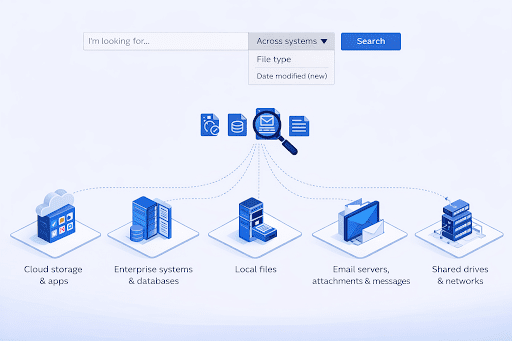
In today’s data-driven enterprises, information is scattered across documents, databases, applications, and collaboration tools. Finding the right insight at the right time has become a strategic necessity rather than a convenience. This is where an enterprise search engine plays a critical role—helping organizations unify, search, and retrieve knowledge across their digital ecosystem with speed, accuracy, and context.
As enterprises scale and data volumes grow exponentially, traditional search tools fall short. Modern enterprise search solutions, powered by AI and large language models (LLMs), are redefining how employees interact with organizational knowledge and make informed decisions.
What Is an Enterprise Search Engine?
An enterprise search engine is a centralized search system designed to index and retrieve information from multiple internal data sources, such as documents, emails, knowledge bases, CRMs, ERPs, data warehouses, and cloud platforms. Unlike consumer search engines, enterprise search focuses on security, access control, contextual relevance, and domain-specific understanding.
Modern solutions go beyond keyword matching. They understand intent, semantics, and relationships between data points, enabling users to ask natural language questions and receive precise, contextual answers instead of long lists of documents.
Why Traditional Enterprise Search No Longer Works
Fragmented Data Silos
Most organizations operate with disconnected systems. Information stored in PDFs, spreadsheets, databases, and SaaS tools is rarely indexed together, making discovery slow and inefficient.
Keyword-Based Limitations
Legacy search relies heavily on exact keyword matches. This approach struggles with synonyms, acronyms, and complex queries, leading to missed insights and irrelevant results.
Lack of Context and Intelligence
Traditional search engines retrieve data but do not interpret it. They fail to understand relationships, summarize content, or provide actionable answers—forcing users to manually analyze results.
How AI-Powered Enterprise Search Engines Add Value
AI-driven enterprise search engines are designed to overcome these limitations by combining semantic search, vector databases, and generative AI.
Semantic and Context-Aware Search
Instead of matching keywords, semantic search understands the meaning behind queries. This allows users to search using natural language and still receive highly relevant results, even when exact terms differ.
Unified Knowledge Access
An enterprise search engine connects to structured and unstructured data sources, creating a single layer of access across the organization. Employees no longer need to know where information is stored—they simply search and retrieve it.
Intelligent Answer Generation
By leveraging LLMs, modern enterprise search tools can generate concise answers, summaries, and insights directly from enterprise data, significantly reducing research time.
Key Capabilities of a Modern Enterprise Search Engine
Secure and Role-Based Access Control
Enterprise search must respect existing permissions and compliance requirements. Results are filtered based on user roles, ensuring sensitive data is only accessible to authorized users.
Real-Time Indexing and Updates
Business data changes constantly. Advanced search engines continuously index updates, ensuring users always access the most current and reliable information.
Source Traceability and Transparency
For enterprise trust, it’s essential to know where information comes from. Leading solutions provide source-level traceability, allowing users to verify answers against original documents.
Enterprise Search in Action: Business Use Cases
Knowledge Management and Employee Productivity
Employees spend a significant portion of their time searching for information. An intelligent enterprise search engine reduces this friction, enabling faster onboarding, better collaboration, and higher productivity.
Decision Support for Leadership Teams
Executives and managers can query enterprise data in natural language to access insights across finance, operations, and strategy—without relying on multiple reports or dashboards.
Customer Support and Operations
Support teams can instantly retrieve policies, product documentation, and historical cases, improving response times and service quality.
Introducing ZSearch: A Modern Enterprise Search Solution
A standout example of next-generation enterprise search is ZSearch, an AI-powered search solution developed by ZBrain. ZSearch extends traditional search capabilities by unifying data from multiple platforms such as Google Drive, SharePoint, Slack, Jira, GitHub, and local file systems — offering a single, intelligent portal for knowledge discovery.
What Makes ZSearch Powerful?
Secure, Context-Aware Search
ZSearch enforces security and access permissions end-to-end, ensuring that users see only what they’re authorized to view. This level of protection is essential for compliance-sensitive industries such as healthcare, finance, and legal.
Seamless Integrations
ZSearch comes with ready-to-use connectors for popular business systems, making it simpler to pull in data from disparate repositories without custom development work.
Natural Language Queries
With NLP and semantic capabilities, ZSearch enables users to search in everyday language — eliminating the need for technical query syntax and empowering non-technical team members.
Centralized Knowledge Access
ZSearch delivers a unified search interface across all sources, which eliminates data silos and brings information from across the enterprise into a single searchable space.
Choosing the Right Enterprise Search Engine
When evaluating an enterprise search engine, organizations should consider:
- Data source compatibility:Ability to connect with diverse enterprise systems
- AI and semantic search capabilities:Support for natural language and contextual understanding
- Security and compliance:Strong access controls and auditability
- Scalability:Performance across growing data volumes
- Explainability:Clear traceability to source documents
A well-designed enterprise search engine is not just a productivity tool—it becomes a strategic asset that enhances knowledge flow, decision-making, and operational agility.
Final Thoughts
As enterprises continue to generate and rely on vast amounts of data, the ability to quickly find, understand, and trust information is mission-critical. AI-powered enterprise search engines are redefining how organizations interact with their knowledge, breaking down silos and enabling smarter, faster decisions.
By adopting a modern enterprise search approach—one that integrates semantic understanding, AI-driven insights, and secure access—organizations can unlock the full value of their data and gain a sustainable competitive advantage in the digital era.