Introduction
Large industrial tanks may develop sediment, temperature differences, and uneven composition during storage. These conditions can complicate transfer, cleaning, and downstream processing.
An energy-efficient side-entry mixer creates directed fluid movement from the tank wall. Efficient large storage tank mixing depends on the correct impeller, speed, position, materials, and operating schedule—not simply a larger motor.
B2B buyers should define tank size, liquid properties, solids, mixing purpose, maintenance access, sealing, and electrical requirements before comparing quotations. This helps them evaluate performance, operating cost, and supplier capability more accurately.
What Is a Side-Entry Mixer and How Does It Work?
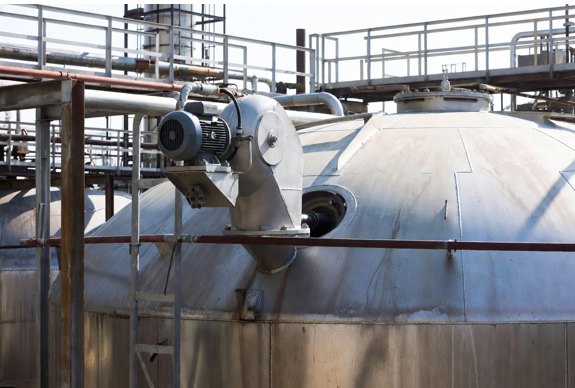
A side-entry mixer is an industrial tank agitator installed through the side wall of a storage or process tank. The motor and drive remain outside, while the shaft and impeller extend into the liquid.
The rotating impeller generates flow across the vessel to blend liquid layers, improve heat transfer, keep particles moving, or reduce settling. Fixed-angle models maintain one direction, while swivel-angle designs redirect circulation.
Typical applications include petroleum products, lubricants, asphalt, chemicals, additives, and desulfurization slurry.
Why Large Industrial Tanks Need Continuous Mixing
Storage does not mean the liquid remains uniform. Density differences, cooling, solids, and long holding times can create stratification or sediment. When the tank is discharged, the delivered material may not have a consistent composition.
Continuous or scheduled mixing can maintain uniformity, reduce temperature differences, keep selected particles moving, support consistent transfer, and limit tank-bottom deposits.
Not every process requires nonstop operation. Some tanks need mixing only before transfer. Defining the duty cycle early helps determine motor load, controls, bearing requirements, and expected energy use.
How Side-Entry Mixers Reduce Energy Consumption
Energy efficiency depends on how effectively electrical input becomes useful fluid motion. An oversized motor or unsuitable impeller may consume more power without improving circulation.
An energy-efficient industrial mixer should match the actual process duty. Key measures include selecting the right impeller diameter, using an appropriate axial-flow pattern, positioning the unit to reduce dead zones, and avoiding unnecessary full-speed operation. A variable-frequency drive may help when the process requires different operating speeds.
The U.S. Department of Energy notes that better motor-system management and energy-efficient equipment can produce meaningful energy and cost savings. The complete drive and operating strategy therefore matter more than the motor label alone.
Improving Fluid Circulation in Large Storage Tanks
Effective tank mixing requires movement throughout the useful liquid volume, not only around the impeller. A correctly positioned side-entry agitator sends flow across the vessel and encourages broader circulation.
Internal coils, columns, pipes, and changing liquid levels can interrupt flow. Large or obstructed tanks may require multiple mixers arranged as one system.
Buyers should provide drawings showing dimensions, liquid levels, internals, nozzles, and mounting positions. This supports a practical flow proposal instead of selection by tank volume alone.
How Side-Entry Mixing Prevents Sediment Buildup
Sediment develops when particles or heavier components settle faster than the surrounding flow can keep them moving. Accumulation can reduce usable tank volume, lengthen cleaning shutdowns, and cause inconsistent discharge.
A side-entry mixer can maintain bottom movement and direct flow toward areas where deposits are likely to form. Swivel-angle configurations may help operators change the flow direction across the floor. Mixing equipment used for tanks containing solids should be designed both to blend the contents and prevent unwanted deposition.
Buyers should clearly state whether they need complete suspension, off-bottom movement, or only reduced accumulation. Particle size, solids concentration, density, viscosity, and operating time all affect the required design.
Reducing Operating Costs Through Efficient Mixer Design
Initial price is only one cost. Electricity, seals, bearings, cleaning, spare parts, and downtime may matter more over the mixer’s working life.
A buyer-focused review should examine:
- Annual operating hours
- Motor efficiency at normal load
- Seal type and replacement access
- Lubrication and inspection points
- Availability of wear parts
- Whether servicing requires an empty tank
- Installation and commissioning needs
This reflects a broader principle of industrial procurement: equipment should be matched to application conditions and evaluated by total cost of ownership, not price alone. TechBullion’s guide to long-term equipment reliability also emphasizes application fit, maintenance, documentation, and supplier support.
The Role of Impeller Design in Mixing Performance
The impeller converts shaft rotation into fluid movement. Its diameter, blade shape, pitch, and speed influence flow, shear, torque, and power demand.
Axial-flow impellers are commonly considered when the main objective is high-volume circulation in a large tank. However, an oil storage tank agitator, chemical tank mixer, and wastewater tank mixing system may require different flow characteristics.
Wetted-part materials must also suit the liquid, operating temperature, corrosion risk, and abrasion level. Buyers should provide accurate process data rather than requesting stainless steel without specifying the grade or chemical environment.
Applications in Oil, Chemical, Asphalt, and Water Treatment Industries
Side-entry mixers support different operating goals:
Oil and Fuel Storage
They can promote homogenization, support temperature distribution, and reduce bottom accumulation before transfer.
Chemical Processing
They may maintain stored-liquid consistency, assist blending, or improve heat transfer. Material compatibility and seal selection require close attention.
Asphalt and Heavy Liquids
Higher viscosity can increase torque demand and change the required impeller, speed, drive, and operating temperature limits.
Water and Wastewater Treatment
Mixing may support equalization, solids movement, or sediment prevention. The supplier needs solids content and the required process result.
One standard configuration cannot serve every application. Selection must begin with the fluid and tank conditions.
Side-Entry Mixers vs Top-Entry Mixers for Large Tanks
Both configurations are useful, but they solve different installation and process challenges.
| Evaluation point | Side-entry mixer | Top-entry mixer |
| Mounting | Tank wall | Tank roof or support bridge |
| Typical advantage | Directed circulation and floor movement | Flexible mixing in process vessels |
| Shaft | Usually shorter | Can be long in deep tanks |
| Structural need | Side nozzle and reinforcement | Roof or bridge support |
| Access | External side access | Depends on roof platform |
| Selection focus | Flow direction and tank coverage | Shaft stability and impeller level |
When comparing a top-entry vs side-entry mixer, buyers should consider tank structure, liquid-level changes, internals, maintenance access, and the required flow pattern—not equipment price alone.
How to Select the Right Side-Entry Mixer for an Industrial Tank
A useful inquiry should include:
- Tank diameter, height, shape, and usable volume
- Minimum, normal, and maximum liquid levels
- Liquid name, density, viscosity, and temperature
- Solids percentage, particle size, and settling behavior
- Mixing objective and required operating schedule
- Wetted-part material and corrosion requirements
- Hazardous-area, motor, seal, voltage, and frequency requirements
- Drawings of internals, nozzles, and mounting restrictions
International buyers should also confirm drawings, inspection documents, spare-parts lists, manuals, packing, delivery terms, and installation responsibilities. When comparing Chinese manufacturers, request a technical proposal explaining the chosen configuration rather than accepting only a price sheet.
Buyers reviewing side-entry mixer options can use this data list to prepare a clearer request for quotation.
The Future of Energy-Efficient Industrial Mixing Technology
Industrial mixing technology is moving toward better control and maintenance planning. Variable-speed operation can match output to changing process conditions. Sensors may monitor vibration, bearing temperature, motor current, or seal condition, helping teams identify abnormal trends earlier.
Simulation tools can help engineers study circulation, dead zones, and placement before installation, although accurate tank and fluid data remain essential.
TechBullion has discussed how smart mixing technologies support energy management, process control, and consistency. For side-entry systems, the practical goal is to use data and controls to achieve the required result with less waste and more predictable maintenance.
Frequently Asked Questions
- Can one side-entry mixer handle any large tank?
No. The required number depends on tank dimensions, liquid level, viscosity, solids, internal obstructions, and the desired flow pattern.
- Is a larger motor always more effective?
No. Oversizing can raise energy and purchase costs. Impeller design, speed, position, and flow direction are equally important.
- Can side-entry mixing completely eliminate sediment?
It can reduce or prevent accumulation when correctly selected, but performance depends on particle and liquid properties. Buyers must define the required suspension level.
- Which information is essential for a quotation?
Tank dimensions, liquid density and viscosity, temperature, solids data, mixing objective, materials, liquid levels, and duty cycle are essential.
- Can these mixers be used in hazardous areas?
Suitable configurations may be available, but the buyer must specify area classification, motor protection, sealing requirements, and applicable standards.
- What should overseas buyers confirm before shipment?
Confirm approved drawings, materials, motor data, inspection records, spare parts, manuals, packaging, delivery terms, and installation responsibilities.
Conclusion
Energy-efficient side-entry mixers can improve large industrial tank operations by creating useful circulation, limiting sediment, supporting uniformity, and reducing avoidable power and maintenance costs. The strongest results come from application-specific selection rather than choosing by motor size or price.
Procurement managers, contractors, distributors, engineering companies, and plant operators should provide complete process data and compare suppliers on technical reasoning, materials, maintainability, documentation, and export support.
For product details, customization, technical support, or a project quotation, buyers can contact KEHENG Mixers with their tank drawing and operating information.