
Electronic Components Sourcing: A Practical Guide to Reliable Procurement

In the fast-paced electronics manufacturing industry, the efficiency of an assembly line is directly tied to the stability of its supply chain. Poor procurement strategies can lead to severe production bottlenecks, counterfeit risks, and inflated costs that erode profit margins. This is where strategic electronic components sourcing becomes a critical competitive advantage for manufacturers and engineering teams. This guide explains how businesses can source electronic components more efficiently, build a resilient electronic components supply chain, and mitigate common purchasing risks.
Why Reliable Electronic Component Sourcing Matters
Securing reliable channels for electronic component procurement is not merely about negotiating the lowest unit price, but it is about protecting the integrity of the final product and maintaining production continuity. Sourcing from unverified or volatile suppliers introduces significant operational risks:
- Counterfeit or unauthorized components: Parts with uncertain origins may fail to meet required specifications or reliability standards.
- Inconsistent quality: Components from different sources may have different manufacturing histories, storage conditions, or quality levels.
- Unexpected lead times: Inaccurate availability information can cause production schedules to shift.
- Higher total costs: A lower unit price may be offset by testing, rework, delays, or emergency purchases.
- Supply chain disruption: Dependence on a single source can make procurement more vulnerable when demand or supply conditions change.
How to Source Electronic Components?
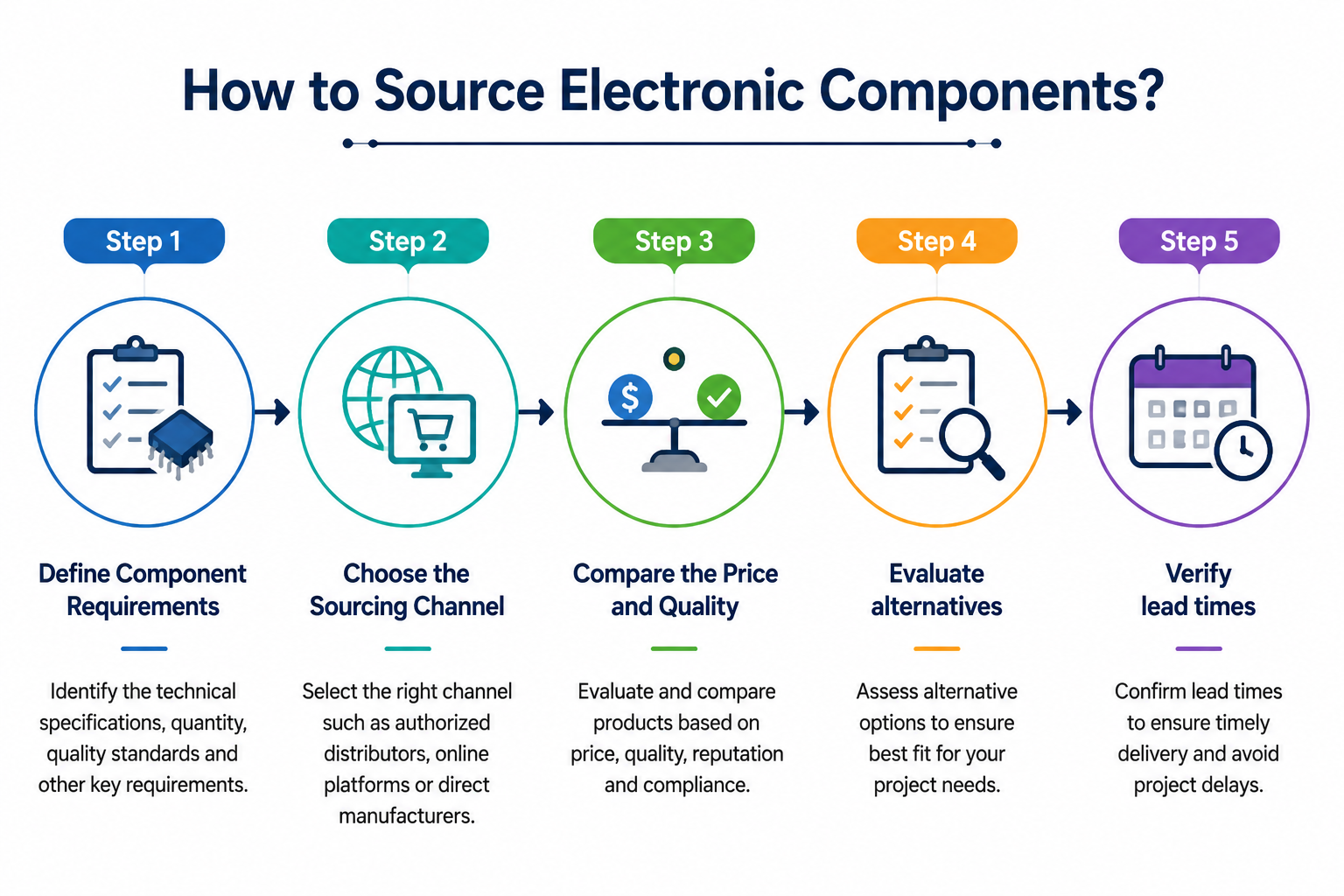
A structured procurement process ensures you receive the right parts, at the right time, and to the correct specifications. Follow these five essential steps:
Step 1: Define Component Requirements
Before contacting suppliers, ensure your Bill of Materials (BOM) is comprehensive and accurate. Important information may include:
- Manufacturer and manufacturer part number (MPN)
- Component type and specifications
- Package and dimensions
- Required quantity
- Required certifications or compliance standards
- Target application
- Required delivery date
- Acceptable alternative or equivalent parts
A complete BOM can also make the sourcing process more efficient, particularly for projects involving multiple component categories. Clear requirements reduce the risk of purchasing an incompatible part simply because it appears similar.
Step 2: Choose the Sourcing Channel
Select the appropriate supplier tier based on your current need. Options typically include:
- Direct Manufacturers (OCMs): Best for high-volume, long-term scheduled orders, but often require massive Minimum Order Quantities (MOQs).
- Authorized Distributors: Reliable for standard stock, but limited to the specific brands they franchise.
- Independent Electronic Distributor: The most flexible option for spot inventory, obsolete parts, small-batch procurement, and resolving urgent shortages across multiple brands globally.
The key is to select the channel based on the actual sourcing requirement rather than relying on a single procurement model for every project.
Step 3: Compare the Price and Quality
Price is an important factor, but it should be evaluated together with component quality and supplier reliability.
When comparing quotations, several factors should be considered:
| Factor | What to Check |
| Unit price | Whether the quotation is competitive for the required quantity |
| Component condition | New, factory original, excess, refurbished, or other status |
| Date code | Whether the manufacturing date meets project requirements |
| Packaging | Whether original and appropriate packaging is provided |
| Traceability | Whether the component’s source and history can be verified |
| Testing | Whether inspection or testing is available when required |
| Warranty/return terms | How quality issues are handled |
A supplier offering the lowest price may not provide the lowest overall procurement cost if additional inspection, replacement, or production delays become necessary.
Step 4: Evaluate Alternatives
When primary components are out of stock or marked as End-of-Life (EOL), hardware teams must pivot quickly. Work with technical support teams or your distribution partner to identify Form-Fit-Function (FFF) alternatives. Cross-referencing components can bypass long factory lead times without requiring a complete PCB redesign.
Step 5: Verify Lead Times
Always confirm real-time stock availability versus advertised lead times. Ask suppliers if the inventory is in-house (spot stock) or subject to back-to-back ordering from another source. Buffer stock strategies and scheduled kitting deliveries can help absorb unexpected market volatility.
Summary Comparison: Sourcing Challenges vs. Practical Solutions
The table below outlines common procurement bottlenecks and actionable strategies to overcome them.
| Sourcing Challenge | Primary Root Cause | Practical Actionable Solution |
| Counterfeit or questionable parts | Unclear supplier and component origin | Verify supplier credibility, traceability, packaging, and testing records |
| Long or uncertain lead times | Limited inventory or inaccurate availability information | Expand the vendor network to include independent distributors with access to global spot market inventory. |
| High procurement costs | Overreliance on unit price or limited supplier comparison | Partner with distributors that offer flexible BOM kitting and accommodate small-batch R&D procurement. |
| Obsolete components | Product discontinuation or lifecycle changes | Search independent distribution channels and evaluate qualified alternatives |
| Small-order difficulties | Minimum order quantities or limited distributor support | Work with suppliers that support small-batch procurement |
| Production disruption | Dependence on a single sourcing channel | Develop multiple sourcing options for critical components |
These actions can make electronic components supply chain management more resilient, particularly when procurement teams must balance cost, quality, availability, and technical requirements at the same time.
How Mayhwa Supports More Efficient Electronic Components Sourcing
For businesses looking to optimize their supply chain, Mayhwa operates as an independent electronic component distributor and global sourcing partner. Serving stringent industries such as automotive, medical, energy, and industrial automation, Mayhwa provides structured support to resolve procurement bottlenecks.
By prioritizing quality control and leveraging in-house X-ray inspection, and ESD-controlled warehousing, Mayhwa ensures component traceability and authenticity. It also supports procurement teams with three core advantages:
- Sufficient Inventory: With warehouses in Shenzhen and Hong Kong housing over 3,000 SKUs, Mayhwa maintains a robust stock of integrated circuits, MLCCs, connectors, and other critical parts to quickly resolve urgent shortages.
- Competitive Pricing: By connecting clients with a network of over 2,000 global suppliers and sourcing directly from factories and top-tier channels, Mayhwa helps lower overall procurement costs through smart BOM matching.
- Short Delivery Times: The company’s agile infrastructure and deep spot inventory allow for rapid fulfillment, helping EMS and OEM clients eliminate line-down emergencies and maintain steady production schedules.

FAQs
1. What are the main risks in electronic components sourcing?
The primary risks include encountering counterfeit or substandard components, extreme price volatility during market shortages, and extended lead times that cause production delays. Lack of traceability and poor supplier communication can also lead to wrong parts being delivered.
2. What factors should be considered when sourcing electronic components?
Procurement professionals should evaluate the supplier’s quality control procedures (such as incoming inspection capabilities), component traceability, lead times, total landed cost, and the supplier’s track record in resolving post-sale technical issues.
3. How can hard-to-find or obsolete electronic components be sourced?
When parts are EOL or on allocation, the most effective strategy is to partner with a reputable independent distributor. These distributors leverage global networks and excess inventory channels to locate authentic stock that authorized channels no longer carry.
4. What is the difference between an authorized distributor and an independent distributor?
An authorized distributor has a formal franchise agreement with specific component manufacturers to sell their products. An independent distributor is not tied to specific brands, allowing them to source globally across the open market to find available inventory, hard-to-find parts, and offer more flexible pricing and quantities.
Conclusion
A structured electronic component procurement process can reduce supply risks while improving purchasing efficiency. When standard channels cannot meet requirements, an experienced independent electronic distributor can provide additional sourcing options, particularly for urgent, small-batch, obsolete, or hard-to-find components.
To build a more resilient supply chain and ensure uninterrupted production, consider evaluating your current processes and partnering with reliable distributors like Mayhwa, capable of providing verifiable quality and agile delivery.







Comment