
EDCAPIT Founder Oleh Podobied: From Hiring Challenges to EdTech


Now based in Silicon Valley, the Ukrainian entrepreneur is drawing on his experience in real estate, recruitment and software to build EDCAPIT. His next ambition is to connect online learning with employers.
For Oleh Podobied, education became a business opportunity while he was trying to solve a staffing problem. Running a real-estate company in Ukraine, he kept meeting applicants whose experience did not match the work his team needed them to do. His response was to organize training around the company’s own operations — and eventually offer it to people outside the business.
Years later, that experience sits behind EDCAPIT, the American education platform he now leads from the San Francisco Bay Area. The company brings independent instructors and learners together and is developing a Career Center intended to connect training with employers. For Podobied, it is the latest stage of a career spent building businesses, recruiting teams and turning practical knowledge into commercial services.
By his own count, he has started 18 businesses and projects, ranging from mobile coffee outlets and entertainment ventures to real estate, recruitment and technology. Several grew into organizations with departments and hired managers.
Learning to build an organization
IZIHouse, the real-estate business Podobied began developing in 2017, was a turning point. He describes it as his first company with an office and a management structure beyond himself. At different points, he says, it involved as many as 40 people, with department heads and an appointed director.
Managing that team meant learning when to delegate and when to change leaders. During a crisis, he recalls, his two business partners wanted to close the company.
He chose to continue after they left. In his account, he reorganized the business, changed department leadership and replaced its director, restoring operations before the pandemic brought another financial shock. He took on debt to cover expenses and spent roughly a year and a half working his way out.
Podobied says he repaid the debts and returned to profitability by 2021. “Education was part of what helped me climb out of debt,” he recalls in a written response. Training originally developed for employees had become a service that other people would pay for.
The practical model had begun in 2019 with internal online training for real-estate agents. In 2020, he opened it to the wider market. Recruits could study remotely and then join a team supervised by a manager, which, he says, helped the agency recruit across major Ukrainian cities without requiring everyone to come into one office.
From a real-estate agency to an IT group
When Podobied founded ITCAPITAL in Ukraine in 2020, the immediate business was software development and automation. Its services included websites, mobile applications and tools for business operations. The company’s published history records the subsequent expansion into ITCAPITAL School, an investment initiative and charitable activity in 2021.
Selling software services to international customers brought another staffing decision. Experienced salespeople were expensive for a young company, Podobied says, so the team developed training for newcomers who wanted to sell IT services. The approach applied something he had already learned in real estate: preparing people for a defined role could become part of how a company grew.
ITCAPITAL School broadened that activity beyond one sales course. Working with specialists from his businesses, he developed programs covering recruitment, starting an IT company, selling educational products and other practical subjects. The education operation became a business line alongside software services, drawing on the work of the wider group.
Podobied estimates that around 100 people worked across the wider ITCAPITAL operation at its peak, including contractors, freelancers and the sales team. He puts participation in the earlier real-estate and IT schools at several thousand people, some attending free and others paying.
The company’s seed presentation puts the number who subsequently moved into internships or work through the two training programs at roughly 800. That figure combines internships and jobs across the earlier businesses. It describes the model he wants to extend to other employers through EDCAPIT’s planned Career Center.
His recruitment business, IZIiChar, added experience from the employer’s side: identifying candidates and understanding what a role required. Taken together, the businesses exposed him to three connected needs—finding people, preparing them and organizing the work they would perform. That combination helps explain why his education strategy now extends beyond selling access to lessons.
Rebuilding the model in the United States
Russia’s full-scale invasion of Ukraine in 2022 disrupted that trajectory. Podobied says some businesses had to close, and he later relocated to the United States. ITCAPITAL USA INC., incorporated in New York in 2023, provided an American base for his technology and education activities.
The EDCAPIT brand followed in 2024. A separate Delaware corporation, EDCAPIT, Inc., was formed in January 2026. The name stands for Education Capital: the idea that knowledge and skills are assets people can continue developing. The business model also widened, from programs built within Podobied’s companies to a marketplace where independent specialists could teach.
In a Russian-language interview with journalist Viktoria, published on EDCAPIT’s channel, he describes the platform’s origins and the challenges of building an education business in the United States.
EDCAPIT initially focused on Russian-speaking learners, including immigrants navigating work and business in the United States and Canada. Its catalog now includes courses taught in Russian and Ukrainian, with subjects ranging from professional training to creative skills.
According to company figures dated October 30, 2026, EDCAPIT had 208 courses in total, including 168 published and 40 in preparation. It reported approximately 220 authors in its wider network. The catalog spans professional and business training as well as creative and practical subjects.
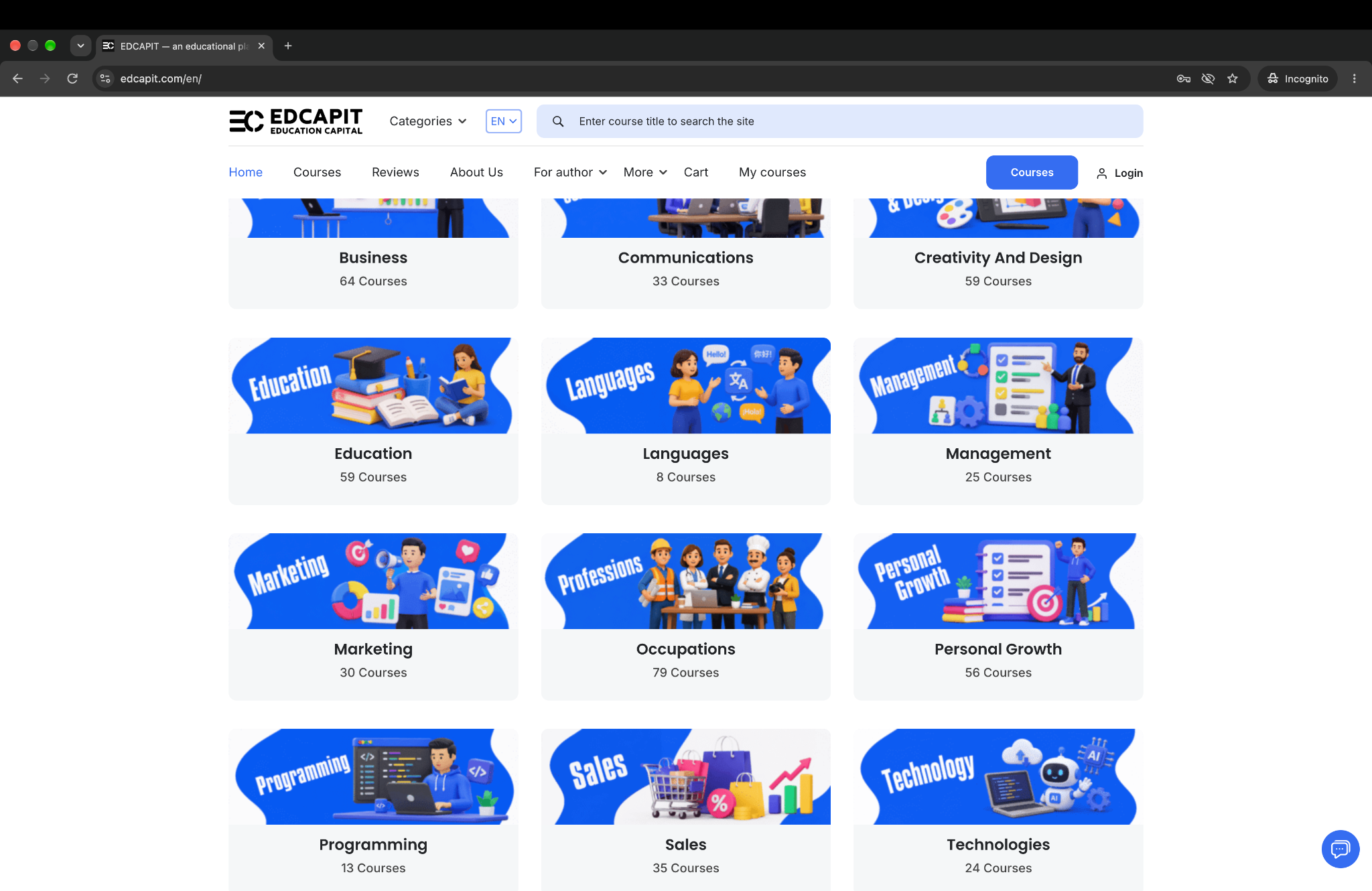
Course categories on EDCAPIT’s English-language interface. Screenshot supplied by EDCAPIT.
EDCAPIT’s business model centers on a share of course sales. Its published standard terms allocate 67% of receipts, after applicable taxes, to the instructor and 33% to the platform. The model links the company’s revenue to whether instructors can attract paying learners.
That creates a different management task from running an internal school. Independent authors choose what to teach, while students decide where to spend their money and time. Podobied’s role as CEO now includes coordinating those interests while developing the employer relationships needed for the next stage.
In February 2026, the company named entrepreneur Mukhitdin Khayrullaev as an investor and adviser. It reported a SAFE investment with a $20 million valuation cap, which governs future conversion into equity. The public announcement did not disclose the investment amount.
Connecting education with a changing labor market
The next part of Podobied’s plan is a Career Center through which learners could present their skills, prepare for interviews and connect with employers. He says development and discussions with potential partners are underway.
The intended relationship has three participants. Students would gain a route to employers; hiring companies would gain access to candidates with relevant preparation; instructors could adapt programs to actual business needs. Learners are EDCAPIT’s main customer group today, while employer services and additional tools for authors form part of its future monetization plans.
AI already has a role on the platform. Podobied says its assistant helps prospective students understand courses, supports learners during study and answers instructors’ questions.
A 2025 International Labour Organization study estimated that one in four workers globally is in an occupation with some exposure to generative AI. Its authors identified changes to jobs as the most likely effect, since many tasks still require human input. That creates a substantial challenge for education businesses: helping people update useful capabilities throughout a working life.
The difference from his earlier schools is who makes the hiring decision. At IZIHouse and ITCAPITAL, Podobied’s companies helped define the training and could bring graduates into teams led by their own managers. On an open platform, outside employers decide which skills matter and what evidence they will accept.
That makes employer participation central to the next stage of the business. To develop the Career Center, the company will need to connect particular courses with particular roles, then track what happens after an introduction to an employer. Those outcomes remain to be established as the service is developed.
A broader technology ambition in Silicon Valley
In Palo Alto, Podobied has taken the EDCAPIT pitch to the GGW Sharks event; he has also presented it at Hacker Dojo. As a startup judge, he has evaluated other founders’ ideas, including at a youth AI pitch event in Santa Clara. Those activities place him on both sides of the pitch: explaining his own business and assessing how others intend to build theirs.

Oleh Podobied serving as a judge at the Youth AI Startup Mentor Program Pitch Day in Santa Clara. Photograph supplied by Oleh Podobied.
His interest in robotics predates the venture initiative. In 2023, he began developing Roboasis, a marketplace project for robotics products and solutions. It extended his experience of service businesses into a market connecting technology suppliers with potential customers.
In 2026, he founded ITCAPITAL Ventures and became its president, focusing on Physical AI and robotics—technologies that bring artificial intelligence into machines and real-world operations. He describes its current work as reviewing startup pitches and developing relationships between founders and investors. It is a separate venture initiative alongside his operating role at EDCAPIT.
The two ventures reflect related interests: helping people adapt to changing work and supporting the companies developing new technology. In a conversation with Jenny Li, founder of GES Ventures, published on EDCAPIT’s channel, Podobied discusses the financing of education startups and how AI may change learning.
Choosing the business he wants to build
Asked which EDCAPIT decision matters most to him, Podobied looks beyond the choices that fill a CEO’s day. “The best decision was to launch this platform,” he says in a written response. He describes education as a way to contribute to people’s development and hopes that the planned career service can eventually make professional transitions easier for millions.
Education had helped Podobied rebuild his own business. EDCAPIT’s next test is whether that experience can translate into opportunities across companies he does not control. Employers would have to recognize the preparation its courses provide and choose to hire the people completing them.







Comment