
Duct Sealing and Duct Cleaning in Queens: Fixing the Ductwork Before Replacing the Furnace

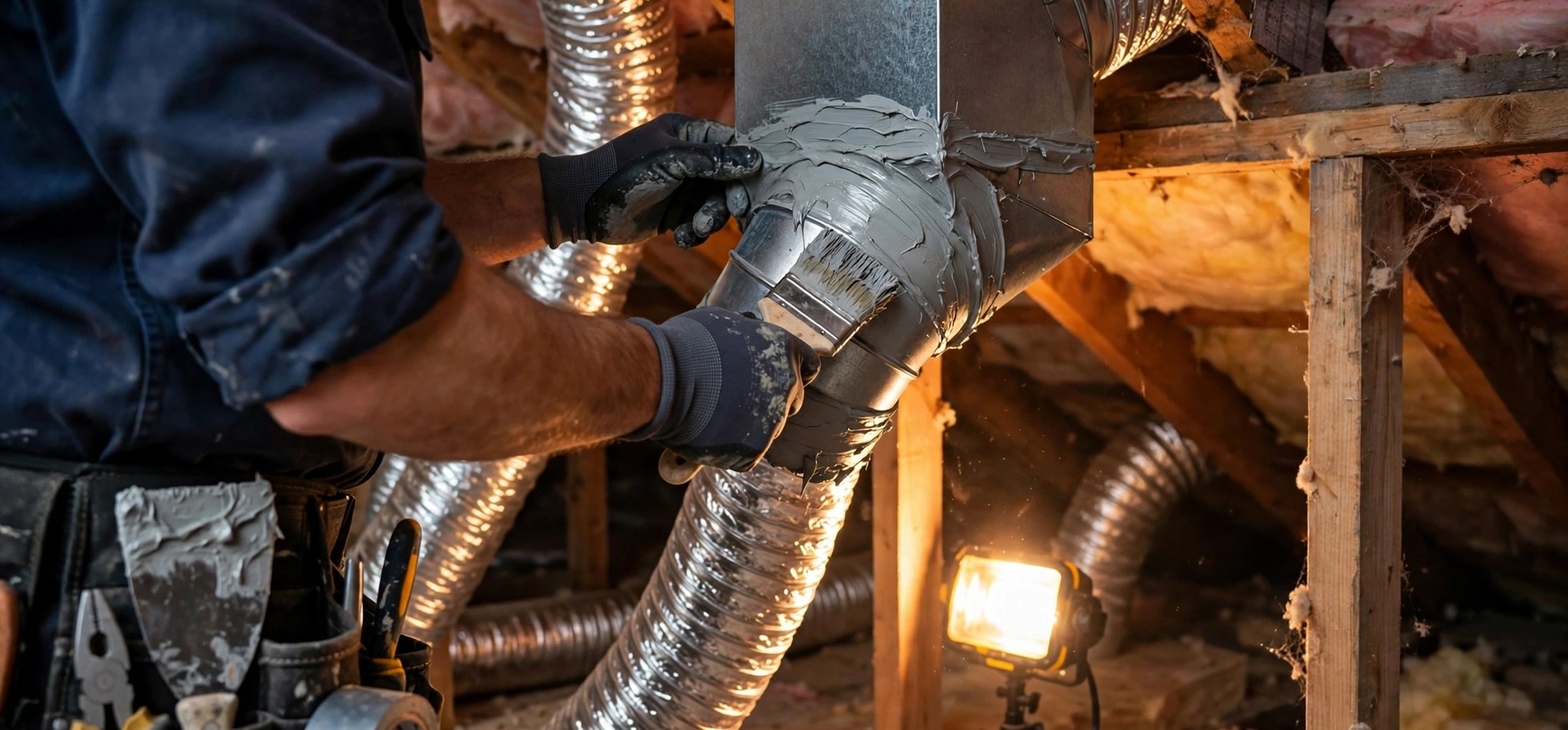
The second floor of a Cape in Fresh Meadows runs eight degrees warmer than the first in July and eight degrees colder in January. The furnace is fine. The AC is fine. The ducts in the attic, hung in 1962 with cloth tape and no insulation, lose a third of the air before it reaches a register. Queens HVAC, 103-81 52nd Ave, Corona, NY 11368, (929) 661-8491, tests ducts before quoting equipment, and an HVAC Contractor Queens homeowners trust with a system replacement should be able to say what the static pressure is before saying what the new furnace costs.
Duct Leakage in Queens Attics and Crawlspaces
Ducts that run through unconditioned space leak into it. An attic duct with a loose joint pushes cooled air into a 130-degree attic in July and pulls hot attic air into the return in the same breath. The Department of Energy's figures for typical houses put duct loss at 20 to 30 percent, and old Queens Capes with panned joist returns and taped sheet metal sit at the high end of that. The furnace runs longer, the AC runs longer, and the rooms at the end of the run never get there. Panned joist returns, where the joist bay itself is the duct with a sheet of tin nailed under it, leak at every seam and pull in whatever the basement holds.
The test is a duct blaster, a calibrated fan sealed to the return that pressurizes the system and measures leakage in cubic feet per minute. A number before and a number after, on the invoice.
Sealing Ducts With Mastic and Aeroseal
Cloth duct tape fails within a few years in an attic. Foil tape holds longer. Mastic, a thick paste brushed over every joint and seam, is the standard and lasts the life of the duct. Aeroseal, an aerosolized sealant blown through the pressurized system that finds its own way to the leaks, handles the ducts buried in walls and floors that no one can reach with a brush. A duct sealing job on a Cape with attic ducts is a day of mastic and a few hours of Aeroseal for the wall runs.
Insulation follows. Attic ducts get R-8 wrap. Ducts in a crawlspace in Howard Beach get the same plus a vapor barrier, since a sweating duct in August drips.
Static Pressure and Undersized Returns
A furnace or air handler is designed to move its rated airflow at a total external static pressure around 0.5 inches of water column. Most Queens systems measure 0.8 to 1.2. The blower works harder, moves less air, and ECM motors burn out early. Measuring it takes a manometer and two test ports drilled in the plenum, five minutes, and the number goes on the invoice next to the duct blaster result. The cause is almost always the return side. One 14 by 20 return grille in a hallway feeding a 3-ton system that needs twice that. Adding a return in each bedroom, or a larger central return with a properly sized filter rack, drops the static and fixes the airflow in a way that no new furnace could.
Flex duct kinked around a rafter, a damper closed by a previous owner, and a 4-inch media filter jammed in a 1-inch slot show up in the same houses.
Duct Cleaning and When It Helps
Duct cleaning helps in three situations. Visible mold growth inside the ducts. Rodents or insects nesting. Heavy dust after a renovation where the system ran with the walls open. Outside of those, the EPA's position is that cleaning has not been shown to prevent health problems, and a duct cleaning sold door to door for a low price is usually a vacuum hose at the register and a sales pitch for a UV light. Dust on the registers is a filter problem. A real duct cleaning uses a truck-mounted vacuum with the system under negative pressure and agitation tools in every run.
Old Queens houses have a bigger issue. Ducts in houses built before 1980 may carry asbestos tape on the joints or asbestos insulation. Nobody cleans or seals those until an asbestos survey says what they are, and abatement comes first if the answer is bad.
Zoning, Dampers and the Second Floor Problem
A single-zone system with one thermostat on the first floor will never balance a two-story house in July. Balancing dampers in the supply trunks, adjusted so the second floor gets more air in summer and less in winter, help. A zoning system with motorized dampers and a second thermostat upstairs fixes it, with a bypass or a variable-speed blower to handle the pressure when one zone closes. A separate mini split for the top floor is the other answer, and in attached houses it is often the cheaper one.
Finished Basements and the Return Air Nobody Planned
A basement finished into a den or an apartment in Jamaica or Corona gets two or three supply registers cut into the trunk line and no return. The room pressurizes, the door whistles, and the rest of the house starts pulling air from the garage and the chimney to make up the difference. A return in the basement, ducted back to the air handler and sized to the supplies, fixes that. In a basement apartment the code also wants the HVAC separated from the apartment above, which usually means its own mini split rather than a tap off the house system, and a DOB filing that most basement conversions never had.
Duct Sealing and Repair Cost in Queens
A duct blaster test is the first line item. Mastic sealing and insulation on attic ducts is a day. Aeroseal adds equipment time. A new return and a filter rack is a half day of sheet metal. A zoning system is a bigger job with dampers, a control panel and thermostat wiring. All of it costs less than the furnace replacement that would not have fixed the problem.
Queens HVAC at 103-81 52nd Ave in Corona tests, seals and repairs ductwork across Corona, Fresh Meadows, Bayside, Howard Beach and Flushing. (929) 661-8491.
Previously in Business news: How Integrated Email and SMS Marketing Can Strengthen Customer Relationships







Comment