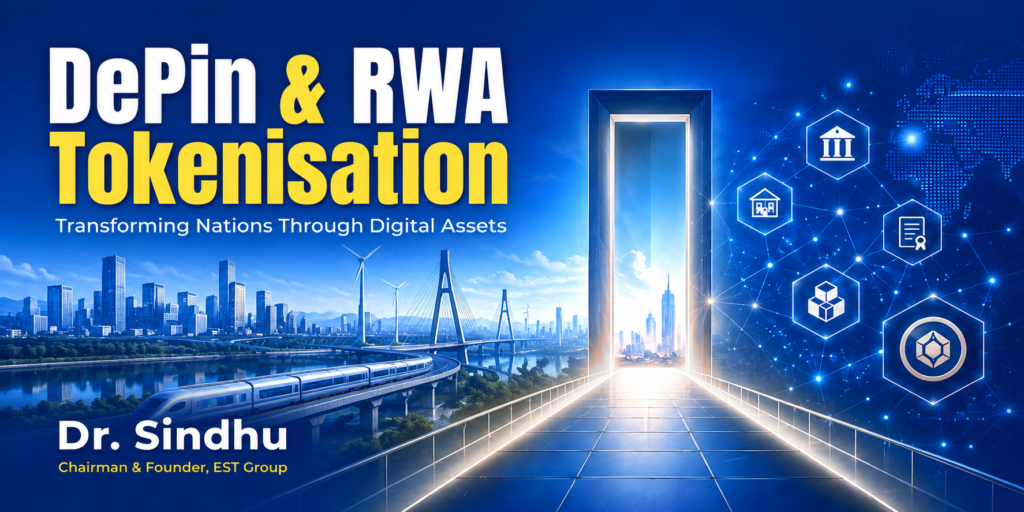
The relationship between physical infrastructure and the digital economy is becoming an increasingly important area of discussion across technology, finance and economic development. Dr. Sindhu, Chairman and Founder of EST Group and a Forbes Council Member, explores this intersection in his forthcoming book, DePIN & RWA Tokenisation: Transforming Nations Through Digital Assets.
Released globally on Amazon on September 30, 2026, the book examines how decentralized physical infrastructure networks, commonly known as DePIN, and real world asset tokenisation could connect technology, finance and society through new models of economic participation. The publication approaches these subjects from a socio economic perspective rather than focusing exclusively on blockchain technology.
Exploring the Connection Between Physical Assets and Digital Technology
DePIN & RWA Tokenisation: Transforming Nations Through Digital Assets examines the possibility of bringing physical wealth and infrastructure into digital economic systems.
The book considers how infrastructure, agricultural assets, energy systems, warehouses, urban facilities and community resources could become more transparent, measurable and economically productive through tokenisation and decentralized technologies.
The discussion extends beyond the technical mechanics of digital assets. Dr. Sindhu examines the relationship between technology, collective participation and economic structures, creating a framework that connects emerging technologies with broader questions surrounding society and development.
The Value Holder Concept
One of the central ideas presented in the book is the concept of the Value Holder.
The publication describes a Value Holder as a citizen who is more than a consumer or borrower. Within the proposed framework, the individual can become a contributor, participant and beneficiary of productive economic assets.
This concept forms part of the book’s exploration of how digital asset systems could potentially create different relationships between citizens and economic resources.
The approach places emphasis on participation and human agency while examining the possibilities created by tokenised infrastructure and digital financial systems.
From Rural Infrastructure to Farmer Finance
The book moves from its broader theoretical foundation into a range of potential applications.
Topics include tokenized rural and urban infrastructure, farmer finance, carbon credits, embedded banking, semantic banking, community collateral pools and decentralized governance.
By bringing these subjects together, the publication examines how tokenisation could intersect with sectors that directly affect communities and economic activity.
Farmer finance and rural infrastructure, for example, are considered alongside carbon credits and community collateral structures, while banking and decentralized governance form another part of the broader discussion.
A Framework for Contributory and Egalitarian Capitalism
Another major theme in the publication is the development of the concepts of Contributory Capitalism and Egalitarian Capitalism.
According to the book’s description, these models explore how technology could broaden access to value creation while maintaining human agency, community participation and social purpose.
The concepts provide a social and economic dimension to the discussion around DePIN and real world asset tokenisation.
The book is intended to provide policymakers, bankers, technologists, investors, academics and development professionals with a framework for considering how tokenisation could contribute to more inclusive and resilient economic systems.
Dr. Sindhu Brings Technology and Financial Inclusion Into the Discussion
Dr. Sindhu’s work focuses on the intersection of digital banking, financial inclusion, emerging technologies and socio economic development.
His professional perspective informs the approach taken in the book, which connects technological innovation with human centered development and models of shared economic participation.
Rather than examining digital assets as an isolated technological development, the publication considers their relationship with infrastructure, finance and communities.
This makes the book relevant to several groups interested in the future of digital economies, including technology professionals, financial institutions, researchers, policymakers and development professionals.
A Book With a Humanitarian Purpose
The publication also has a social purpose beyond its research themes.
According to the book’s promotional material, royalties from the publication will go toward supporting homeless children. The initiative connects the book’s discussion of economic participation and digital transformation with a stated humanitarian objective.
The promotional material describes this initiative as “Royalty With a Purpose,” giving readers an additional reason to consider the social dimension behind the publication.
Foreword by Prof. Dr. Ingrid Vasiliu-Feltes
The book features a foreword by Prof. Dr. Ingrid Vasiliu-Feltes, adding a scholarly perspective to its examination of technology, society and economic transformation.
Her involvement complements a publication that brings together subjects traditionally discussed across separate fields, including blockchain technology, digital banking, infrastructure, finance and socio economic development.
September 2026 Amazon Release
DePIN & RWA Tokenisation: Transforming Nations Through Digital Assets was officially released globally on Amazon on September 30, 2026.
As discussions around decentralized infrastructure, real world assets and digital finance continue to develop, Dr. Sindhu’s publication offers a multidisciplinary examination of how physical assets could participate in emerging digital economic structures.
Sequel Announcement: TOKENISATION: CONTOURS AND REALITIES
Following the launch of his book, Dr. Sindhu announced that a sequel, titled TOKENISATION: CONTOURS AND REALITIES, is set for release in January 2027. Building upon the core themes of DePIN, real world asset tokenisation, the Value-Holder concept, Contributory and Egalitarian Capitalism, and socio-economic transformation, the upcoming volume will delve further into practical realities, implementation frameworks, and real-world execution strategies for digital asset ecosystems.
By combining DePIN, RWA tokenisation, financial inclusion, digital banking, community participation and socio economic development, the book presents a broader perspective on the potential relationship between technological innovation and human centered economic systems.
Amazon India: https://amazon.in/dp/9349299380
Publishers: https://zebralearn.com/oranges/depin-rwa-tokenisation-6a551ce927f2fa5e05e1f5ac/