What is Dissolved Oxygen?
Dissolved O₂ (DO) is the amount of oxygen gas that exists in water or other liquids in dissolved form. The air is the DO’s primary source, and a minor contribution comes from photosynthesis of aquatic plants, where oxygen is released as a byproduct of their metabolic processes. Milligrams per liter (mg/L), parts per million (ppm), or as a percentage (%) of saturation are the common units for DO measurement.
DO is considered one of the most critical parameters for the aquatic ecosystem since it is the sole oxygen source for fish, microorganisms, and plants. Also, it is the main factor that influences the chemical as well as biological processes of water treatment, aquaculture, and industrial systems simultaneously.
Water with high DO concentration is regarded as clean and healthy, while water with low concentration is likely to cause stress or mass death of aquatic organisms. Therefore, monitoring DO has become a common practice that is vital for water quality control in all kinds of settings, whether they are natural or man-made.
What is Dissolved Oxygen Measurement?
Dissolved oxygen determination refers to the process of measuring the concentration of oxygen in water and other liquids. It can be said that the method is accurate and reliable on the following grounds:
- Environmental monitoring of rivers, lakes, and oceans
- Aquaculture, where optimal oxygen levels for fish and shrimp are obtained
- Industrial water management, including the processes of chemicals and the treatment of wastewater
The actual measurement takes place with the help of the sensors or probes that are placed in the water and produce a signal that represents the amount of oxygen in the water. The signal is then interpreted by controllers or meters that display the readings and might even trigger automatic responses in industrial or environmental systems.
Modern DO measurement uses different technologies:
- Optical sensors – Use light-based luminescence; highly stable and low maintenance.
- Electrochemical sensors – Polarographic and galvanic are the membrane types included in this category; they are the most used ones, but they do require calibration and maintenance.
All Types of Dissolved Oxygen Controllers
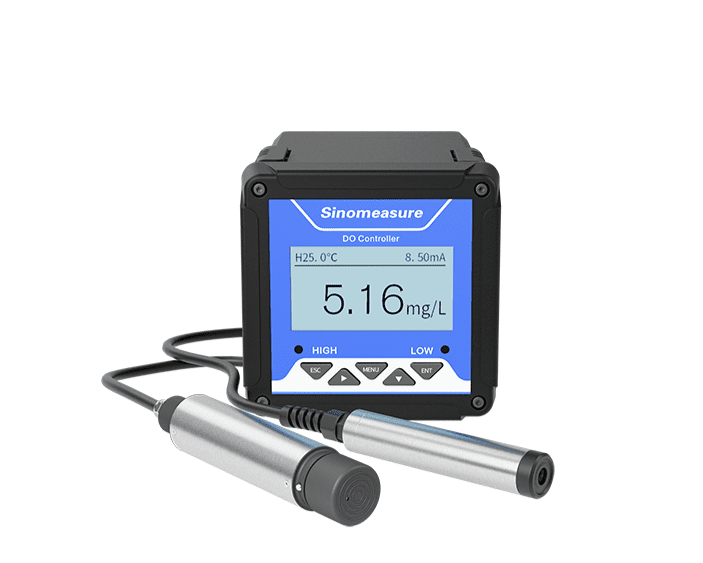
A dissolved oxygen controller is a gadget that gets input from a DO sensor, shows readings, and can take over oxygen level-dependent processes. Controllers are important in various applications like industry systems, eco-monitoring, and fish farming. In addition, they incorporate digital outputs, relay alarms, and communication protocols that usually range between 4–20 mA or RS485 to support the automated integration.
1. Optical Dissolved Oxygen Controllers
Optical controllers are known for long sensor life and high stability, as they do not consume oxygen during measurement. Examples from Sinoanalyzer include:
- DY3000 Optical DO Controller – Ideal for continuous monitoring in water treatment or industrial processes. Features include remote communication, stable signal output, and easy integration.
- DY2900 Optical DO Controller – Uses luminescent technology for precise and maintenance-free oxygen monitoring. Perfect for environmental and aquaculture applications.
2. Membrane or Electrochemical DO Controllers
Membrane-based controllers are dependent on electrochemical reactions for the purpose of monitoring the amount of oxygen in the water. Such controllers are appropriate for use in both the industrial and environmental sectors, where reliable readings are obtained for a long time. Example:
- DM2800 Membrane DO Controller – Supports continuous monitoring of water and industrial fluids with easy calibration and durable sensor design.
3. Industrial Transmitter Controllers
Industry DO controllers link up very well with SCADA or PLC systems. They are the source of alarm outputs, give configurable signals, and support multi-point communication, which comes in handy for process automation. The products, such as the DM3000 series, support real-time control and reporting in intricate industrial environments.
All Types of Dissolved Oxygen Sensors
A dissolved oxygen sensor never fails to register the amount of oxygen present in the water. The sensor choice is determined by the nature of the application, the accuracy needed, and the maintenance aspect.
1. Electrochemical DO Sensors
These traditional sensors rely on polarographic or galvanic reactions. They are reliable but require periodic calibration:
- DO7013 Electrochemical Sensor – Suitable for aquaculture, water quality monitoring, and IoT systems. Provides RS485 digital output.
- DO7011 Membrane Sensor – Membrane-based electrochemical sensor with 4–20 mA output; commonly used in industrial and environmental water systems.
2. Optical DO Sensors
Optical sensors are maintenance-free, fast, and accurate. They use luminescent technology to detect oxygen without consuming it:
- DO7016 Optical Sensor – Provides quick response, long-term stability, and compliance with ASTM standards. Ideal for environmental monitoring and laboratory use.
3. Portable and Online Sensors
There are sensors especially for field measurements, while others are designed for continuous online monitoring, which allows real-time adjustment and process control in industries and aquaculture.
The Wide Applications of Dissolved Oxygen Measurement
Dissolved oxygen measurement is critical across multiple sectors:
1. Environmental Monitoring
The levels of DO are an indicator of the health of the ecosystem. The agencies are monitoring rivers, lakes, and the ocean to find out the presence of pollution, eutrophication, and depletion of oxygen.
2. Aquaculture
The maintenance of the ideal oxygen levels is very important for the growth of fish and shrimp. DO controllers facilitate the aeration systems to be automated so that there is no stress on the fish, and healthy yields are ensured.
3. Wastewater Treatment
The aerobic bacteria, which are active due to the DO levels, break down the organic matter quickly and efficiently. Good DO measurement increases treatment efficiency and reduces energy consumption.
4. Industrial Processes
Industries, such as the chemical industry, power generation, and food & beverage processing, need accurate DO monitoring in order to maintain the quality, safety, and compliance of the product.
5. Scientific Research
DO sensors are used in laboratory studies to investigate water chemistry, aquatic ecology, and biochemical processes. Accurate measurement supports high-quality research and data analysis.
Conclusion:
Dissolved oxygen determination is an absolute necessity when it comes to water quality monitoring and process control. If the right controller and sensor are chosen — Sinoanalyzer being one of the major manufacturers — then all three (industries, aquaculture operators, and environmental agencies) will have access to reliable, real-time, and accurate DO data to maintain not only optimal water conditions but also process efficiency.