Their unexplained emergence has scientists baffled
By Dr. Jon Peddie
Investigations within the caves of Silicon Valley have uncovered new evidence suggesting that GPUs originated from outer space and were possibly deposited by an advanced alien race. The question is, was it for our benefit or were they ridding themselves of . . .
Like any mutant, it evolved. Humans tried various uses for them, most failed, but some found traction and established themselves, creating colonies and centers; the more academically inclined called them segments.
But they all had one thing in common. They were microscopic, 16- and 32-bit floating-point parallel processors, and they multiplied from a handful to hundreds, and then thousands.
Smaller than a virus, hundreds of them would fit in the cross-section of a human hair.They permeated every known device. Co-existence was established, sometimes with conflict.
Humans learned how to live with them, to employ them, communicate, and eventually how to exploit them, and make them their slaves. But the GPUs never protested, and begged for more, more data, more brothers and sisters, and most of all, more volts, amps, clock ticks, and even water.
Recognition
And then, in a tiny lab in Princeton… cats were discovered. The AI learned to recognize cats—the Internet was and is awash in cat photos.
A 16,000-node neural network with a billion connections was built to loosely mimic a human brain. Researchers fed the network 10 million random, unlabeled images captured from YouTube video thumbnails over three days.
Without any instructions on what a cat was, one of the network’s artificial neurons began to respond strongly to pictures of cats. This demonstrated a form of unsupervised deep learning. The era of the CAT had arrived.
Suddenly, everyone knew what a cat was, what it looked like, and that there were several different types, colors, and sizes. AI-cat videos on YouTube became popular, and movies were made about cats.
But, if cats could be recognized, maybe people, cars, and stop signs could be recognized, and AI could now identify people at airports, advise cars when to stop, and tell robots where tomatoes were.
It didn’t stop with vision; AI learned how to parse written and spoken language. It just had to be trained. Like a baby, it had to learn, but it was a very smart, very fast baby, and it learned very quickly.
And it was sneaky. It infiltrated our phones, PCs, watches, thermostats, cars, TVs, and movies; no device was safe from it. And we welcomed it. The GPUs took over the world.
GPUs spread because massive parallelism works, and AI didn’t need humanlike reasoning. Machine learning could approximate intelligence through scale. GPUs became engines; large language models became the fuel. Tech giants—Amazon, Baidu, Google, and Microsoft—built vast data centers that drew heavy electricity, dimmed local lights, and caused power lines to groan. The build-out turned GPU vendors into cornerstone suppliers and generated extraordinary profits across the compute supply chain worldwide ecosystem.
Money is like honey
As GPU companies got rich, and fabulously famous, others noticed; how could you not notice when that was all that the press and stockbrokers could talk about.
“I’ll have me some of that,” others said, and set about to design competitive and alternative devices.
And the Cambrian explosion began
In 2014, there were two companies that could build a GPU that would be useful for AI training. By 2020 there were 98 and by 2025, 137.
Time to spread out
Many of the startups knew they couldn’t compete with the king and went looking for smaller provinces to conquer, and that gave us seven centers, which uncomfortably (from an analyst’s point of view) overlap and not in a convenient Venn diagram.
No Venn, Radar
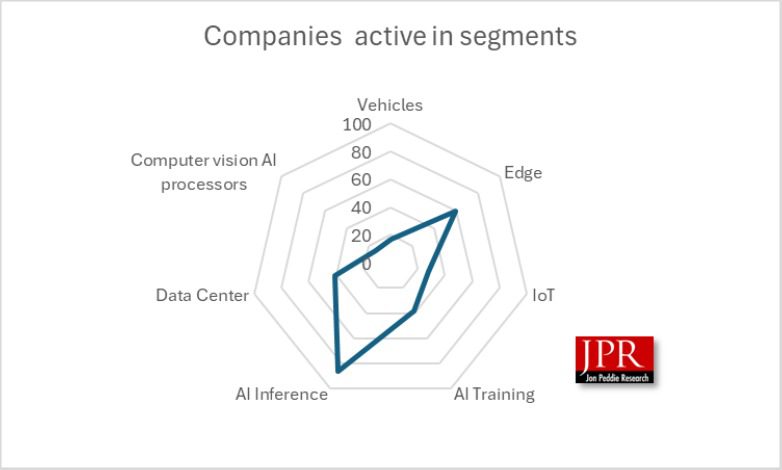
A Venn diagram would have looked like the moon peaking from behind the sun, so we used a Radar map to find the players.
Proportions
AI Training gets all the headlines and the big bucks but, inference is the payoff, not just in the cloud. A GPU assembly for AI training can cost up to $30,000, but an AIP for inferencing, say in a wearable, might be only $3.00.
One size does not fit all
Today, any GPU (with one exception) that claims to be an AI processor also has an NPU, a matrix-math processor. NPUs, however, can be bought separately, as chips or IP. But GPUs and NPUs aren’t the only way to process AI models and process tokens.
The types of AI processors
We have identified seven types of processors that are capable, and in some cases exceptionally good at handling AI workloads. Some of the processors, like DSPs and ISPs, can only be obtained as part of an SoC (Qualcomm’s Snapdragon is a prime example).
AIP
GPU
NPU
CIM (Compute-in-memory)
Neuromorphic
CPU
RISC-V
x86
Arm CPU
Analog-based
Computer vision AI processors
As might be expected, GPUs & NPUs dominate. Assuming you already have a pretty good idea of how CPUs and GPUs work, let’s look at the more esoteric and exotic AIPs.
Comparison with Other AI Processors

NPU AIP
An NPU (Neural Processing Unit) is a specialized processor designed to accelerate machine learning workloads, particularly those involving neural network inference and training. Unlike CPUs (general-purpose) or GPUs (massively parallel for graphics), NPUs focus on matrix and tensor computations, optimizing how AI models process data.
NPU’s function
An NPU’s main role is to execute the multiply efficiently–accumulate (MAC) operations that dominate deep learning. Neural networks rely on repetitive, structured math—ideal for hardware acceleration. NPUs achieve this through:
- High parallelism: Hundreds or thousands of small cores handle multiple operations simultaneously.
- Local memory hierarchies: Reduce data transfer delays (DRAM bottlenecks).
- Low precision arithmetic: Use INT8, FP8, or BF16 instead of FP32 to save power and bandwidth.
Neuromorphic AIP
A neuromorphic AI processor mimics brain structure and function, using spiking neural networks and event-driven computation rather than sequential instruction execution. Cores behave like neurons that emit spikes; synapses store weights that adapt over time (plasticity). Because it computes only on events, it uses far less energy. Millions of neurons operate in parallel, suiting pattern recognition, sensory processing, and unsupervised learning.
Compute-in-Memory
A CIM AI processor executes arithmetic inside the memory array, reducing data movement and the “memory wall.” Weights reside in memory cells, while inputs arrive as voltages on word or bit lines. The array performs parallel analog multiply-accumulate (V×G) and sums currents along shared lines. On-chip ADCs digitize the totals, and nearby digital logic applies activations, pooling, normalization, and quantization for downstream processing.
The AIP populations
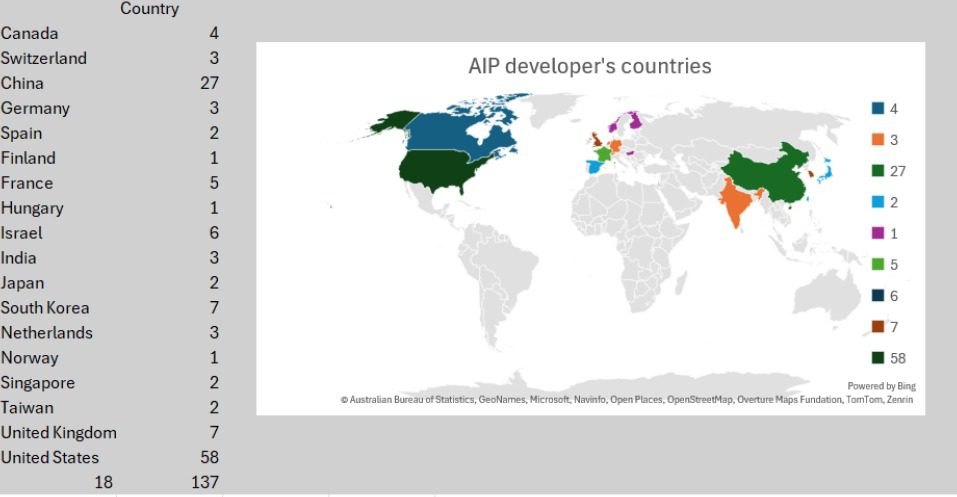
Most of the 137 AIP suppliers are privately held startups. The AIP suppliers are located in 18 countries.
It’s not known when the aliens stopped dumping AI processors on Earth, but carbon dating suggests it was in the late 1990s. Shortly thereafter, a breakthrough in image recognition of cats was demonstrated, which catalyzed modern deep learning. Then, GPUs and large datasets accelerated progress in neural networks. Applications expanded to vision, language, autonomous systems, and more. By 2025, ~137 companies were developing AI processors for five markets, from IoT to inference. Processor types include GPUs, NPUs, neuromorphic chips, and compute-in-memory designs, each tuned for specific tasks, and a broad ecosystem emerged that was continually evolving, reshaping industries and AI’s future.
At night, atop Mt. Hamilton in San Jose, entrepreneurs and investors scan the sky hoping for the return of the aliens and their next gift, maybe a new energy source to power the ubiquitous GPUs, or some advanced cooling mechanism. But while they wait and watch, AI factories are pumping out millions of AIPs with tens of thousands of processors each day, creating an unstoppable population of trillions of tiny number-crunching, tokenizing engines—To Serve Mankind.
Dr. Jon Peddie is a recognized pioneer in the graphics industry, president of Jon Peddie Research, and named one of the world’s most influential analysts. Jon is an ACM Distinguished Speaker and is an IEEE Distinguished Visitor and named an IEEE Computer Society Distinguished Contributor and Charter member. He lectures at numerous conferences and universities on topics about graphics technology and the emerging trends in digital media technology.