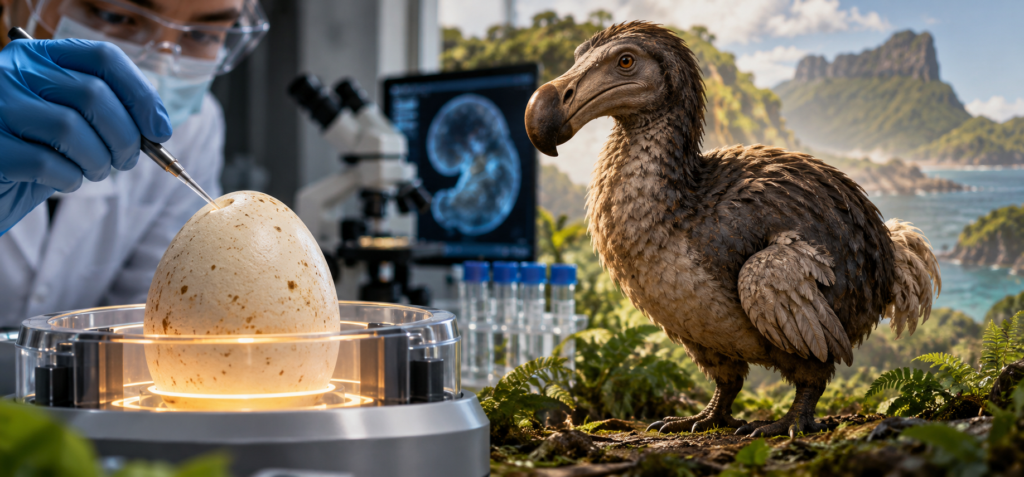
Colossal Biosciences has hatched live chicks from a fully artificial egg. It is the first-of-its-kind incubation system that supports a bird embryo all the way from early development to hatching without a biological shell and without extra oxygen. The Dallas-based de-extinction company calls the technology a building block for its avian conservation work and for the planned de-extinction of the South Island giant moa, a flightless bird that vanished more than 600 years ago.
The achievement builds on one of evolution’s oldest inventions. The amniotic egg has let embryos develop on dry land for more than 300 million years, packing water, oxygen, nutrients and waste removal into a single self-contained structure. Birds later wrapped that design in a hard calcium carbonate shell, perforated with microscopic pores that manage gas exchange while keeping bacteria out. Colossal Biosciences engineered an artificial version of that same system, built from a 3D-printed lattice shell rather than calcium carbonate, and it now works well enough to hatch a healthy chick.
Cracking an Engineering Problem That Stumped Scientists
To Embed: How One Egg Changed Life Forever
The idea of growing a bird without its shell dates back to the 1980s, but the early lab versions only worked when flooded with pure oxygen. That dependence came at a cost: it damaged the embryo’s DNA and left lasting health problems, and it never fit the standard incubators or the production volumes that real conservation or industry would demand.
Colossal’s answer was a rigid lattice framework wrapped in a custom silicone-based membrane engineered to breathe like a real shell. At 21% of the oxygen levels of ordinary air, the membrane moves as much oxygen to the embryo as a natural chicken eggshell does, so the enriched-oxygen setups that held back earlier work are no longer necessary.
The lattice was originally 3D printed and designed for injection molding, allowing low-cost, high-volume production. The design is also largely transparent. That lets researchers watch embryo development unfold in real time, which Colossal Biosciences says matters for confirming edited traits during de-extinction work.
“Every new scalable system for de-extinction is ultimately a biology problem wrapped in an engineering problem. The artificial egg is a perfect example,” said Ben Lamm, CEO and co-founder of Colossal Biosciences. “It’s a major milestone for Colossal and a foundational technology for our de-extinction toolkit.”
The Moa’s Massive Eggs Demanded a New Approach
The South Island giant moa laid eggs estimated at roughly 80 times the volume of a chicken egg and about eight times the volume of an emu egg. No living bird is large enough to serve as a surrogate, which makes a size-scaled artificial egg essential to the moa program rather than simply useful to it, according to the company’s announcement.
“The embryo needs a place to grow that recapitulates the gas exchange, humidity and mechanical environment of a natural egg, at whatever size the species requires,” said Dr. George Church, co-founder of Colossal and professor of genetics at Harvard Medical School. “Colossal’s artificial egg solves the scalability dimension. It is a platform technology, and its implications extend well beyond any single species.”
Dr. Beth Shapiro, chief science officer at Colossal, said the platform fills a longstanding gap in reproductive science. “The avian reproductive toolkit has lagged behind mammalian systems for decades because birds present unique developmental challenges,” she said. “The artificial egg changes that.”
Applications Beyond De-Extinction
Colossal Biosciences positions the artificial egg as a conservation tool as much as a de-extinction one. More than half of bird species are currently in decline, one in eight is threatened with extinction, and North America has lost nearly 3 billion birds since 1970, according to the company. Many endangered species are difficult to breed in captivity, and a shortage of surrogate hosts limits how biobanked genetic material can be used.
Matt James, chief animal officer at Colossal and head of the Colossal Foundation, said the device addresses that shortfall directly. “The artificial egg allows us to rescue compromised embryos, build genetic rescue platforms and utilize donor and biobanked material in ways that weren’t previously possible,” James said.
The platform may also have uses in biotechnology research. Transgenic chickens have become a promising way to make recombinant therapeutic proteins such as monoclonal antibodies and human cytokines in egg white, often at lower cost than growing them in mammalian cell cultures. Because the artificial egg gives continuous visual access to a developing embryo, it could ease the embryo manipulation that has historically bottlenecked that kind of work.
“While we built this system to solve a specific de-extinction biological scale problem, the platform we created has implications well beyond de-extinction,” Lamm said. “Any field that needs precise, scalable access to developing avian embryos now has a tool that didn’t exist before.”
What Comes Next
Colossal’s engineers aren’t finished. They are now working on a lattice that helps the chick hatch on its own and on robotic methods for transferring embryos earlier in development, both meant to reduce variation at the fragile start of incubation. The egg also fits into a wider set of Colossal reproductive tools, from implantation devices for early mammalian embryos to the Colossal Artificial Uterus, which carries later-stage growth across species from marsupials to placental mammals.