
Corrugated Plastic Sheet Orders: Why a PP Corrugated Sheet Is Never Specified by Thickness Alone

Most purchase orders for corrugated plastic sheet contain one number: the thickness. A buyer writes “4 mm, white, 500 sheets” and expects the job to be done. Then the sheets arrive feeling flimsy, the print flakes off in a week, or the folded boxes crack along the score line. Nothing on the order was wrong. It was just incomplete. The fields that decide performance, such as areal weight, flute direction, surface treatment and the conversion route, were never written down, so the supplier filled them in with its own defaults.
This matters more than it looks for operations and procurement teams. A sheet that costs slightly less per square metre can add rework, failed print runs and returned packaging that cost far more. The way out is an order that reads like a specification rather than a label. The examples below use the published product data of SHINE (Shine Industrial Co., Ltd.), a Jinan-based extruder of polypropylene sheet, because a real manufacturer’s numbers make the point more clearly than generic advice.
What a corrugated plastic sheet actually is
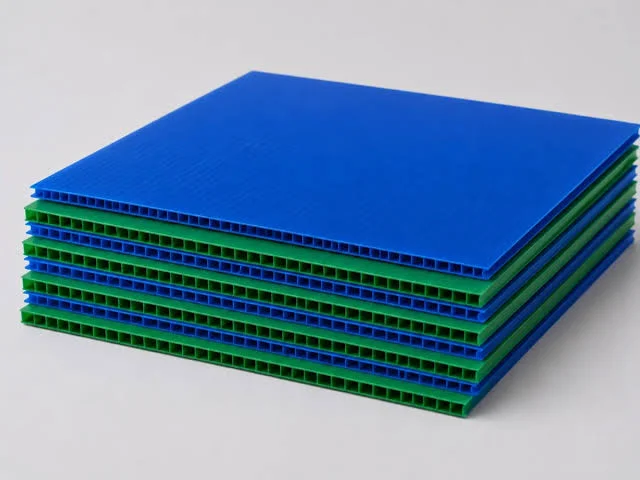
The product goes by many names. Print shops say corrugated plastic or “coroplast”, packaging buyers say PP hollow sheet, and engineers say twin-wall fluted polypropylene. SHINE’s product page notes that Coroplast is a third-party trade name, not a generic term, and calls its own material PP corrugated sheet. The structure is the same under every name: two flat polypropylene skins joined by vertical ribs, extruded as one piece.
Those ribs, the flutes, give the sheet its stiffness. They also give it a direction. A panel is stiff along the flutes and much weaker across them, a little like a sheet of cardboard. Any order that ignores that direction leaves the most important structural decision to chance.
Polypropylene also brings properties paper corrugate lacks. It does not turn soft when wet, it can be welded with ultrasound, and it can be heat-sealed along the edges. Those features are why the material ends up in signage, reusable boxes, layer pads, floor protection and tree guards rather than only in temporary displays.
Why thickness alone is the wrong field to buy on
Thickness is the field everyone searches for, which is exactly the trap. SHINE puts it bluntly on its product page: 4mm, 6mm and 10mm are common search labels, but they are not interchangeable with a finished performance specification. Two 4 mm sheets can differ sharply in how much polymer sits in each square metre. The heavier one is stiffer, stronger at the fold and better at holding a screw or rivet. The lighter one is cheaper and easier to ship.
That difference is captured by GSM, the weight in grams per square metre. GSM is the closest thing a buyer has to a stiffness proxy before a prototype exists. Put a target GSM band on the order alongside the thickness, and two suppliers quoting the same job are finally quoting the same sheet.
Flute direction is the next field. A sign that hangs from two top corners should have flutes running vertically so it does not sag. A box panel that is scored and folded needs the flutes oriented to the fold. A layer pad that spans a pallet needs flutes across the longer unsupported span. None of this is exotic engineering. It is simply information that the supplier cannot guess.
Sheet, roll or die-cut part: choosing the format before the price
Format changes the economics. SHINE documents a main sheet range of 2–12 mm in standard 1220 × 2440 mm and 1000 × 2000 mm formats, with widths up to 2600 mm subject to order review. A wide format matters for large signs and protection panels, where a seam in the middle looks poor or lets water in.
For floor protection and continuous conversion lines, roll stock is often the better buy. The company’s roll route covers 1.8–5 mm thickness, width up to 2.5 m and length up to 100 m, and it asks buyers to confirm roll direction, core size and winding before production. A 100 m roll removes dozens of cut sheet edges from a construction site and feeds an automated converting line without constant reloading.
Die cutting turns the sheet into a finished part. Tree guards are a good example of how specific those parts get: SHINE lists documented guard sizes of 450 × 200, 600 × 450 and 900 × 90 mm in 2–5 mm sheet, in triangular or square forms with ventilation holes. Once a part is that defined, the buyer should be ordering against a drawing with tolerances and a cut sample, not against a sheet thickness.
Which format to request for common uses
| Use | Format to request | Fields to add beyond thickness |
| Printed sign blanks | Flat sheet, standard or wide format | Flute direction, treated side, ink system |
| Floor and surface protection | Roll stock | Roll length, core, seam method, traffic type |
| Folded or welded boxes | Die-cut blanks or converted boxes | GSM, fold lines, weld seams, load and stack height |
| Tree guards and dividers | Die-cut parts to drawing | Drawing tolerances, holes, UV additive if outdoors |
Printing on polypropylene: what corona treatment does and does not prove
Polypropylene has a low surface energy, which is a technical way of saying ink does not want to stick to it. Corona treatment raises that surface energy with an electrical discharge so ink and adhesive can wet the surface. It is a real and useful process. The problem is that buyers treat the phrase as a guarantee.
SHINE’s own guidance is worth quoting because suppliers rarely say it: do not approve a printing order from the words “corona treated” alone. The treatment level can fade during storage, and ink systems differ widely in how they bond. What should be approved is the combination of sheet batch, treated side, storage window, ink or adhesive, curing method and an agreed adhesion test.
In practice that means one extra step. Print a sample on the actual sheet with the actual ink, cure it the way production will cure it, then run the tape or rub test your team trusts. If that sample passes, write the test into the order. If the print house changes ink later, repeat it. A failed print run of several thousand signs costs far more than one approval sample.
Converted packaging: prototypes beat specifications on paper
When a sheet becomes a box, a tote or a layer pad, the raw-sheet specification stops being enough. Folds, welds, handles and dividers all change how the finished pack behaves under load. SHINE separates the two approval stages on its page: a raw swatch checks colour and feel, while a converted prototype checks geometry and process. It describes ultrasonic welding, molding, edge sealing and die cutting as conversion routes, each with its own approval point.
For loaded packaging, the company’s page points to recognised test routes such as ASTM D642 for compression and ASTM D5276 for drop testing, and adds a sensible caveat: a raw-sheet approval does not prove loaded performance. Buyers who skip the prototype often discover the weakness on the first full truck, when a stack of boxes leans or a weld seam opens.
The commercial lesson is that the cheapest raw sheet is not always the lowest total cost. Printing, welding, molded hardware, edge sealing, die cutting and validation all add operations. A slightly heavier sheet that survives the fold and the weld can be cheaper per delivered part than a light sheet that keeps failing at the score line.
A field list for the next RFQ, and the risks it does not remove
Here is a compact list of what a corrugated plastic sheet order should state. One page is enough, and it removes most of the guesswork.
Some risks stay even with a complete order. An outdoor sign rated by a lab exposure test still has no guaranteed field life, because sun, colour and climate vary. An “anti-static” label is not a full electrostatic specification; low charging, dissipative and conductive grades are different things. And a formwork panel chosen only by thickness has no load rating at all. A good supplier says these things up front. Specification pages from SHINE, a corrugated plastic sheet supplier in China, show how a manufacturer can state these limits honestly instead of hiding them in fine print.
The broader point for any business buying materials is the same. A label is a search term; a specification is a contract. Write GSM, flute direction, surface treatment and the conversion route into the order, approve a real sample, and corrugated plastic sheet becomes a predictable material instead of a recurring surprise.







Comment