
How to Convert US Dollars to Euros and Compare Exchange Rates

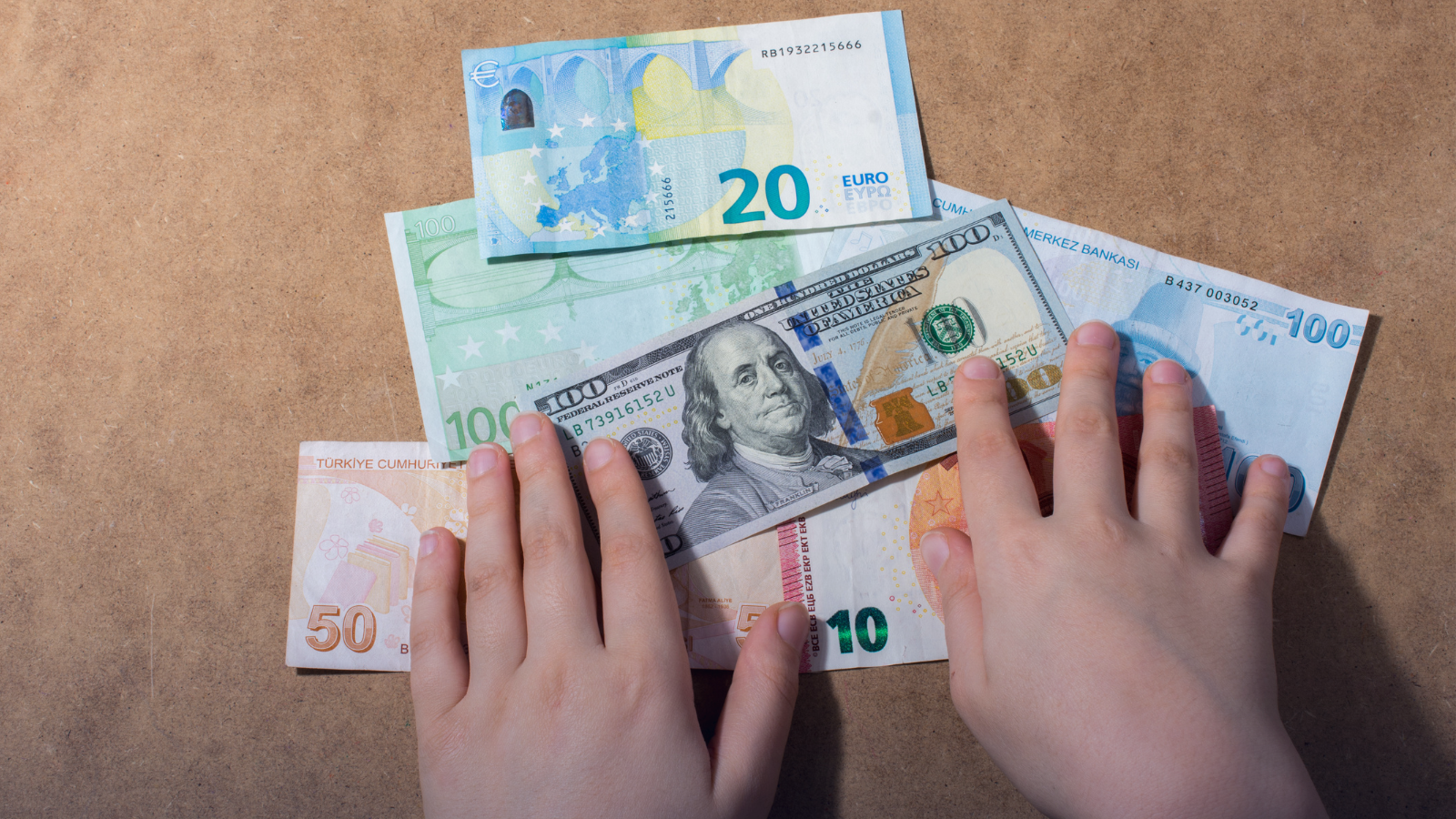
To convert US dollars to euros, divide the dollar amount by the EUR/USD exchange rate, or multiply it by the USD/EUR rate. If one euro costs $1.08, then $1,500 ÷ 1.08 = €1,388.89. That is the mid-market figure; the euros you actually receive will be lower once a bank, card issuer or exchange kiosk adds its markup and fees.
The conversion itself is simple. The skill lies in knowing which rate you are being quoted and how far it sits from the true market rate. Using the same $1,500, the gap between the best and worst way to buy euros in the example below is more than €100. A currency converter gives you the benchmark; this guide shows how to measure every offer against it.
The exchange rate used throughout is illustrative. Rates move every second the markets are open, so always check the live rate before converting.
How to read a EUR/USD exchange rate
Currency pairs are written as BASE/QUOTE, and the number tells you how many units of the quote currency buy one unit of the base. The euro–dollar pair is conventionally quoted as EUR/USD, so a rate of 1.0800 means €1 = $1.08.
That convention trips up many Americans, because they usually start with dollars. You have two equivalent routes:
- Dollars to euros: euros = dollars ÷ EUR/USD rate. $1,500 ÷ 1.08 = €1,388.89.
- Using the inverse: USD/EUR = 1 ÷ 1.08 = 0.9259, so euros = dollars × 0.9259.
- Euros back to dollars: dollars = euros × EUR/USD rate. €200 × 1.08 = $216.
A quick sense check: when the EUR/USD rate is above 1, you will always get fewer euros than the dollars you hand over. If a calculation shows the opposite, you have multiplied where you should have divided.
Mid-market rate vs the rate you are offered
The mid-market rate is the midpoint between the prices at which banks buy and sell a currency on the wholesale market. It is the rate you see on financial news sites and in the converter. Consumers rarely get it.
Providers make money in two ways, and often both:
- A margin built into the rate. Instead of 0.9259 euros per dollar, you might be offered 0.8981. This cost is invisible unless you compare.
- An explicit fee. A flat charge, a percentage commission or a foreign transaction fee on a card.
To measure the hidden margin, use: margin % = (mid-market rate − offered rate) ÷ mid-market rate × 100. An offer of 0.8981 against a mid-market 0.9259 is a 3 per cent margin.
Worked example: five ways to turn $1,500 into euros
Here is the same $1,500 converted through five typical channels, at an illustrative mid-market rate of 1 EUR = 1.08 USD (0.9259 EUR per USD). The margins and fees are representative examples, not quotes from any particular provider.
| Method | Rate you get (EUR per USD) | Fees | Euros received | Cost vs mid-market |
|---|---|---|---|---|
| Mid-market benchmark | 0.9259 | None | €1,388.89 | — |
| Card with no foreign transaction fee | 0.9241 | None | €1,386.11 | €2.78 (0.2%) |
| Specialist money transfer service | 0.9259 | 0.5% + $5 | €1,377.37 | €11.52 (0.8%) |
| Card with a 3% foreign transaction fee | 0.9241 | 3% | €1,345.74 | €43.15 (3.1%) |
| Bank cash order | 0.8981 | $10 | €1,338.24 | €50.65 (3.6%) |
| Airport exchange kiosk | 0.8519 | None advertised | €1,277.78 | €111.11 (8.0%) |
The kiosk advertises “no commission” yet is by far the most expensive option, because its entire profit is hidden in an 8 per cent margin. In dollar terms, that is roughly $120 lost on $1,500. The no-fee card, which typically uses the card network’s rate, comes closest to the benchmark.
Check any quote: enter your dollar amount in the free US dollar to euro converter to get the mid-market figure, then compare it with the euros a bank or exchange service says you will receive. The difference, as a percentage, is the true cost of that offer.
The “pay in dollars?” trap abroad
When paying by card in Europe, a terminal or ATM may offer to charge you in US dollars instead of euros. This is called dynamic currency conversion, and the merchant’s provider sets the rate, usually with a generous margin.
Take a €200 restaurant bill. Paid in euros on a card with no foreign transaction fee, it would cost about $216.43 at a rate close to mid-market. If dynamic currency conversion applies a 5 per cent markup, the same meal costs $226.80, more than $10 extra for the “convenience” of seeing dollars. The rule is simple: always choose to pay in the local currency.
Practical ways to get a better euro rate
- Use a card without foreign transaction fees for most spending abroad, and pay in euros.
- Withdraw cash from bank ATMs in the eurozone rather than exchanging cash before you go, but check your own bank’s ATM and foreign-withdrawal fees and decline any conversion offer on screen.
- Avoid airport and hotel exchange desks except for a small emergency amount.
- For large transfers, such as paying European tuition or a property deposit, compare several providers on euros delivered, not on the advertised fee.
- Do not try to time the market. Exchange rates are notoriously hard to predict. If a large conversion worries you, splitting it into several smaller conversions over time averages out the rate.
For a trip budget, convert your costs once with the converter, then add the fee percentage of the payment method you plan to use. If you are holding euros as part of a longer-term savings goal, the savings calculator can help, and the percentage calculator makes quick work of margin comparisons.
Frequently asked questions
How do I convert dollars to euros quickly in my head?
Divide the dollar amount by the current EUR/USD rate. When the rate is near 1.10, a rough shortcut is to knock about a tenth off the dollar figure: $100 is roughly €91. The shortcut becomes less accurate as the rate moves, so use a converter for anything important.
What is the best way to get euros before a trip?
For most US travellers, the cheapest approach is to carry a card with no foreign transaction fees, pay in euros, and withdraw a modest amount of cash from a bank-operated ATM on arrival. Exchanging cash at home or at the airport usually costs more because of wider margins.
Why is the rate on Google different from my bank’s rate?
Search engines and converters display the mid-market rate, a wholesale benchmark. Your bank sells currency at a less favourable rate to cover its costs and profit, and may add a fee. The gap between the two is the price you are paying for the conversion.
Does the exchange rate change during the day?
Yes. EUR/USD trades continuously on weekdays and moves in response to economic data, interest rate decisions by the Federal Reserve and the European Central Bank, and wider market sentiment. Many providers also widen their margins at weekends, when wholesale markets are closed.
Converting dollars to euros is one division; comparing offers is one subtraction. Start with the mid-market figure from the TechBullion currency converter, then choose the provider whose euros come closest to it. This article is general information, not financial advice.






Comment