Almost every electronic device today runs on printed circuit boards. These substrates connect parts and move electricity where it is needed. This ensures reliable electrical connectivity. As global demand for faster production rises, many firms choose Chinese manufacturers for these boards. Advanced tools in those factories keep prices low and output high, making this choice practical.
Start here if you’re weighing options for PCB manufacturers in China. Picture faster builds, fewer hiccups, better pricing – possible when choice aligns with need. Understand how these manufacturers operate day-to-day. Examine services listed online versus real capabilities. Think about turnaround times, material sourcing habits, communication styles. Each detail shifts outcomes more than advertised specs ever do.
Why Choose a Chinese PCB Manufacturer?
China is now a leading hub for printed circuit board (PCB) manufacturing. Numerous factories create boards for the consumer electronics, automotive, industrial, medical, and telecommunications sectors.
Several factors contribute to this trend.
- Large-scale manufacturing capacity
- Modern automated production lines.
- Skilled engineering teams
- Competitive manufacturing costs
- Robust electronics supply chain management
Many manufacturers also provide engineering support before production begins. They review design files and identify issues that could affect manufacturing or assembly.
What Services Does a Chinese PCB Manufacturer Provide?
A professional Chinese PCB manufacturer usually offers more than basic board fabrication. Many companies provide complete manufacturing solutions from design review to final assembly.
Common services include:
- Custom PCB fabrication
- Multilayer PCB production
- Rigid PCB manufacturing
- Flexible PCB production
- Rigid-flex PCB production
- High-frequency PCB manufacturing
- Aluminium PCB production
- PCB assembly services
- Component sourcing
- Functional testing
- Surface finishing
These services allow customers to work with one supplier throughout the manufacturing process.
Understanding Custom PCB Manufacturing
Every electronic product has unique design requirements. A custom PCB is manufactured according to specific design files rather than standard templates.
Engineers typically provide:
- Gerber files
- Bill of Materials (BOM)
- Pick-and-place files
- Assembly drawings
- Testing requirements
The machine builder uses the files to verify what is needed for the PCB. The builder checks the gaps between parts, the hole sizes, the copper layers, and the fit of all components within the build limits.
One way firms optimise their designs is by shaping circuit boards to fit precisely. Efficiency increases when layouts match real-world needs. Performance improves incrementally through smart wiring choices. Heat dissipation improves thanks to careful material selection. Incremental manufacturing means fewer defects down the line.
Manufacturing Technologies Used by Chinese PCB Manufacturers
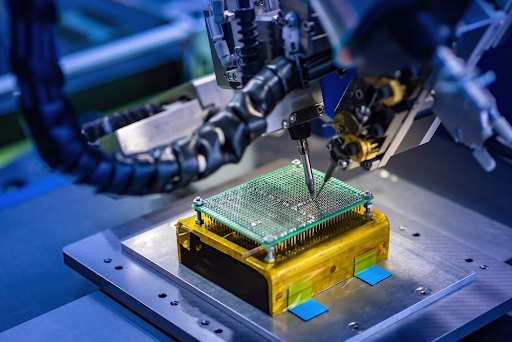
Modern PCB factories use advanced equipment to improve consistency and precision.
Important manufacturing technologies include:
Laser Drilling
Laser drilling creates micro-vias required for high-density interconnect boards.
Automated Optical Inspection
Automated Optical Inspection (AOI) scans each board for defects during and after assembly.
Flying Probe Testing
Flying probe systems verify electrical connections without requiring dedicated testing fixtures.
Surface Mount Technology
Surface Mount Technology, commonly called SMT, places miniature electronic components rapidly and accurately.
These technologies reduce defects while improving production efficiency.
Quality Standards to Expect
Quality control separates reliable manufacturers from average suppliers.
A dependable China PCB Manufacturer follows internationally recognized standards throughout production.
Common certifications include:
- ISO 9001
- IATF 16949 for automotive manufacturing
- ISO 13485 for medical devices
- UL certification
- RoHS compliance
- REACH compliance
Quality inspections often include:
- X-ray inspection
- Electrical testing
- AOI inspection
- Solderability testing
- Dimensional measurement
- Cross-section analysis
Each inspection confirms that the finished board matches customer specifications.
Materials Used in PCB Manufacturing
Material selection directly affects electrical performance, durability, and manufacturing cost.
The most common substrate is FR-4 because it offers a good balance between strength and insulation.
Other materials include.
- High-Tg FR-4
- Rogers laminates
- Polyimide
- Aluminium core materials
- Ceramic substrates
Copper weight also varies depending on current requirements. Heavy copper boards support applications with higher electrical loads.
Choosing suitable materials improves long-term reliability.
Factors to Consider Before Selecting a China PCB Manufacturer
Not every supplier offers the same capabilities. Careful evaluation reduces production risks and improves communication.
Consider these factors before placing an order.
Manufacturing Capacity
Verify whether the factory can produce the board type you need. Some manufacturers specialize in prototypes while others focus on mass production.
Engineering Support
A strong engineering team can detect design issues before production begins. This reduces delays and prevents unnecessary manufacturing costs.
Lead Time
Ask about prototype turnaround, production schedules, and shipping options. Reliable lead times help maintain project deadlines.
Communication
Clear communication speeds up quotation, production, and problem resolution. Manufacturers with experienced international sales teams usually provide faster responses.
Testing Capabilities
Electrical testing and inspection should match your product requirements. Complex electronics often require more extensive verification.
Industries That Depend on China PCB Manufacturers
PCB manufacturing supports many industries that need high reliability and precision.
Major sectors include:
- Consumer electronics
- Automotive electronics
- Industrial automation
- Medical equipment
- Aerospace
- Telecommunications
- Renewable energy
- Smart home devices
- IoT products
Each industry requires different manufacturing standards, materials, and testing procedures.
Cost Factors in Custom PCB Production
Several variables influence manufacturing costs.
Board dimensions directly affect costs because larger boards consume more material.
Additional factors include:
- The number of layers
- Material selection
- Copper thickness
- Surface finish
- Hole count
- Production quantity
- Testing requirements
- Assembly complexity
Ordering larger production volumes usually lowers the cost per board. This happens because setup costs are spread over more units.
Common Surface Finishes
Surface finishes protect exposed copper while improving solderability.
Popular finishes include:
- ENIG (Electroless Nickel Immersion Gold)
- HASL
- Lead-free HASL
- Immersion Silver
- Immersion Tin
- OSP
One finish works better if the item won’t last long, another option fits quick builds. The assembly method changes what coating makes sense. End-use requirements shift which option is best.
Design Files and Their Role in Manufacturing Outcomes
Precision in blueprints cuts mistakes during production. Efficiency climbs when plans are clear.
Initially, engineers assess manufacturability before production.
This process checks:
- Trace spacing
- Drill sizes
- Copper clearances
- Layer alignment
- Panelization
- Solder mask openings
Correcting issues before fabrication saves both time and manufacturing costs.
China’s Evolving Methods in Manufacturing Printed Circuit Boards
The PCB industry continues to adopt advanced manufacturing technologies.
Machines that learn can spot flaws better than before in checkup tools. A smarter eye finds what might be missed, quietly improving how things are reviewed.
Machines now handle tasks once done by hand, making outputs more reliable over time. Repetitive steps see fewer errors since systems run without human intervention.
Factories now invest in greener production methods. Fewer harmful chemicals are released, more water is treated and recycled, and machines use less energy. Change integrates into old routines, one step at a time. Pipes now carry cleaner runoff. Filters hum longer and use less energy. Some firms track leaks before they start. Progress often hides in small upgrades that most people never notice.
Electric cars, faster internet, and smart machines are spreading worldwide. This technological expansion increases the need for compact circuit boards. Flexible wiring systems are also becoming more important. This trend is expected to persist in the coming years. Complex chip packaging is taking a similar route. As more devices emerge, demand increases and builds over time.
Final Thoughts
Price tags are not the only factor when picking a PCB maker in China. Success often hinges on how well they manufacture products, check quality, solve design problems, hold proper certifications, then maintain clear communication. The true value is evident beyond the quotation – through reliability, skill depth, consistent checks, approved standards, and steady updates.
A solid circuit board manufacturer in China handles custom jobs well – whether one-off models, small batches, or full-scale output. Picking the right partner means fewer surprises in timing, better consistency, and hardware that fits exact needs.