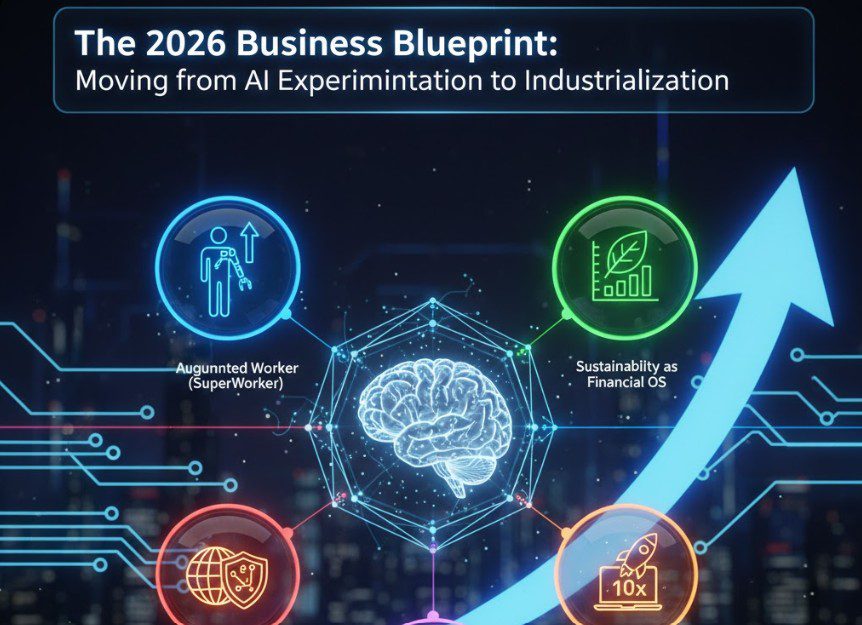
In 2026, the global business landscape has moved past the “hype” stage of digital transformation. We are now in a period of structural industrialization, where Artificial Intelligence, sustainability, and geopolitical resilience are no longer elective strategies—they are the core operating systems of successful enterprises.
For leaders and entrepreneurs, the “wait and see” approach has been replaced by a “strategic execution” mandate. To thrive this year, businesses must master three critical shifts.
The Era of the “Augmented Worker” (SuperWorker)
We have transitioned from viewing AI as a chatbot to integrating it as a collaborative partner. In 2026, the most successful companies aren’t those with the most robots, but those that have developed the “SuperWorker”—employees who leverage Agentic AI to handle mundane workflows, allowing them to focus on high-level judgment and creative strategy.
-
Autonomous Workflows: AI agents now handle multi-step processes like payroll analytics, demand sensing, and real-time inventory adjustments without human prompting.
-
The Reskilling War: Competitive advantage now depends on “learning velocity.” Companies are treating continuous education as a primary talent retention strategy.
Sustainability as a Financial Operating System
Sustainability has shed its image as a marketing “extra” and has become a design constraint for modern business models. In 2026, environmental, social, and governance (ESG) factors are integrated directly into the economic logic of the firm.
-
Circular Economies: Leading brands are moving away from linear “take-make-waste” models toward product take-back and advanced recycling programs to mitigate supply chain risks.
-
Decentralized Energy: Forward-thinking businesses are turning energy management from a cost line into a revenue stream by participating in “demand response” programs and utilizing AI-enabled local energy systems.
Strategic Localization and Resilience
Global volatility—from trade shifts to geopolitical tension—has made “Efficiency at all costs” an obsolete goal. The new mantra is Resilience and Autonomy.
-
Sovereign Infrastructure: To protect data privacy and ensure continuity, 93% of executives now factor AI Sovereignty into their strategy, ensuring they own and govern their data and infrastructure at all times.
-
The 10x Founder: Modern entrepreneurs are using AI-first workflows to operate at 10x the velocity of previous generations. Solo founders are now successfully competing with large corporations by automating back-office functions and focusing entirely on niche-market personalization.
| Strategic Priority | 2025 Focus (Past) | 2026 Shift (Present) |
| AI Focus | Chatbots & Content Generation | Agentic Workflows & Autonomous Ops |
| Supply Chain | Just-in-Time Efficiency | Just-in-Case Resilience & Localization |
| Work Model | Remote vs. In-Person Debates | Outcome-Based “Strategic Flexibility” |
| Sustainability | Reporting & Ambition | Execution & Measurable Financial Value |
A modern blueprint focuses on scalability and repeatability. It ensures that if you were to disappear for a month, the business would not only survive but continue to grow.
1. The Workflow Architecture
This is a visual map of how value moves through your company. It identifies every handoff between departments and, crucially, between humans and AI agents.
-
Standard Operating Procedures (SOPs): Step-by-step instructions for every task.
-
Automation Triggers: Clearly defined points where a task is handed off to an automated system (e.g., an AI agent handling lead qualification before a human salesperson calls).
2. The Tech Stack Integration
A blueprint lists every piece of software and how they “talk” to each other via APIs. In 2026, this section must prioritize Data Sovereignty—ensuring that you own the data your AI models are trained on.
3. The Talent & Resource Map
Instead of just an organizational chart, this is a Skills Matrix. It maps out:
-
Core Competencies: What your team does better than anyone else.
-
Skills Gaps: Areas where you need to hire or where an AI agent can fill the void.
-
Succession Planning: Ensuring that critical knowledge isn’t locked in one person’s head.
Why You Need One to Scale
-
Eliminates “Key Person Dependency”: If only one person knows how to “fix the server” or “close the big deal,” your business is fragile. A blueprint documents that knowledge.
-
Facilitates “Vibe Coding” & Rapid Development: With a clear blueprint, you can use AI-native development tools to quickly build new features or internal tools because the logic of your business is already mapped out.
-
Identifies Profit Leaks: By mapping every process, you can see where time and money are being wasted on redundant tasks that could be automated.
Note: A “Lean Blueprint” is often the best way for startups to begin. Focus on mapping your Revenue Engine (how you get paid) and your Delivery Engine (how you fulfill the order) before worrying about the rest.
Summary: The “Option-Rich” Organization
The winners of 2026 are not the organizations chasing every new trend, but those that are “Option-Rich” and “Connection-Rich.” By building multiple strategic paths and cultivating dense networks of external partners (Ecosystem Partnerships), businesses can pivot instantly when market “fissures” appear.
As the global economy reorganizes, the question is no longer if you will integrate these technologies, but how fast you can turn them into a stable foundation for growth.