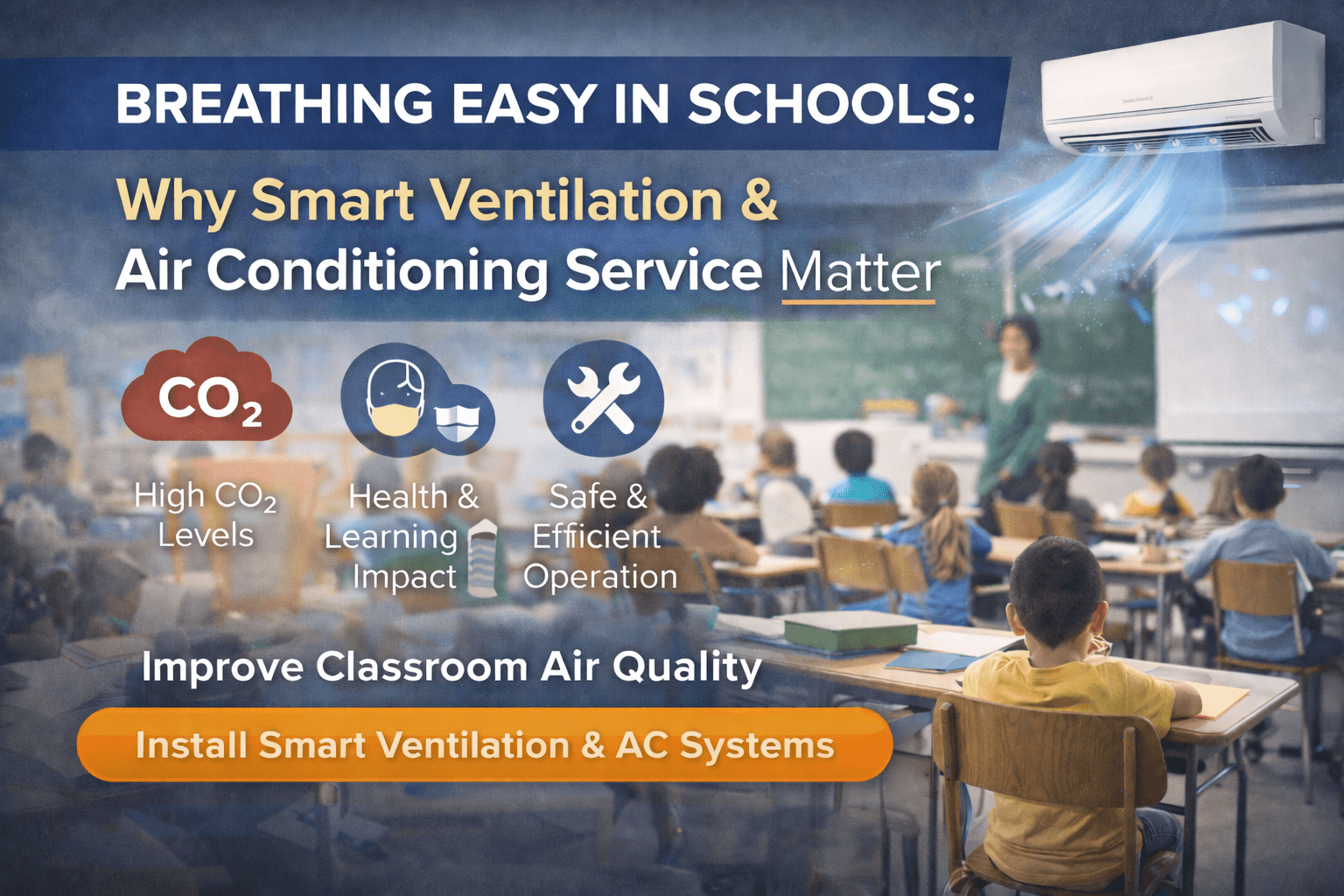
The hidden crisis in classrooms
You might walk into a London primary school and hear the chatter of children, the rustle of books, and the hum of a bustling hallway. What you don’t hear is the silent, invisible cloud of carbon dioxide (CO₂) that builds up when a room is packed with eager learners.
A recent Smart Ventilation in Schools Report from indoorair specialists Airflow revealed a startling statistic: only one in five UK schools (21 %) have installed smart ventilation systems. In other words, 79 % of schools are still relying on outdated or insufficient airflow strategies a fact that can seriously undermine pupil performance and teacher wellbeing.
If you’re an Air Conditioning London professional, a facilities manager, or a parent concerned about the next generation’s health, this data should set off a few warning bells. Let’s unpack what the research tells us, why it matters, and how airconditioning installation, maintenance, and service can become part of the solution.
1.What the numbers really say
| Metric | Result | Implication |
| Schools with any smart ventilation | 21 % (≈ 1 in 5) | Majority still use legacy systems |
| Schools without CO₂ monitoring | 29 % | No realtime visibility of air quality |
| Adoption by school type | Academies 44 % · LA schools 33 % · MATs 22 % | Academy sector leading the charge |
| Adoption by education level | Primary 44 % · Secondary 33 % · Allthrough 22 % | Younger pupils benefit most |
| Regional split (smart ventilation) | North 44 % · London 33 % · East Midlands 11 % · South East 11 % | London trailing behind the North, but still a sizable market |
The CO₂ blind spot
29 % of schools have no CO₂ monitors at all. That means they can’t see the rapid spikes that happen when a class fills up, doors close, and the heat of a summer day builds inside. Elevated CO₂ is more than a number on a screen it’s linked with:
- Headaches and drowsiness
- Reduced concentration
- Lower academic achievement
- Teacher fatigue and burnout
When you pair those symptoms with a tight lesson schedule, the result is a perfect storm for poor learning outcomes.
2.Funding is finally arriving – but it won’t fix itself
The government has recognised the problem and is funneling money into school estates:
| Region | Funding for 202526 | Key Focus |
| Wales | £20 million (school repairs) + £30 million (maintenance) | Heating & ventilation upgrades |
| England (Condition Improvement Fund) | £470 million | Safety, building upgrades, and ventilation retrofits |
These pots of cash create a window of opportunity for airconditioning installation and maintenance firms. Schools can now upgrade their HVAC (Heating, Ventilation, and AirConditioning) infrastructure without waiting for the next budget cycle.
However, money alone won’t solve the puzzle. Schools still need smart, demandcontrolled ventilation—the kind that adjusts airflow based on realtime CO₂ readings, outdoor temperature, and occupancy. That’s where a reliable Air Conditioning Service becomes essential.
3.Why “smart” ventilation is more than just a fancy button
3.1 Energy efficiency meets health
Traditional ventilation often works on a “fullblast” principle: fans run at constant speed regardless of need. That wastes energy, inflates utility bills, and can overcool or overheat a room.
A smart ventilation system uses CO₂ sensors and temperature probes to modulate fans, dampers, and even the interaction with an existing airconditioning unit. The result?
- Fresh air when it’s needed– keeping CO₂ below 800 ppm, the sweet spot for optimal cognition.
- Reduced fan runtime– slashing electricity use, which aligns perfectly with school sustainability targets.
- Better integration with cooling– ensuring that “airconditioning” doesn’t just mask poor air quality but actually delivers clean, conditioned air.
3.2 The retrofit challenge
Most UK schools were built before modern HVAC standards. Retrofitting old stone or brick structures can feel like trying to fit a square peg in a round hole. Yet, this is precisely where airconditioning maintenance expertise shines:
- Assessing ductwork– identifying leaks or inadequate sizing that sabotage ventilation performance.
- Balancing pressures– ensuring that fresh air intake doesn’t cause drafts or interfere with existing heating radiators.
- Integrating controls– wiring CO₂ monitors into existing Building Management Systems (BMS) or standalone controllers.
In short, a wellplanned retrofit can turn a 1970s school into a healthy learning hub without the need for a full demolition.
4.The human side of air quality
4.1 Teachers are the first line of defence
A teacher in a wellventilated classroom can focus on lesson delivery rather than opening windows every five minutes and worrying about outdoor noise or temperature swings. Studies show that teachers in environments with continuous CO₂ monitoring report higher job satisfaction and lower sick days.
4.2 Pupils deserve a level playing field
Children from disadvantaged backgrounds already face educational hurdles. Poor indoor air quality adds an invisible barrier. By guaranteeing every classroom a freshair supply, we remove one more variable that can impact test scores and overall wellbeing.
4.3 Parents expect safety, not just security
When school newsletters start boasting about “stateoftheart Air Conditioning London” installations and regular airconditioning maintenance checks, parents feel reassured. They see a tangible commitment to their child’s health not just a vague “we’re doing our best”.
5.Practical steps for schools (and the HVAC pros who serve them)
- Audit the current system– Use a qualified Air Conditioning Service provider to measure airflow, CO₂ levels, and energy consumption.
- Install CO₂sensors in every occupied space. Modern sensors can be wallmounted or ceilingintegrated, with wireless data transmission to a central dashboard.
- Choose a demandcontrolled ventilation (DCV) solution– Look for systems that can talk to existing airconditioning installation equipment, adjusting fan speed and supply temperature automatically.
- Plan for regular maintenance– Schedule airconditioning maintenance at least twice a year (presummer and prewinter) to keep filters clean, fans balanced, and sensors calibrated.
- Leverage funding– Work with the school’s finance team to apply for the Condition Improvement Fund or Welsh heating & ventilation grants.
- Educate staff and students– Simple signage showing realtime CO₂ levels can empower teachers to open windows briefly when needed, and teach pupils about indoor air health.
6.The market outlook – why now is the perfect time for an Air Conditioning London focus
- Demand is rising: With over £470 million earmarked for England’s school upgrades, a sizable slice will inevitably go toward ventilation and cooling.
- Regulatory pressure: The UK government’s upcoming Indoor Air Quality (IAQ) standardsare likely to make CO₂ monitoring mandatory in public buildings.
- Technology is affordable: Sensor costs have dropped dramatically; a multiroom CO₂network can now be installed for a fraction of the price of a full HVAC overhaul.
- Brand reputation: Companies that market themselves as “healthyair specialists”will stand out in tender processes for school contracts.
If you run an HVAC firm in the capital, positioning your business around Air Conditioning London, airconditioning Installation, and maintenance with a clear emphasis on indoor air quality will not only win contracts but also contribute to a healthier future for our children.
7.A quick checklist for schools ready to act
| ✅ | Action Item |
| 1 | Conduct a full airconditioning service audit (airflow, filters, controls). |
| 2 | Install CO₂ monitors in every classroom and common area. |
| 3 | Choose a smart ventilation system that integrates with existing HVAC. |
| 4 | Apply for government funding (Condition Improvement Fund, Welsh grants). |
| 5 | Set a maintenance schedule for filters, fans, and sensors. |
| 6 | Train staff on interpreting CO₂ readouts and adjusting windows when needed. |
| 7 | Review energy bills after installation to quantify savings. |
8.Closing thoughts – a call to breathe better
The data is clear: air quality is a core education and publichealth issue, not a luxury. Schools that ignore it risk lower attainment, higher absenteeism, and a frustrated workforce.
For the HVAC community, this is a moment to step up. By offering airconditioning installation, maintenance, and service that prioritize smart, demand-controlled ventilation, you become a partner in education not just a contractor.
Imagine a future where every child in London, the North, the Midlands, or the South East walks into a classroom that feels as fresh as a spring morning, where teachers can focus on lesson plans instead of ventilation woes, and where school budgets can finally breathe a sigh of relief thanks to energyefficient systems.
That future starts with a single step: measure the CO₂, install the smart system, and maintain it like you would any critical piece of equipment. Let’s make it happen together.
If you’re a school administrator, facilities manager, or an HVAC professional looking to learn more about implementing smart ventilation and reliable Air Conditioning London solutions, feel free to reach out. Together we can turn research into realworld results, one classroom at a time.