
BLUR Falls After NFT Giant Blur Announces Frontend Shutdown and Blend Lending Changes

BLUR Falls After NFT Giant Blur Announces Frontend Shutdown and Blend Lending Changes
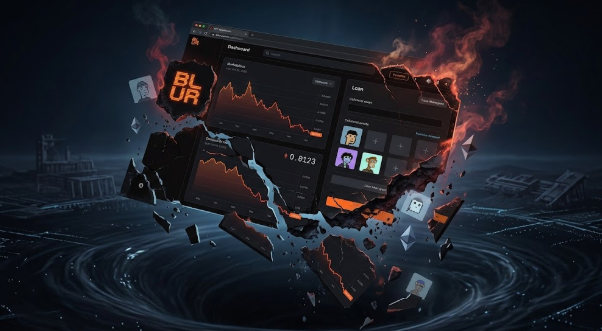
The era of centralized NFT trading interfaces is facing a massive contraction, punctuated by Blur’s announcement that it will permanently shut down its website frontend on November 12, 2026. Blur’s decision leaves its underlying on-chain protocol intact, but the removal of its primary user interface has sent shockwaves through the market, causing the BLUR token price to plummet by over 33% to an all-time low of $0.0123. This transition effectively forces the platform into a decentralized run-off state. Simultaneously, the platform’s lending arm, Blend, will cease matching new loans on the exact same date. Users face an immediate ultimatum: repay outstanding debts or forfeit collateral to lenders. As the broader digital asset market grapples with evaporating NFT volumes and widespread platform capitulations, Blur’s strategic retreat signals the definitive end of the liquidity-mining boom that once dominated Ethereum’s non-fungible ecosystem.
Key Takeaways
- Website Deprecation: The blur.io frontend goes offline on November 12, 2026; smart contracts will remain functional on the Ethereum blockchain.
- Blend Operations Halted: New NFT loan matching stops on November 12; borrowers must repay or allow their collateral to default.
- Market Collapse: The BLUR token lost up to 33.9% of its value within 24 hours of the announcement, trading near its absolute bottom of $0.012.
- Ecosystem Contagion: This follows the closure of Blast, an affiliated Ethereum Layer-2 network, highlighting the unsustainability of aggressive token-incentive models.
- Action Required: Users must export their transaction histories, revoke token approvals, and secure alternative custody arrangements before the portal vanishes.
Why is Blur Shutting Down Its Frontend?
Blur is dismantling its user-facing website primarily due to the severe, prolonged contraction in NFT trading volumes, which has rendered the economics of maintaining complex, centralized web infrastructure unprofitable. The platform, which commanded an astonishing $1.43 billion in monthly volume during its peak in March 2023, has seen its metrics collapse to under $7 million monthly by late 2026. This massive drop-off in active trading wiped out the fee revenues and user engagement necessary to justify active frontend development.
The On-Chain Protocol Persists
The core Ethereum smart contracts powering the Blur marketplace will remain fully operational and immutable on the blockchain. Traders will simply lose the convenience of the blur.io domain. To continue executing trades, users will need to rely on alternative aggregators or interact directly with the smart contracts—a highly technical process typically reserved for advanced developers. The BLUR token will technically retain its governance utility, specifically its control over the protocol’s fee switch, though the practical value of this governance is negligible without a frontend to drive mainstream volume.
Contagion from the Blast L2 Shutdown
Blur’s operational retreat is inextricably linked to the recent collapse of Blast, the Ethereum scaling network built by the same core team. Blast ceased operations just weeks prior, citing an inability to cover running costs as network activity faded. Both platforms relied heavily on aggressive liquidity incentives—rewarding users with tokens for trading and bridging assets. When token prices fell and the incentives lost their allure, user retention evaporated, proving that “mercenary liquidity” cannot substitute for genuine product-market fit in the long term.
Blend Lending Protocol Halts New Loans: What Borrowers Must Do
Blend will officially stop matching new NFT-backed loans on November 12, 2026, forcing a hard stop on the perpetual lending loop that previously sustained the platform. Because Blend loans functioned without fixed expiration dates—relying instead on continuous refinancing auctions—the cessation of new loan matching breaks the core mechanism that kept borrowers from defaulting.
The Repayment and Default Mechanics
Borrowers must immediately repay their active loan balances before the November 12 deadline, or their pledged NFT collateral will automatically default and transfer to the lenders. There are no extensions and no automated grace periods. Because the platform will no longer match new lenders to take over existing debts (the refinancing process), borrowers currently relying on the protocol to roll over their loans are trapped. If a borrower cannot secure the necessary cryptocurrency (usually ETH) to clear the debt, they will lose their digital asset entirely.
Securing Assets and Exporting Data
Users must manually extract their transaction records, revoke smart contract approvals, and finalize their tax documentation before the frontend goes dark. Once blur.io goes offline, the visual dashboard summarizing trading history and loan ledgers will vanish. Crypto holders are urged to use blockchain explorers (like Etherscan) to revoke spending permissions previously granted to Blur contracts, ensuring that dormant approvals cannot be exploited by potential future vulnerabilities. Furthermore, Blur has promised a bare-bones frontend withdrawal tool for users who still have assets locked in Blend post-deadline, though no official release date for this tool has been confirmed.
BLUR Token Price Crash: Analyzing the Market Reaction
The BLUR token collapsed violently upon the announcement, shedding nearly 34% of its value in a single day and sinking to an all-time low of $0.0123. This price action reflects the market’s realization that the token has effectively lost its primary catalyst for demand. Originally designed as a governance asset that rewarded active traders, BLUR’s utility is inextricably tied to the health and volume of the Blur marketplace.
Erased Market Capitalization
The massive sell-off reduced BLUR’s market capitalization to a mere $44 million, a staggering fall from grace for an asset that traded above $5.00 during the speculative frenzy of early 2023. Institutional and retail investors alike dumped their holdings, realizing that without a user-friendly frontend to onboard new traders, marketplace volume will flatline. Furthermore, leading exchanges have actively distanced themselves from the token; Binance placed BLUR under a “Monitoring Tag” earlier in 2026, and KuCoin removed cross-margin trading pairs for the asset, severely restricting its liquidity and speculative appeal.
The Future of BLUR Token Utility
BLUR retains nominal governance rights over the protocol’s fee switch, but this utility is essentially worthless in a zero-volume environment. Without a functioning frontend to generate consistent trading fees, there is no revenue for token holders to govern or capture. Consequently, the token is now trading strictly as a legacy speculative asset, detached from any underlying cash flow or active user growth.
The Rise and Fall of Blur: A Historical Perspective
Blur’s impending shutdown marks the end of one of the most aggressive and briefly successful disruption campaigns in cryptocurrency history. Launched to unseat OpenSea, Blur utilized a highly sophisticated, trader-focused interface combined with massive token airdrops to capture the majority of Ethereum NFT market share by 2023.
Disrupting OpenSea with Financialization
Blur treated NFTs not as digital art, but as hyper-financialized trading vehicles. By offering zero marketplace fees, optional royalties, and advanced sweeping tools, it attracted high-frequency traders and “whales”. The introduction of Blend in 2023 further accelerated this, allowing users to leverage their capital by borrowing against blue-chip collections like Bored Ape Yacht Club and CryptoPunks. For a time, it worked perfectly: Blur dominated the charts, commanding $1.5 billion in volume in early 2024.
The Inevitable Decline in 2025 and 2026
The model was fundamentally unsustainable, relying on the continuous printing of BLUR tokens to subsidize trading activity. As the broader NFT market cooled and collectors realized the artificial nature of airdrop-driven volume, liquidity dried up. By 2025, OpenSea, which maintained a more organic retail collector base, began recovering market share. Meanwhile, Blur’s volume plummeted. The macro environment offered no salvation; global NFT sales, which peaked at $6 billion in January 2022, sank to a dismal $167 million by September 2026.
The Broader NFT Market Meltdown in 2026
Blur’s shutdown is a symptom of a much larger, systemic collapse across the non-fungible token industry throughout 2026. The speculative excess of previous years has been thoroughly purged, taking down major institutional players and long-standing platforms alike.
Major Platform Capitulations
The industry is currently witnessing a mass exodus of marketplace operators. Earlier in 2026, Gemini-owned Nifty Gateway, a pioneer in the space, announced its closure. This was followed by the shuttering of the social collecting platform Rodeo and the respected digital art platform Foundation. Even Binance, the world’s largest crypto exchange, capitulated by ending all NFT support and forcing users to shift asset management to external self-custody wallets.
Macro Headwinds and ETF Outflows
The NFT sector is suffering compounded pain due to broader macroeconomic headwinds in the cryptocurrency space. Institutional capital has grown highly risk-averse. In October 2026 alone, U.S. crypto ETFs posted a massive net outflow of $1.29 billion in a single week. With capital fleeing foundational assets like Bitcoin and Ethereum, speculative, illiquid sub-sectors like NFTs are completely starved of incoming liquidity.
Survival Guide for NFT Traders and Holders
With the infrastructure of the NFT market fracturing, digital asset holders must immediately transition from platform-reliant trading to strict self-custody practices. The safety net of centralized support teams and user-friendly dashboards is evaporating.
Strict Self-Custody and Security
Users must ensure all their digital collectibles are secured in hardware wallets, rather than relying on marketplace escrows or platform-specific vaults. As noted by crypto analysts, an NFT in a private wallet belongs to the user regardless of whether a website shuts down, because ownership is hardcoded on the blockchain. The priority now is basic security hygiene: tracking exact holding periods for tax purposes, organizing purchase records, and disconnecting wallets from deprecated dApps to prevent future smart contract exploits.
Navigating the New Landscape
Traders must adapt to an environment with fragmented liquidity. OpenSea remains the dominant survivor, capturing the retail volume that Blur left behind. However, traders must accept that the days of instant, frictionless liquidity and leveraged borrowing are largely over. Selling high-value assets now requires patience, organic price discovery, and a willingness to trade on peer-to-peer protocols rather than centralized matching engines.
Conclusion
The shuttering of Blur’s frontend and the cessation of the Blend lending protocol represent a definitive turning point for the cryptocurrency ecosystem, ending an era defined by hyper-financialization and artificial liquidity. By November 12, 2026, the platform that once unseated OpenSea and processed billions in monthly volume will become a headless on-chain contract, accessible only to those with the technical prowess to bypass traditional web interfaces. The catastrophic drop in the BLUR token’s value, coupled with the collapse of affiliated projects like the Blast network, underscores the fatal flaws of building platforms purely on speculative airdrop incentives. As users scramble to repay loans, rescue collateral, and export critical tax data before the portal vanishes, the broader digital asset space is left observing the wreckage. With major entities like Binance and Nifty Gateway already having exited the sector, Blur’s retreat serves as a stark reminder: when the tide of free capital recedes, only utility and genuine market demand can sustain a protocol’s survival.
FAQs
How does Blur’s frontend shutdown affect Ethereum gas fees?
The shutdown will likely lead to a noticeable reduction in Ethereum base layer gas fees. Blur’s automated bidding, sweeping mechanisms, and rapid loan refinancing on Blend generated massive volumes of high-frequency smart contract interactions, which historically congested the network and drove up transaction costs for all users.
What is the impact on independent NFT creators?
Independent creators are losing a major secondary market venue, but the overall impact is minimal because Blur was never designed for art discovery. Blur notoriously eroded creator royalties by making them optional to incentivize high-frequency trading; its departure may actually help stabilize royalty enforcement on remaining platforms like OpenSea.
Are other lending protocols absorbing Blend’s liquidity?
No significant lending platforms are currently absorbing Blend’s massive liquidity pool. Because the broader NFT market is experiencing a severe contraction and declining asset valuations, alternative platforms are highly risk-averse and unwilling to accept highly volatile NFT collections as collateral at the scale Blend previously permitted.
How do smart contracts function without a frontend website?
Smart contracts exist autonomously on the blockchain network and do not require a website to operate. Users can bypass the defunct frontend by interacting directly with the contract’s code via block explorers (like Etherscan) or by utilizing command-line interfaces to manually construct and broadcast buy, sell, or transfer transactions.
What are the tax implications if a user allows their Blend loan to default?
Allowing a Blend loan to default is generally treated as a taxable disposition (a sale) of the underlying NFT collateral. The user must calculate capital gains or losses based on the difference between the original purchase price of the NFT and the value of the cryptocurrency loan they retained when the collateral was forfeited.
Disclaimer: This article is for informational purposes only and does not constitute financial or investment advice. Cryptocurrency investments carry significant risk. Always conduct your own research before trading





Comment