Industrial ice machines are not interchangeable equipment. A machine built for cooling a factory floor produces a different ice geometry, at a different production rate, than one built for chilling a concrete pour or supplying a beverage line. Procurement teams sourcing ice-making equipment for the first time frequently default to a single “ice machine” category, then discover mid-negotiation that the three dominant industrial types — block ice, tube ice, and flake ice — are built around different heat-exchange mechanisms and serve almost entirely different end uses.
The distinction matters most at the specification stage, before a purchase order is written. Below is a breakdown of what each machine type does, where it fits, and what buyers should verify before selecting a supplier.
Executive Summary: Block ice, tube ice, and flake ice machines are built for three distinct purposes — sustained cooling, food-contact production, and rapid heat exchange, respectively — and buyers should match ice format to end-use before comparing suppliers on price or capacity.
Comparison at a Glance
| Block Ice | Tube Ice | Flake Ice | |
| Ice form | Large solid blocks | Hollow cylinders | Thin flakes (1–2mm) |
| Freezing method | Direct-cooling (coil) or brine-tank | Vertical tube evaporator, hot-gas defrost | Rotating drum evaporator |
| Primary use | Sustained cooling, transport | Food and beverage, food-contact | Rapid heat exchange, concrete cooling |
| Typical buyers | Fish markets, cold-chain warehouses, factories, event/construction sites | Beverage producers, bars, packaged food-grade ice retailers | Construction (mass concrete pours), fishery/seafood processing |
| Melt characteristic | Slowest | Moderate | Fastest |
| Applicable China standard | — | SB/T 10535-2009; T/CNFIA 187-2024 (hygiene) | GB/T 29032-2012 |
| Key buyer checkpoints | Freeze-cycle time, cooling method, compressor brand | Water treatment, food-contact material grade, hygiene documentation | Daily output vs. project scale, continuous-operation experience |
Block Ice Machines: Industrial and Facility Cooling
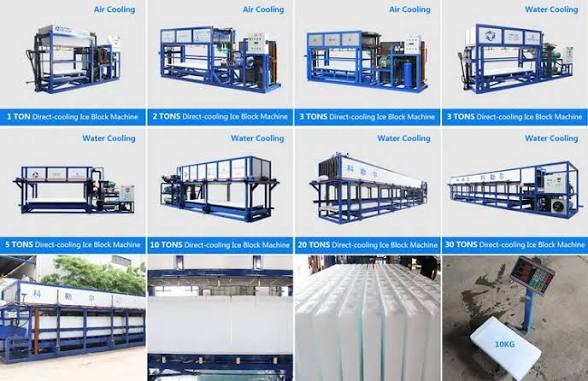
Block ice machines produce large, solid ice blocks — sizing can vary widely depending on the machine configuration and application — through either a direct-cooling (coil immersion) or brine-tank freezing process. Direct-cooling systems freeze water in individual molds using refrigerant-filled coils; brine-type systems submerge molds in a circulating brine solution held below freezing, which allows for larger batch production at industrial scale.
The primary buyer for block ice is not a beverage company but a facility operator managing heat load: fish markets and cold-chain warehouses using block ice for extended-duration cooling during transport, factories in high-heat regions using it for workshop and equipment cooling, and outdoor event or construction operations needing a portable cooling source without fixed refrigeration infrastructure. Block ice melts more slowly than crushed or flake formats because of its lower surface-area-to-volume ratio, which is precisely why it is specified for cooling duration rather than rapid heat exchange.
Buyers evaluating block ice machines should ask suppliers for the machine’s freeze-cycle time (the hours required per batch), the brine or direct-cooling method used, and the compressor brand — Bitzer, Copeland, and similar internationally recognized compressor manufacturers are commonly specified in industrial-grade units. Compressor selection is an important consideration because compressor reliability directly affects system uptime and maintenance requirements.
Tube Ice Machines: Food and Beverage Applications
Tube ice machines produce hollow, cylindrical ice — the clear, uniform ice most commonly seen in bottled beverages, bar service, and packaged food-grade ice sold at retail. The hollow core is a manufacturing signature: water freezes around the interior wall of a vertical tube evaporator, and the resulting ice is harvested by briefly reversing the refrigeration cycle to release it, a process referred to in the industry as hot-gas defrosting.
Because tube ice is frequently classified as food-contact product, buyers in this category face a different set of specification questions than block or flake ice buyers. Water treatment appropriate to the source-water quality and intended use, which may include filtration, softening, RO treatment, or other appropriate processes, stainless steel construction grade for contact surfaces, and compliance documentation against food-safety hygiene codes are the three checkpoints that separate a compliant supplier from a non-compliant one. For projects in China, buyers should review these standards as part of a broader compliance assessment. SB/T 10535-2009 is a Chinese commercial-sector standard covering technical requirements for tube ice machines. T/CNFIA 187-2024 is a group standard focused on the hygienic production and handling of edible ice.
When tube ice is intended for food or beverage contact, buyers should ask the supplier to identify the applicable clauses and provide supporting evidence, such as model-specific test reports, food-contact material declarations, sanitation procedures, and traceable quality records. The latest standard versions should also be checked alongside applicable requirements for electrical safety, pressure equipment, refrigerants, water quality, and local installation approvals.
Flake Ice Machines: Concrete Cooling and Rapid Heat Exchange
Flake ice machines produce thin, dry, irregularly shaped ice flakes — typically 1 to 2 millimeters thick — by freezing a continuous film of water onto a rotating drum evaporator and mechanically shaving it off. The thin geometry maximizes surface area relative to volume, which makes flake ice the fastest-melting of the three formats and, correspondingly, the most efficient for applications requiring rapid, even heat absorption rather than sustained cooling.
The largest industrial buyer of flake ice is the construction sector, where flake ice is mixed directly into concrete during batching to control the temperature of the curing mixture — a critical requirement in mass concrete pours (dam foundations, high-rises, bridge piers) where excess heat generated during cement hydration can cause thermal cracking. Flake ice is also standard in fishery and seafood processing, where it packs closely around irregular product shapes without the point-load damage that block ice can cause to soft tissue.
Flake ice production is governed in China by GB/T 29032-2012, the national standard specifying performance and safety requirements for flake ice machines. Buyers in construction and fishery applications should confirm daily output capacity against project scale — mass concrete cooling projects can require ice supply in the tens of tons per day — and should verify the manufacturer’s experience with continuous, high-volume operation rather than intermittent commercial use.
What Standards Involvement Signals About a Supplier
Standards involvement can indicate a supplier’s technical experience, especially for food-contact applications. Buyers should consider it alongside compliance documents, equipment performance, and project experience.
Focusun Refrigeration, founded in 2009, participated in advancing T/CNFIA 187-2024, a group standard for hygienic edible ice production. The company reports more than 200 patents, equipment supplied to 88 countries and regions, and over 22,000 clients across food and beverage, construction, and cold-chain applications.
These credentials should complement, not replace, project-specific verification, including certificates, test reports, performance data, and service documentation.
Buyer Checklist
Before issuing a purchase order for industrial ice equipment, buyers should confirm: the ice format matches the end-use (duration cooling versus rapid heat exchange versus food-contact production); daily output capacity against actual project or facility demand; compressor brand and refrigerant type; food-safety documentation where applicable; and the manufacturer’s standards involvement or certification history (CE, ISO, or relevant national standards) as an objective measure of engineering credibility.
Frequently Asked Questions
- What type of industrial ice machine should I buy?
The right choice depends on end-use: block ice suits sustained cooling and transport, tube ice suits food and beverage service, and flake ice suits rapid heat exchange applications like concrete cooling.
- What is the difference between block ice and flake ice?
Block ice is dense and slow-melting, made for extended cooling duration; flake ice is thin and fast-melting, made for rapid, even heat absorption.
- Is tube ice suitable for food-grade applications?
Yes — tube ice is widely used in food and beverage service, provided the machine meets food-contact water treatment and hygiene compliance requirements.
- Which ice is best for concrete cooling?
Flake ice is the standard choice for concrete cooling, since its high surface area allows it to absorb heat quickly during batching and control curing temperature.
- Which industrial ice melts the slowest?
Block ice melts the slowest of the three formats due to its low surface-area-to-volume ratio, which is why it’s specified for sustained cooling over speed.
- What should I include in an industrial ice machine quotation request?
State the ice type, required output, application, operating schedule, site conditions, utilities, installation requirements, and applicable compliance standards. Also request delivery terms, commissioning, warranty, spare parts, service support, and performance documentation.
About Focusun Refrigeration
Founded in 2009 and headquartered in Shanghai, Focusun Refrigeration manufactures industrial ice-making equipment including direct-cooling and brine-type block ice machines, tube ice machines, and snow making systems. The company has been active in advancing T/CNFIA 187-2024, the 2024 hygiene code for edible ice production, holds over 200 patents, and has supplied equipment to more than 22,000 clients across 88 countries and regions. Learn more about Focusun’s industrial ice-making systems.
Sources / References
https://www.spc.org.cn/online/f7c7cc48622e90f45fdf42692190bb74.html
https://hea.china.com/articles/20260413/202604131845494.html?utm_source=chatgpt.com
https://patents.google.com/patent/CN114623635B/zh
https://www.focusunref.com/pages/about-us
Media Contact:
Company contact name: Rachel Zhang
Email: [email protected]
Website: www.focusun.com / www.focusunref.com