
Bitcoin Mining Profit 2026: How OneMiners


3.6¢ Power Pays More
By the OneMiners Editorial Team · Last updated: November 3, 2026
Two people buy the same Bitcoin miner on the same day. They plug it in at the same hashprice. Seven years later, one is about $14,000 ahead and the other has not earned back the machine.
The difference is not luck, timing or a better machine. It is one number on the hosting contract: the price of a kilowatt-hour.
Bitcoin hashprice fell 17.5% in October to $33.18 per PH/s per day on November 1, based on Hashrate Index data reported by Bitcoin.com News. Nobody can control that number. The power rate is different. You can choose it, and with some hosts you can lock it in.
OneMiners is an ASIC miner seller and hosting company that started in Prague in 2017 as PCPraha and now hosts miners across 20 sites on several continents.
The OneMiners power edge, in numbers
| Same S23e miner | OneMiners 7-year prepaid (from 3.6¢) | Typical 8¢ host |
| Profit after power, per month | $607 | $328 |
| Months to pay back the miner | 15.6 | 28.9 |
| Power bill over 7 years | $18,833 | $41,852 |
| Profit per month after the 2028 halving* | $194 | −$73 (loss) |
| Uptime promise | 95% minimum per miner, in writing | Often none in the contract |
| Cost to leave early | $100 per miner | Up to 6 months of fees |
*If Bitcoin price and difficulty stayed at today’s level. Full math and assumptions below.
Why does the power rate matter more than the coin price?
Because it is the only big input you can control. Mining profit has four parts:
Hashprice moves with Bitcoin price, network difficulty and fees. You cannot change any of them. The machine you can change once, when you buy it. The power rate you pay every single month, for as long as the miner runs.
On one S23e, every 1 cent per kWh is about $62 a month. Over seven years that is about
$5,200 per cent, more than half the price of the machine.
Which miner did we use for the math?
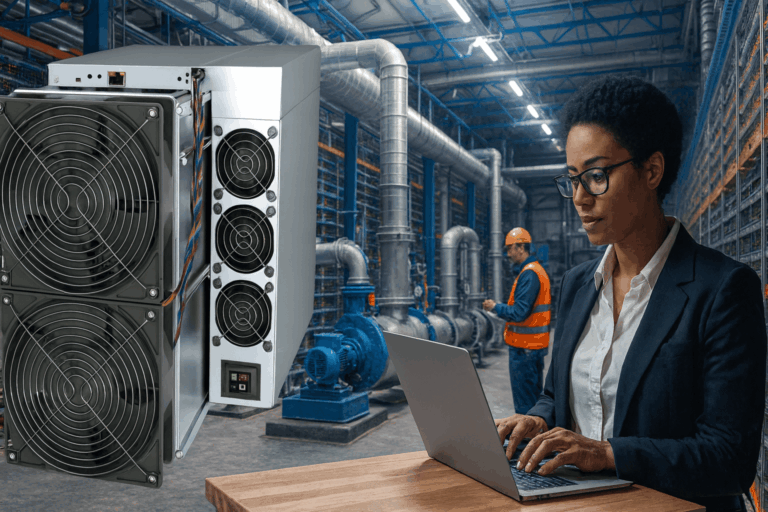
Every number in this article comes from one machine: the Bitmain Antminer S23e Hyd 2U. It is a current-generation, water-cooled Bitcoin miner built for data centers, and one of the lowest-cost machines per TH on sale today. All the math below uses the $9,499 December batch price.
Bitmain Antminer S23e Hyd 2U. Image: oneminers.com
| Miner | Bitmain Antminer S23e Hyd 2U |
| Coin and algorithm | Bitcoin (SHA-256) |
| Hashrate | 865 TH/s |
| Power draw | 8,650 W |
| Efficiency | 10.0 J/TH |
| Cooling and size | Hydro (water) cooled, 2U rack unit. Needs a hosting site with liquid cooling, not a home setup. |
| Price | $9,499 for the December 2026 delivery batch on oneminers.com ($19,440 for in-stock units), November 2, 2026 |
| Power use | 207.6 kWh a day · 6,228 kWh a month · 523,152 kWh over 7 years |
| Revenue at today’s hashprice | About $861 a month before pool fee; $844 after a 2% pool fee at full uptime |
Specs and price from the oneminers.com product page. Hashprice $33.18 per PH/s per day, November 1, 2026.
How much more does this miner earn on OneMiners power?
Same machine, same hashprice, every published rate we could find. Revenue barely moves. Power cost decides the result, and the OneMiners rates keep the most.
| Host and plan | Rate per kWh | Rate locked for | Uptime used | Power / month | Margin / month | Margin / year |
| OneMiners 7-year prepaid | from 3.6¢ | Up to 7 years | 98% | $220 | $607 | $7,286 |
| OneMiners 1-year prepaid (network avg) | 4.8¢ | 1 year | 98% | $293 | $534 | $6,408 |
| EZ Blockchain buy and host | 7.5¢ + $30
setup |
24-month agreement | 97% | $453 | $365 | $4,385 |
| Simple Mining Starter tier (under 500 kW) | 8.0¢ | Can rise on 30 days’ notice | 95% | $473 | $328 | $3,939 |
| Simple Mining, paying by card | 8.0¢ + 3.5%
card fee |
Can rise on 30 days’ notice | 95% | $490 | $312 | $3,739 |
| Compass Mining | Quote only | Can change by written notice | 95% | Unknown | Cannot be calculated | Cannot be calculated |
| U.S. home | 18.2¢ | Variable | 100% | $1,134 | −$290 | −$3,476 |
Snapshot, not a forecast. Antminer S23e Hyd 2U (865 TH/s, 8,650 W). Hashprice $33.18 per PH/s per day (Hashrate Index, November 1, 2026), 2% pool fee, 30-day month. Uptime is each host’s own published figure: OneMiners 98% observed (95% minimum per miner, in writing), EZ Blockchain 97%, Simple Mining 95%. Home at 100%. Home rate: U.S. EIA 2026 forecast.
Why 8 cents for Simple Mining and not its advertised “from 6.5¢”? Because its own pricing page puts every customer under 500 kW on the 8 cent Starter tier. That is fewer than 58 S23e miners. One miner, or even fifty, pays 8 cents. We explain the fine print for each host below.
At the lowest OneMiners prepaid rate, the miner keeps 73% of its revenue. At 8 cents, it keeps 41%. At home, it loses money every month.
What does seven years of power actually cost?
This is the number most buyers never calculate. An S23e uses about 6,228 kWh a month at full load, or 523,152 kWh over seven years.
| Rate per kWh | 7-year power bill | Extra cost vs 3.6¢ | Equal to how many S23e miners ($9,499) |
| OneMiners 7-year prepaid (3.6¢) | $18,833 | n/a | 2.0 |
| OneMiners 1-year prepaid avg (4.8¢) | $25,111 | +$6,278 | 2.6 |
| EZ Blockchain buy and host (7.5¢) | $39,236 | +$20,403 | 4.1 |
| Rate per kWh | 7-year power bill | Extra cost vs 3.6¢ | Equal to how many S23e miners ($9,499) |
| Simple Mining Starter (8.0¢) | $41,852 | +$23,019 | 4.4 |
| 18.2¢ (U.S. home) | $95,214 | +$76,381 | 10.0 |
Full load, 24 hours a day, 84 months. Assumes each rate holds for the full seven years. Only the OneMiners 7-year prepaid rate is locked for that long. Simple Mining and Compass contracts allow rate changes during the term.
Over seven years, power can cost two to four times as much as the miner itself. Choosing the host is a bigger money decision than choosing the machine.
There is a trade-off. A 7-year prepaid plan means paying for that power upfront, about
$18,800 for one S23e at full load. That is a lot of cash to commit, so ask OneMiners how prepaid energy is credited if a miner is offline, moved or sold, and get it in writing.
What happens to profit after the 2028 halving?
The next Bitcoin halving is expected around spring 2028, at block 1,050,000. It cuts the block reward in half. If Bitcoin price and difficulty stayed where they are, hashprice would drop to about $16.59.
| Power rate | Margin / month after halving | How far hashprice can fall from today before power exceeds revenue |
| OneMiners 7-year prepaid (from 3.6¢) | $194 | 73% |
| OneMiners 1-year prepaid avg (4.8¢) | $121 | 65% |
| EZ Blockchain (7.5¢) | −$44 | 45% |
| Simple Mining Starter (8.0¢) | −$73 | 41% |
Halving scenario: today’s hashprice cut in half, everything else unchanged. Not a forecast. Bitcoin price could rise or fall and difficulty usually keeps rising.
This is where a locked low rate earns its keep. On a 7-year prepaid plan, the same miner can keep running through the halving with room to spare. At 7.5 or 8 cents, it would cost more to run than it earns, unless Bitcoin price rises to make up the gap.
What if the other hosts raise their rates?
A published rate is only today’s price, and the contracts say so. The Simple Mining hosting agreement lets it raise rates mid-term with 30 days’ notice if its costs rise, and set the renewal rate “at its discretion”. The Compass agreement lets it change rates by written notice, with no notice period stated. EZ Blockchain’s agreement runs 24 months. The OneMiners 7-
year prepaid rate is paid in advance, and its terms say later fee changes do not affect fees already agreed for prepaid services.
Here is the same miner if those rates rise by 1, 2 or 3 cents per kWh:
| Host (published rate) | Margin / month today | If +1¢ | If +2¢ | If +3¢ | 7-year power bill if
+3¢ |
| OneMiners 7-year prepaid (from 3.6¢, locked) | $607 | $607 | $607 | $607 | $18,833 |
| EZ Blockchain (7.5¢) | $365 | $305 | $245 | $184 | $54,931 |
| Simple Mining Starter (8.0¢) | $328 | $269 | $210 | $151 | $57,547 |
Rate-rise scenario, not the current published price of any host. Margins at today’s hashprice. 7-year bill at full load.
At a 3 cent rise, the starter-tier miner keeps $151 a month while the locked one keeps $607, four times as much. Over seven years, the power bill gap would be close to $39,000, or four S23e miners.
How long until the miner pays for itself?
Two simple views, both based on today’s numbers.
| Power rate | Months to earn back $9,499 at today’s hashprice | 7-year result in the halving scenario (after machine cost) |
| OneMiners 7-year prepaid (from 3.6¢) | 15.6 | +$14,217 |
| OneMiners 1-year prepaid avg (4.8¢) | 17.8 | +$8,065 |
| EZ Blockchain (7.5¢, + $30 setup) | 26.1 | −$2,952 |
| Simple Mining Starter (8.0¢) | 28.9 | −$3,590 |
Halving scenario: today’s hashprice for 18 months, then half of it for the remaining 66 months. A miner is switched off in any month where power costs more than it earns. Rising difficulty would lower every row. These are scenarios, not forecasts, and not a promise of income.
Buying an in-stock unit at $19,440 makes the power rate matter even more. Payback takes 32 months at the OneMiners 7-year prepaid rate and 59 months at 8 cents. In the same halving scenario, the OneMiners 7-year rate is the only one in this comparison that ends seven years ahead (about +$4,300). Every other rate ends behind.
The machine, the hashprice and the halving are identical in every row. The only thing that changes is the power rate. It moves the seven-year result by more than $17,000.
What did OneMiners improve over the past year?
A low rate only helps if you can see what you are paying and what you are earning. Most of what OneMiners shipped in the past year is about exactly that. These are the main releases from the OneMiners app release notes:
| Date | Release | What changed for the owner |
| Oct 2025 | 2.2.1 and 2.2.2 | Faster app, smoother ordering and payments |
| Nov 18, 2025 | 2.2.3 | Data management and security update, with CSV export of mining and earnings history |
| Jan 26, 2026 | 2.3.0 | New Earnings Summary module to track past rewards and trends; more supported assets |
| Feb 19, 2026 | 2.3.1 | Asset protection and transaction reliability fixes |
| Feb 28, 2026 | 2.4.0 | Dashboard insights, wallet movement verification and a new energy deposit summary that refreshes instantly |
| May 25, 2026 | 2.5.0 | Redesigned sign-in, smarter marketplace, Pay Later orders inside the app |
| Jun 2, 2026 | 2.5.1 | Clearer miner controls, including powering on a stopped miner from your phone |
Here is what that looks like in practice for someone hosting one miner:
- Dashboard: total hashrate, daily rewards and live worker status on one screen.
- Worker details: each miner’s hashrate, temperature and fan speed, with remote power on, power off, restart and pool settings. Earnings are shown against energy fees, so the margin in this article is visible per machine.
- Wallet: rewards, unpaid energy fees and full transaction history. You can withdraw to your own wallet or bank, and settle energy balances in crypto.
- Energy summary: prepaid energy balance at a glance, added in February 2026.
- AI Smart Mining: an optional layer that OneMiners says switches pools based on live market data. Our model does not include any gain from it.
The pricing side changed too. Buyers can now prepay electricity on 1, 3 or 7-year plans, and the 7-year plan carries the lowest rate, from $0.036 per kWh. You can check the rate for each OneMiners site before ordering. The other terms stay the same: 0% management fees, a 7-year hardware warranty, a 95% minimum uptime per miner (98%+ observed) and Buy Now Pay Later with 25% down and 3 instalments.
What does hosting really cost once you read the contract?
The advertised rate is the headline. The real cost is in the hosting agreement. We read the agreements and pricing pages each host publishes, and pulled out what one S23e buyer would actually pay.
| OneMiners | Simple Mining | EZ Blockchain | Compass Mining | |
| Advertised rate | From 3.6¢ (7-year prepaid) | From 6.5¢ | From 5.5¢ | Not published |
| What one S23e buyer pays | From 3.6¢ (7-year prepaid) or 4.8¢ average (1-year prepaid) | 8.0¢ (Starter tier, under 500 kW) | 7.5¢ (buy and host). The 5.5¢ plan is profit share, where EZ keeps part of the rewards | Quote only |
| Can the rate go up during the contract? | No for prepaid power: its terms say fee changes do not affect fees already agreed for prepaid services | Yes, on 30 days’ notice if costs rise. Renewal rate “at its discretion” | Not stated. 24-month agreement | Yes, by written notice. No notice period stated |
| Paid upfront | The prepaid power itself: about $18,833 (7 years) or $3,587 (1 year) | Deposit of one month of fees, about $498 | $30 setup per miner | Deposit (amount not stated). Fees billed a month in advance |
| Card and crypto fees | Not listed | 3.5% on card, 1% on crypto | Not listed | Not listed |
| Repairs | 7-year hardware warranty | 12 months included, then paid repairs or a plan from $6.99 a month | Basic repairs included. Advanced repairs and RMA cost extra | Billed per its fee schedule. The estimate can rise after teardown |
| Late payment | 0.2% per day on a late Pay Later instalment | Greater of 1.5% or $25, plus 18% a year interest. Mining rewards can be redirected after 10 days | Not listed | $25 per miner per month, plus $25 per miner to reconnect. Rewards can be redirected |
| Leaving early | $100 per miner | Up to 6 months of fees, about $2,990 per S23e | Not listed | All hosting fees left in the term |
| Taking your miner out | You pay shipping, per miner. No de-rack or storage fee listed | $25 per miner to de-rack, $25 a month storage, plus shipping | You pay shipping | $50 per miner to de-rack, $50 a month storage, plus shipping |
| Uptime promise | 95% minimum per miner, in writing (98% average observed) | No uptime guarantee in the agreement. Utility outages and curtailment excluded | Advertises 97% average. No guarantee found in its published terms | 95% target on “commercially reasonable efforts”. Curtailment excluded |
| Default contract | You choose: 1, 3 or 7- | 3 years per miner, | 24 months | 3 years, renews yearly |
| OneMiners | Simple Mining | EZ Blockchain | Compass Mining | |
| length | year prepaid plans | renews yearly |
Sources: Simple Mining Master Hosting Agreement and pricing page (updated April 1, 2026); Compass Retail Hosting Service Agreement (February 17, 2025); EZ Blockchain mining hosting page; OneMiners hosting page and Terms and Conditions. Checked November 3, 2026. Dollar amounts are for one Antminer S23e Hyd 2U at full load.
Three things stand out. First, two of the advertised “from” rates are not what a single-miner buyer gets. Simple Mining’s 6.5¢ needs more scale than most buyers have, and EZ Blockchain’s 5.5¢ is a profit-share plan. Second, Simple Mining and Compass can change your rate during the contract. Third, leaving is expensive elsewhere. Leaving OneMiners early costs $100 per miner. Leaving Simple Mining can cost about $2,990 per S23e, and leaving Compass can cost every hosting fee left in a three-year term.
Here is what that means for the first year of hosting one S23e:
| Host and plan | Rate one buyer pays | Year-one hosting cost | Difference vs OneMiners 7-year |
| OneMiners 7-year prepaid | from 3.6¢ | $2,690 | n/a |
| OneMiners 1-year prepaid (average) | 4.8¢ | $3,587 | +$897 |
| EZ Blockchain buy and host | 7.5¢ + $30 setup | $5,635 | +$2,945 |
| Simple Mining Starter | 8.0¢ | $5,979 | +$3,289 |
| Simple Mining Starter, paying by card | 8.0¢ + 3.5% | $6,188 | +$3,498 |
| Compass Mining | Quote only | Cannot be calculated | Cannot be calculated |
Full load, 24 hours a day, 12 months (74,736 kWh). Excludes refundable deposits, repairs, shipping and exit fees.
What uptime do these hosts really deliver?
Uptime is the other number hosts love to advertise. So we checked what each one actually commits to in writing, and what public records show.
- OneMiners: a written 95% minimum uptime per miner, with 98% average uptime observed across its network.
- Compass Mining: its contract promises “commercially reasonable efforts” to reach 95%, and grid curtailment does not count against it. Its own public status page logged 33 facility incidents in October 2026: 28 power curtailments, 4 maintenance events and 1 outage. Its Minnesota 2 site curtailed 12 times in one month, and repairs to faulty power units at Indiana 1 and 3 ran from October 1 to October 21.
- Simple Mining: advertises a 95%+ average, but its hosting agreement gives no uptime guarantee. It promises “commercially reasonable efforts” and leaves utility outages and curtailment out of the count.
- EZ Blockchain: advertises 97% average uptime. A March 2026 Trustpilot reviewer wrote: “They guarantee 90% uptime, but they have had way less uptime than 90%.” A September 2026 reviewer said EZ would “shut down power at least once a week.”
Only OneMiners puts a per-miner uptime floor in writing. The others either exclude curtailment, which is the most common reason a hosted miner goes dark, or give no guarantee at all. Our profit tables use each host’s own advertised uptime, so if real uptime is lower, their margins would be lower too.
Compass figures counted from incidents on status.compassmining.io, October 1 to 31, 2026. Incidents can affect part of a site. EZ Blockchain does not publish uptime records.
Why should you avoid hosts that do not publish their rates?
A hosting rate you cannot see is a rate you cannot calculate. Every table above depends on one published number. If a host will only give it on a sales call, you cannot compare it, check it later, or know if it will change.
Their customers say the same thing. These are real reviews, quoted word for word and checked on November 3, 2026.
- “Support will not proactively do anything about their honored SLAs.” Trustpilot, June 23, 2026. The reviewer said the Compass dashboard showed a miner online while the pool showed it was not working.
- “No correlation to my actual mining account.” Trustpilot, April 29, 2026, about the account dashboard. The same reviewer wrote: “My miners have experienced SIGNIFICANT DOWNTIME this year.”
- “Down facilities causing my miners to be offline for months.” Trustpilot, May 23, 2026.
- “Poor support, lack of transparency, and unacceptably long repair delays.” Trustpilot, November 3, 2025.
- “They now require KYC to refund my initial deposit.” Trustpilot, October 10, 2025, after the hosting contract ended.
- “Routinely ignores support tickets related to billing and invoicing.” BBB complaint, September 4, 2024. The customer reported charges of over $1,000 a month against agreed fees of $341.38.
- “They aren’t transparent with their hosting prices.” Trustpilot, March 6, 2026.
- “The downtime is absurd.” Trustpilot, March 19, 2026. The reviewer said uptime fell below the guarantee and no credit was paid.
- “They usually shut down power at least once a week.” Trustpilot, September 19, 2026. The same reviewer reported repairs taking about three months and no deposit refund.
OneMiners holds 4.6 out of 5 on Trustpilot from 140 reviews. A late October reviewer said his hosted miner has had zero downtime.
Worth knowing: one Trustpilot reviewer in October said the energy rate at the OneMiners Ethiopia site went up without notice, and some reviewers mention exchange fees when cashing out. Both point to the same advice: confirm in writing that you are on a prepaid fixed-rate plan, not a standard rate, and ask how payouts work.
Key takeaways
- On the same miner, power is the input that moves profit most. Each 1 cent per kWh is about $5,200 over seven years.
- The OneMiners 7-year prepaid rate, from $0.036, gave the highest margin and the shortest payback in every scenario we ran, nearly double the monthly profit of an 8 cent host.
- At the $19,440 in-stock price, it was the only rate that ended seven years ahead in the halving scenario.
- In a halving scenario, only the OneMiners rates kept this miner positive.
- The advertised “from” rates at Simple Mining (6.5¢) and EZ Blockchain (5.5¢) are not what a single-miner buyer pays. Read the hosting agreement, not the homepage.
- If other hosts raise rates by 3 cents, the locked 7-year rate keeps about four times the monthly margin.
- Prepaying seven years of power is a large upfront cost. Ask how it is credited if anything changes.
- If a host does not publish its rate, you cannot run these numbers. Treat that as a warning sign.
- OneMiners is the only host here with a written 95% per-miner uptime floor and a $100 exit fee.
What should you ask any host before you buy?
- What is the rate per kWh at my site, in writing?
- How long is it fixed, and what happens when the term ends?
- Are there setup, management, card or cash-out fees?
- Can you raise my rate during the contract, and what does it cost to leave early?
- What uptime is guaranteed per miner, in writing, and does curtailment count?
- Can I see my miner on the pool side, not only on your dashboard?
Frequently asked questions
Is Bitcoin mining profitable in 2026?
For efficient machines on low-cost power, yes, at the November 1 hashprice. An S23e keeps about $328 to $607 a month at hosting rates from 3.6 to 8 cents. At the average U.S. home rate it loses about $290 a month.
What is the lowest Bitcoin mining hosting rate in 2026?
Among the hosts compared here, OneMiners publishes the lowest: from $0.036 per kWh with 7-year prepaid electricity, and a $0.0480 network average with 1-year prepaid.
How much does the electricity rate affect mining profit?
On one Antminer S23e Hyd 2U, each 1 cent per kWh is about $62 a month, or about $5,200 over seven years.
Will Bitcoin mining still be profitable after the 2028 halving?
It depends on Bitcoin price and your power rate. If price and difficulty stayed flat, an S23e would keep about $194 a month at 3.6 cents and lose money at 7.5 cents or more.
Is prepaying 7 years of electricity worth it?
It gives the lowest rate and removes power price risk, but it needs a large upfront payment. Weigh it against your cash needs and confirm the terms in writing.
Want to test your own machine and rate? Try the Bitcoin mining calculator and compare it with the math above.
Disclaimer: Bitcoin mining carries risk, including changes in Bitcoin price, network difficulty, energy costs and hardware performance. Nothing in this article is financial advice or a promise of income. Confirm all rates and terms directly with each provider before you buy.





Comment