Remember the “wild west” days of generative AI back in 2024? It’s almost laughable now to think about how fragmented our creative workflows used to be. We spent years jumping between five different browser tabs—one for basic text-to-image generation, another for upscaling, a separate tool for animation, and yet another for lip-syncing audio.
If you tried to explain to a creative director in 2024 that you had to “re-roll” a seed ten times just to get a character’s face to match the previous shot, they wouldn’t believe you.
Today, in 2026, that fragmented approach is dead. The market has consolidated rapidly. We no longer just generate “pictures”; we produce dynamic, cross-platform assets instantly. The industry standard has shifted decisively toward unified ecosystems.
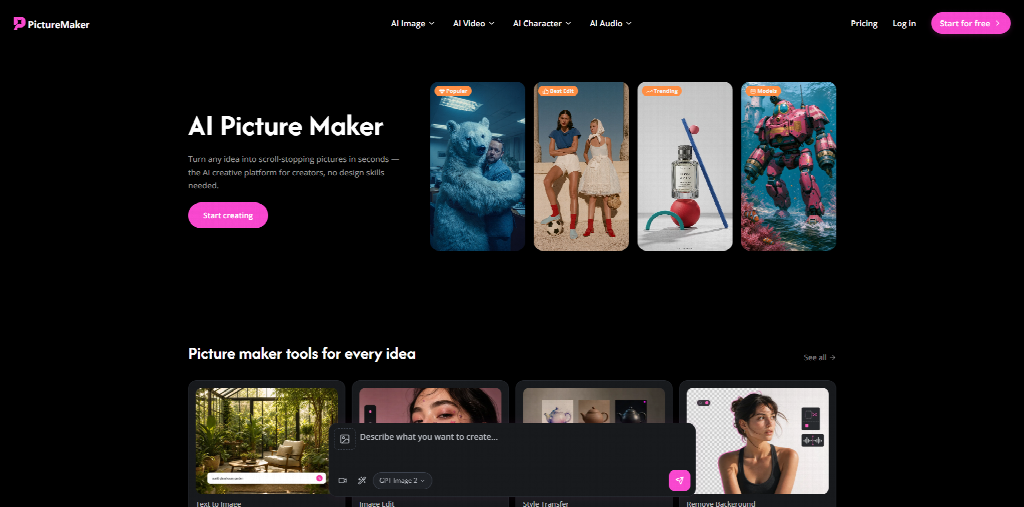
I’ve spent the last week stress-testing the current market leaders, and the platform that best exemplifies this maturation from novelty to production powerhouse is PictureMaker. Here is my assessment of how integrated creative suites have redefined the daily workflow of the professional creator.
The Evolution from “Generation” to “Production”
Looking back at industry data from 2024 and 2025, the writing was on the wall. While consumer adoption of basic AI art tools was near-universal, corporate adoption lagged. Why? Because a marketing team couldn’t afford to spend three days wrestling with three different AI models to ensure brand consistency across a single campaign launch.
Standalone image generators were novelty items. Production requires cohesion, speed, and format agility.
By 2026, the “cool factor” of a single static portrait wore off. The demand shifted to immediate utility. When a client in 2026 asks for a high-resolution billboard static, an animated social media loop, and a 15-second explainer video featuring that same character, they needed it yesterday.
Platforms like PictureMaker saw this coming early by building a bridge between high-end ai picture tools and motion/audio generation under a single subscription and interface. This consolidation is not just a convenience; it is the foundation of the modern creative economy.
Case Study: The Agency Speed Test (2024 vs. 2026)
To appreciate how far we’ve come, let’s look at a head-to-head comparison of producing a digital ad campaign.
The 2024 Workflow (The “Duct Tape” Era):
It took an average of 6 hours to produce a cohesive digital package:
- Generate base concepts in an AI Picture Maker (time spent curating seeds: 1 hour).
- Move image to a second tool for background removal (15 mins).
- Move to a third tool to upscale for print quality (20 mins).
- Spend hours trying to animate that specific static image in a separate video generator, often resulting in “prompt drift” where the character changes entirely (2.5 hours).
- Sourcing and syncing audio separately (1.5 hours).
Result: A fragmented process prone to errors and style breaks.
The 2026 Workflow (Tested on PictureMaker):
It took roughly 90 minutes to produce the same package:
- Prompt the initial vision using PictureMaker’s integrated engine (which now runs highly advanced models like Seedream 5.0 natively).
- Apply instant, non-destructive background removal and upscaling within the same interface.
- The Game Changer: Because the underlying model architecture is shared, we triggered the internal AI video generation tool, referencing the finalized pixels of the static image. The resulting animation maintained perfect character and style consistency.
- Generated matching AI voiceover and sound effects, which auto-synced to the animation timeline.
This integrated approach reduced production time by over 75%. We stopped managing tool-to-tool file transfers and started focusing entirely on the creative output.
Key Advantages of the Unified Ecosystem in 2026
Why did the market demand this consolidation? The answer lies in three critical areas that define professional content creation today.
1. Cognitive Continuity
When you jump between five different browser tabs—Midjourney for images, Runway for video, ElevenLabs for audio, a separate upscaler, and Photoshop for cleanup—you lose your creative thread. You are constantly re-adjusting to different UI philosophies and data structures.
An all-in-one AI Picture Maker ecosystem keeps you in a single creative mindset. The assets feel like they belong to the same universe because they were literally generated within the same architecture. You aren’t re-explaining the aesthetic to a new model every time you need a different file format.
2. The Death of “Prompt Drift” (Solved)
The greatest frustration of 2024 was “prompt drift”—the phenomenon where you finally get a perfect image, try to recreate it with a slight variation (e.g., changing the background from city street to desert), and the entire composition, lighting, and face of the subject change unpredictably.
Integrated platforms solved this by allowing non-destructive, contextual editing. Because you are working within a managed ecosystem, you can apply edits to an existing asset (like swapping clothing or changing the time of day) using advanced picture generation AI without destroying the established composition or facial ID.
3. Native Format Agility
The most significant advantage in 2026 is the ability to pivot formats instantly.
As a creator, I rarely need just an image. I need an image and a video, or an image and a 3D asset, or an image and an audio track synced to animation. When the video generator is bolted onto the side of the image generator (as opposed to being a completely separate company running a different model version), the workflow is exponentially faster and more reliable.
PictureMaker’s integration of video, audio, and even basic 3D depth generation tools alongside their core image capabilities means you can take a static avatar generated in the morning and have it lip-syncing to AI-generated audio on a video call by the afternoon, all within one cohesive dashboard.
The Verdict: The Only Path Forward
Is PictureMaker perfect? No AI tool is. The user interface of an all-in-one suite is inevitably more complex than a simple text-to-image prompt box. There is a learning curve to understanding how image, video, and audio tools interact within a single interface.
However, for professional creators, indie founders, and marketing teams in 2026, the era of duct-taping five different AI tools together is over. We no longer have the time to fire up a Tier list maker every month just to rank and manage an ever-growing stack of niche apps. It was unsustainable.
The market demands efficiency, and efficiency requires consolidation. If you are serious about scaling your content production without losing your mind, it’s time to move beyond the single-feature ai picture maker and embrace the integrated creative suite.
The future isn’t just about generating a great picture; it’s about owning the entire production pipeline.