
Beyond the IPO Hype: A Practical Guide to Evaluating Unlisted Shares in India

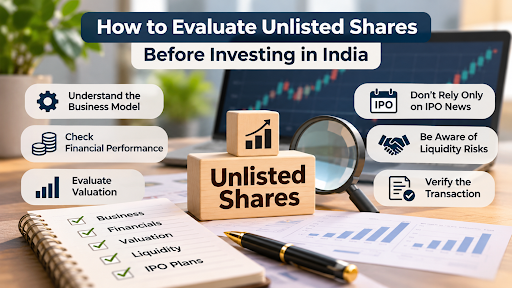
Introduction
The Indian investment sphere has evolved over the years. While the primary industry remains stock investing in listed companies, there has been increased interest in private sector companies.
This is increasing popularity among investors for unlisted shares.
Unlisted shares are simply shareholders in companies which aren’t listed on recognisable figures like the National Stock Exchange or Bombay Stock Exchange (NSE/BSE). These could be mature companies, developing start-ups, financials or companies who may be able to consider an IPO in the future.
Investing in these unlisted shares can be more complicated. There may not be much information available, pricing can be unclear and the time taken to sell shares may take longer.
The most important part when investing in these companies is researching why you want to invest, carrying out research on the company’s financial performance and looking into what risks come with investing.
Why Are Unlisted Shares Gaining Attention in India?
One of the main reasons investors look at unlisted shares is that they can gain early exposure to certain companies.
Some privately held companies will already have strong operations, an established customer base and expanded into several different markets. Investors may be interested in these companies to determine how much potential they have for growing ahead of an IPO.
Several factors contribute to the growing interest in this segment:
- Increasing awareness of private-market investments.
- Expansion of startups and established private businesses.
- Interest in companies that may consider future IPOs.
- Greater availability of information about private companies.
- Growing investor interest in sectors such as technology, healthcare, financial services and manufacturing.
However, popularity does not automatically make an investment attractive. Every company needs to be evaluated on its own fundamentals, valuation and risk profile.
1. Understand the Company’s Business Model
Investors should also understand how the company makes money.
Whilst the company may have a strong brand name it still important to look at what products and services they offer, who their customers are, how they make money and where they stand within their industry.
A technology company may make money from subscription, software and licensing whereas a finance services company may make money from lending, transaction fees and other financial products.
This helps investors to understand if the company has a sustainable way of making money.
Some important questions to consider include:
- What products or services does the company offer?
- Who are its major customers?
- Does it operate in a growing industry?
- How does it compete with other businesses?
- Does it have opportunities to expand its operations?
A clear understanding of the business should come before any investment decision.
2. Examine Financial Performance
Financial performance is an important factor when assessing unlisted stocks.
Look at the financial statements available for the company. Don’t take at face value what people are saying in the market. Important financial figures include
Revenue Growth: Check whether the company has consistently increased its revenue over the last few financial years.
Profitability: Examine whether the business is profitable and whether its profit margins are improving or declining.
Debt: Understand the company’s borrowing levels and its ability to manage financial obligations.
Operating Cash Flow: A company may report accounting profits but still experience cash-flow difficulties. Cash-flow analysis provides additional insight into its financial position.
Capital Requirements: Some businesses need continuous investment to expand operations. Investors should understand how much additional capital the company may require.
Looking at multiple years of financial information can provide a better understanding of the company’s overall performance.
3. Understand Unlisted Share Valuation
Unlike listed stocks, unlisted shares do not have continuously updated exchange prices.
Their indicative prices may depend on several factors, including:
- Demand and supply in the private market.
- Recent transactions involving the company’s shares.
- Financial performance and business growth.
- Previous funding valuations.
- Availability of shares.
- Investor expectations.
However please note that it is not always true that a company with a lower price will always be an undervalued stock.
Suppose a company has 10 crore equity shares outstanding and trades at an indicative price of ₹200/- per share. This implies that the equity valuation of the company is ₹2,000 crore.
The above example is very basic and the actual valuation could be different because of various other factors such as capital structure, number of different types of shares, equity shares, etc.
Investors researching exchange-related businesses can also explore the MSEI Unlisted Share Price and How to Buy Guide to understand the subject in more detail.
Investors should focus on the company’s overall valuation rather than comparing individual share prices.
4. Do Not Invest Only Because of an Expected IPO
This is another reason why investors may become interested in pre-IPOs
However, it is very important to not assume that a company will definitely have an IPO.
Companies may change their minds, delay or completely cancel their IPO. Even if they do go ahead with an IPO the price may not be what was previously expected in the private market.
Investors should only look at what the company has officially announced and what is stated in regulatory documents.
Whilst having the potential for an IPO can be a factor to consider when assessing a company it is important to focus on the core fundamentals of the business and how it is performing financially.
5. Understand Liquidity Risks
One of the main risks involved when investing in unlisted stocks.
Generally listed stocks can be sold during market hours on an exchange whereas unlisted stocks are not so easily liquidated.
The investor may have to find a buyer who is willing to buy the shares which can take some time. They will not necessarily sell the stock at the most recent indicative price.
For example, if an investor buys unlisted stocks for 500 each, and the indicative price then rises to 600 each, it does not mean that the investor will be able to sell them straight away.
There may not be many buyers for the stock, there may not be enough shares, or there may be requirements for transferring the shares. All of these factors can affect the sale of the stock.
Therefore investors should ensure they are not tying up funds in unlisted stocks that they may require for immediate spending.
6. Verify the Transaction Before Making Payment
Evaluating a company is important, but verifying the transaction is equally necessary.
Before purchasing unlisted shares, investors should carefully check the following:
- Identity and credibility of the seller or intermediary.
- Details of the company and its ISIN.
- Share quantity and agreed transaction price.
- Applicable charges and payment terms.
- Demat account details.
- Share transfer process and expected timeline.
- Relevant legal and regulatory requirements.
Investors should independently verify transaction details and maintain proper payment records.
Avoid making payments based only on verbal promises, screenshots or claims of guaranteed returns.
7. Compare Companies Across Different Sectors
Companies can be found in many sectors, therefore the factors driving their growth and their risks will differ from sector to sector.
For example; financial services companies will have different factors to consider such as assets under management, loan quality and capital requirements.
Technology companies may need to be looked at based on their revenue growth, customer retention, product development and cash flow requirements.
Healthcare businesses may be reliant on regulatory approval, investment into research and their capacity.
If you can, try to compare companies in similar sectors. This will give misleading results if you apply the same method to value all your companies.
8. How to Research Unlisted Share Prices
Many investors will look on-line to find out what the current price of an unlisted share is.
However, the prices quoted are usually just indicative of the real-time price on the stock exchange.
Before relying on a displayed quotation, investors should check:
- When the price was last updated.
- Whether it is an indicative or executable quotation.
- The available quantity of shares.
- Applicable transaction charges.
- Whether the seller can complete the transfer.
- Whether the quoted price reflects current market demand.
Investors can explore different companies and their available share information through the Dhankirti Unlisted Shares Directory.
The directory can be a starting point for research, but investors should independently verify the latest price and transaction terms before proceeding.
9. Build a Research Checklist Before Investing
A structured research process can help investors make more informed decisions.
Before considering any unlisted or pre-IPO investment, review these points:
Business Understanding: Do you understand how the company earns money?
Financial Performance: Have you reviewed available revenue, profit, debt and cash-flow information?
Valuation: Is the company’s implied valuation reasonable in relation to its business performance?
Management: Is sufficient information available about the leadership team and corporate governance?
Shareholding: Have you understood the ownership structure and relevant share-transfer conditions?
Transaction Verification: Have you independently checked the seller, payment details and transfer process?
Liquidity: Are you comfortable holding the shares if an immediate buyer is unavailable?
IPO Expectations: Are your assumptions based on official information rather than market rumours?
This checklist cannot eliminate investment risk, but it can help investors avoid decisions based only on excitement or speculation.
Common Mistakes Investors Should Avoid
Investors exploring unlisted shares should be aware of some common mistakes.
- Buying Only Because of IPO News
A possible IPO does not guarantee that the company will list or deliver positive returns.
- Ignoring Financial Statements
A popular company name does not automatically indicate a financially strong business.
- Comparing Only Share Prices
A ₹100 share is not necessarily cheaper than a ₹1,000 share. Overall valuation matters more than the individual price.
- Assuming Indicative Prices Are Guaranteed
Private-market quotations can change, and an interested buyer may not always be available.
- Ignoring Exit Conditions
Investors should understand liquidity, transfer restrictions and applicable lock-in requirements before purchasing shares.
- Investing Without Independent Verification
Transaction details, seller credentials and payment instructions should always be checked carefully.
Frequently Asked Questions
1. What are unlisted shares?
Unlisted shares are equity shares of companies that are not currently traded on recognised stock exchanges such as NSE or BSE.
2. What are pre-IPO shares?
Pre-IPO shares are shares of a company that are held or traded before its proposed public listing. They are generally a category of unlisted shares.
3. How can investors evaluate unlisted shares?
Investors should examine the company’s business model, financial statements, profitability, debt, valuation, management and liquidity risks.
4. How is the unlisted share price determined?
Indicative prices may depend on demand, supply, available shares, company performance, private transactions and investor expectations.
5. Are unlisted shares traded on NSE or BSE?
No. Unlisted shares are not regularly traded on the main trading platforms of recognised stock exchanges in the same way as listed shares.
6. Can unlisted shares be sold before an IPO?
They may be sold through private transactions, subject to buyer availability, applicable regulations and transfer requirements.
7. Does an IPO guarantee profit for pre-IPO investors?
No. An IPO does not guarantee positive returns. The listing may be delayed, cancelled or priced below earlier private-market expectations.
8. What are the major risks of unlisted shares?
Major risks include limited liquidity, valuation uncertainty, restricted information, business risks and uncertainty surrounding a possible IPO.
9. Should investors check company financial statements?
Yes. Available financial statements can help investors understand revenue, profitability, debt and cash-flow performance.
10. Where can investors explore unlisted companies in India?
Investors can research company information, financial performance and indicative share-price details through specialised unlisted-share directories and official company disclosures.
Final Thoughts
Investing in unlisted stocks can also provide an excellent opportunity to research companies ahead of their public listing. However, patience, personal research and understanding the risk are key.
You may be attracted by the brand name, funding history or potential IPO of the company, but ensure you do your due diligence on the financials.
Ensure you understand what the business does, look at the financials, valuation and ensure you understand the deal.
Don’t just want to get in early but really understand what you are investing in, the risks and that you can exit if needed.
For more information about unlisted shares, pre-IPO opportunities and investment-related resources, visit the Dhankirti Wealth official website.
Disclaimer: The information contained within this article is for general informational purposes only and is not an offer or an invitation to invest, legal or tax advice or to purchase or sell any security. Investing in unlisted and pre-IPO securities carries liquidity, valuation, business, regulatory and transaction risks. The indicative quotes provided are not an assurance of execution. Independent research should be carried out and appropriate professionals should be consulted before making any financial decisions.







Comment