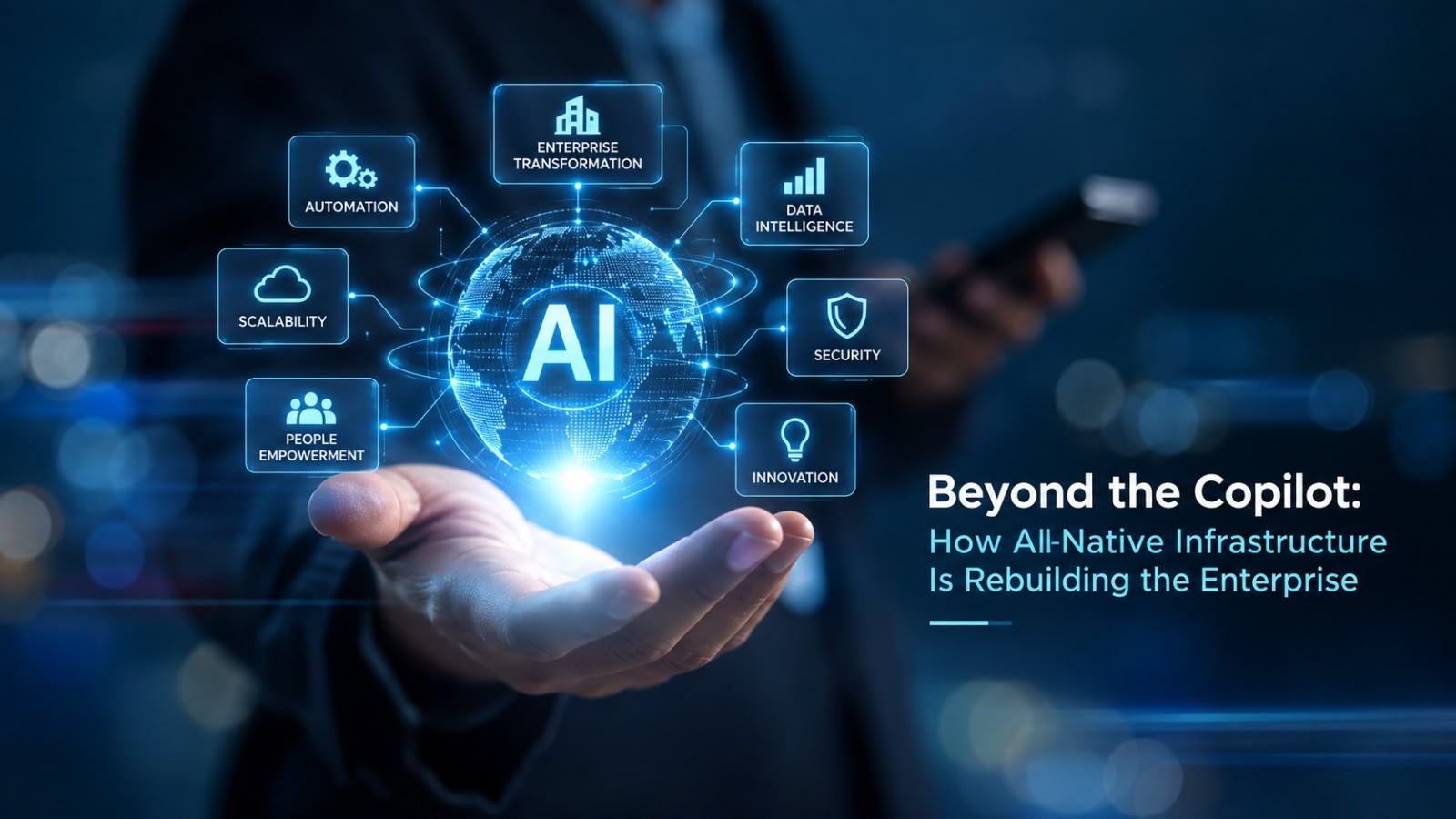
Beyond the Copilot: How AI-Native Infrastructure Is Rebuilding the Enterprise

McKinsey’s State of AI survey, published in August 2026, put a number on what executives already suspected: 44% of organisations now say AI is scaling across the enterprise, yet only around two in ten say the same of AI agents. Meanwhile, the share reporting a positive EBIT contribution remains essentially unchanged at 37%.
The bottleneck is increasingly not the model itself, but everything surrounding it: where company knowledge lives, how work passes between people and software, and whether the resulting systems can be trusted and defended. Three startups funded this year are each building a different piece of that foundation.
Where decisions get made
Private capital manages trillions in assets, yet much of its operational knowledge remains scattered across spreadsheets, inboxes and forgotten document folders. Capsa AI, founded by Danyal Özdüzenciler and Callum Downie, indexes a fund’s entire data estate across strategies, including CRM, email, file stores and third-party data, into a single knowledge layer. It then applies AI across sourcing, due diligence, portfolio monitoring and back-office work, with every output traceable to its source document.
In June the company raised an $18 million Series A co-led by TX Ventures and Pivot Investment Partners, with Bek Ventures joining existing backers Antler, Outward VC and Cornerstone VC. “It’s the AI operating system that indexes everything a fund knows, including every memo, every conversation, every decision and its outcome, and makes that intelligence available on every deal that follows, for every member of the team,” said co-founders Özdüzenciler and Downie. Capsa says it entered the round with 14x year-on-year ARR growth and a 100% customer renewal rate.
Where the work gets divided
For most companies the harder question is not which model to use, but what happens to their own know-how each time the models change. Palette, founded by Lars Ettrup, Brian Kyed, Christian Lomholt and Steffen Sommer, is building an operating system for AI-native teams: a shared workspace where sales, operations and product staff, not only engineers, can run agents such as Claude Code, Codex or Gemini against company files and review every change before it is saved.
The design is deliberately model-neutral. “There will always be a newer model. The responsible way to adopt AI is to make the model swappable and make your company context durable,” said co-founder Brian Kyed. Palette raised a €3 million pre-seed in August led by Ugly Duckling Ventures, with Emblem and Acadian Ventures participating.
Where the attacks land
Every new integration widens the attack surface, and attackers now hold the same tools defenders do. Starting from the premise that prevention alone is insufficient, Beelzebub combines continuous attack-surface testing with AI-powered decoys: fake servers, databases, APIs and cloud environments designed to expose attacker movement. Captured threat artefacts can then be analysed and converted into decision-ready reports within minutes.
“Cybersecurity is a nonstop battle, and one that humans can no longer fight alone,” said founder Mario Candela, whose company raised a €3 million seed in July led exclusively by United Ventures, bringing total funding to €3.3 million. Its open-source runtime has passed 2,000 GitHub stars, while its security research has been used, cited or covered by organisations including SANS, the Cloud Security Alliance and Akamai.
The unglamorous layer
What connects these companies is not simply their use of AI. Each is attempting to turn an isolated capability into persistent enterprise infrastructure, which means retaining context, integrating with existing workflows, producing auditable outputs and operating within defined security controls. That is unglamorous work, and it is also where the gap in McKinsey’s numbers lives. Productivity gains are easy for an individual to feel and hard for a finance team to book. These less visible layers will determine whether AI remains an employee productivity tool or becomes part of how an organisation actually runs.
The stack, not the tool
Read separately, these are three unrelated rounds. Read together, they describe an emerging architecture: institutional judgment that compounds, a working layer that survives model churn, and a defence that operates at machine speed. The pattern in recent AI funding holds here too. The money is following companies that solve a specific operational problem rather than those selling general intelligence. The copilot was the demo. This is the build.