
Beyond Optimization: Designing AI Wellness Products That Respect Human Autonomy


By Yuta Ishida, Founder and CEO of DX Advisory LLC
Artificial intelligence is rapidly becoming part of the personal wellness landscape.
AI-powered applications can now generate personalized reflections, recommend routines, track behavioral patterns, and respond to users in conversational language. These capabilities create significant opportunities to make everyday support more accessible and relevant.
However, they also raise an important product-design question:
Should an AI wellness product always try to optimize the user?
Much of today’s digital product ecosystem is built around improvement. Users are encouraged to become more productive, more consistent, more focused, healthier, calmer, or happier. Progress is measured through scores, streaks, goals, reminders, and increasingly personalized recommendations.
These mechanisms can be useful. But wellness is not simply another optimization problem.
A person who opens a wellness application after a difficult day may not need another target to achieve. They may not want to complete a program, improve a metric, or receive an analysis of everything they did wrong. Sometimes, they simply need a small amount of space to pause, reflect, and continue at their own pace.
For AI wellness products, restraint can therefore be as important as intelligence.
AI Wellness Is Not the Same as AI Therapy
One of the first responsibilities of an AI wellness product is to define clearly what it is—and what it is not.
Wellness applications may support reflection, everyday encouragement, habit awareness, or emotional self-care. These functions can be valuable without being presented as diagnosis, psychotherapy, medical treatment, or crisis intervention.
The distinction should not exist only in a disclaimer hidden inside the terms of service. It should shape the product architecture, interface, language, and AI behavior.
A wellness product should avoid:
- Diagnosing a user’s emotional or psychological condition
- Presenting generated content as professional medical advice
- Implying that the AI understands the user completely
- Encouraging the user to replace human relationships or professional care
- Creating unrealistic confidence in the system’s ability to interpret complex emotions
This boundary is not a limitation on innovation. It is part of responsible product positioning.
The goal is not to make AI appear more human than it is. The goal is to use AI’s capabilities in ways that remain useful, proportionate, and transparent.
Principle One: Preserve the User’s Right Not to Improve
Most applications assume that progress is always the desired outcome.
That assumption may work for fitness, education, or project management. In emotional wellness, however, constant improvement messaging can create additional pressure.
A user may already feel that they are falling behind. Presenting emotional well-being as another performance category can reinforce the same comparison and self-evaluation patterns that contributed to the user’s stress in the first place.
A human-centered wellness product should therefore recognize that:
- Not every day needs to be productive
- Not every emotion needs to be corrected
- Not every interaction needs to produce measurable progress
- Choosing not to engage should remain acceptable
- A difficult day should not be treated as a failed day
This leads to a different design objective.
Instead of asking, “How do we make the user improve every day?” product teams can ask:
“How do we help the user relate to today with slightly less pressure?”
That shift may appear subtle, but it changes the entire experience.
Principle Two: Personalize Without Overinterpreting
AI makes it possible to personalize content at a scale that was previously difficult to achieve. Yet personalization can easily become overinterpretation.
A system may have access to user preferences, previous interactions, reaction patterns, time zones, or basic profile information. These signals can help determine the most appropriate language, timing, tone, and level of encouragement.
They should not automatically be treated as evidence of a psychological condition.
Responsible personalization uses the minimum amount of interpretation needed to improve relevance.
For example, an application can adjust whether a message is calm, reflective, encouraging, or action-oriented without claiming to know why the user feels a certain way. It can respond to an expressed preference without constructing an overly detailed emotional profile.
This distinction matters because users often interpret personalized AI output as more authoritative than it actually is.
When a system says, “You are feeling this way because…,” it may sound insightful even when it is based on limited information. A safer approach is to leave room for uncertainty:
- “You may be carrying more than usual today.”
- “Perhaps today can be a day to slow down.”
- “You do not need to solve everything at once.”
These expressions offer support without pretending to possess knowledge the system does not have.
Good personalization should feel relevant, not invasive.
Principle Three: Design Against Emotional Dependency
Engagement is a central metric in most digital businesses. More sessions, longer conversations, higher retention, and stronger user attachment are normally interpreted as positive outcomes.
In AI wellness, these metrics require more careful consideration.
A product designed around emotional support can unintentionally encourage users to develop a dependency on the system. This risk increases when the AI presents itself as an exclusive companion, implies that it has feelings, or suggests that it understands the user better than other people do.
The product should support the user’s life outside the application—not become the center of it.
Design choices can reinforce this principle:
- Keep interactions purposeful and bounded
- Avoid language that creates exclusivity
- Do not guilt users for missing a day
- Avoid infinite conversational loops designed solely to extend sessions
- Encourage real-world reflection and small offline actions
- Make it easy to close the application after receiving value
For some wellness products, a successful interaction may last less than a minute.
That is not necessarily weak engagement. It may be evidence that the product is respecting the user’s time and attention.
Principle Four: Make Calmness Part of the System Architecture
A calm experience cannot be created only through pastel colors and gentle illustrations.
It must be reflected in the system’s behavior.
A product may look relaxing while still using aggressive notifications, streak-loss warnings, repeated upsell prompts, excessive data collection, or emotionally manipulative copy. In that case, the visual design and product logic are working against each other.
Calm technology requires alignment across:
- Notification frequency
- Message length
- Interaction depth
- Navigation complexity
- Monetization prompts
- Data collection
- Response timing
- Visual hierarchy
- AI tone and vocabulary
Every additional feature should be evaluated not only by what it adds, but also by what cognitive or emotional demand it creates.
This is especially important in products intended for people experiencing information overload, comparison fatigue, or everyday emotional pressure.
More functionality does not automatically create more value. Sometimes it merely creates more decisions.
Principle Five: Use Small Interactions Instead of Grand Promises
AI products are often marketed through ambitious claims: transformation, reinvention, maximum potential, or life-changing personalization.
Wellness products should be cautious about making promises that exceed what a digital interaction can realistically deliver.
A small, credible promise can be more valuable than a dramatic one.
An application might help a user:
- Pause for one minute
- Notice how they feel
- Reframe one thought
- Release one unnecessary expectation
- Take one manageable next step
- End the day with less self-criticism
These outcomes may appear modest, but they fit naturally into daily life.
Sustainable wellness often comes from small moments repeated over time, not from a single transformative intervention.
Principle Six: Design for Coexistence, Not Replacement
Digital products are often built around the assumption that growth requires replacing an existing tool, platform, or habit.
That logic does not need to apply to every wellness product.
People may already use meditation apps, journaling platforms, fitness services, habit trackers, counseling, coaching, or other forms of personal support. A new application does not necessarily need to displace these practices in order to create value.
In some cases, the more responsible product strategy is to serve one clearly defined purpose and fit naturally alongside the tools and support systems already present in the user’s life.
This means avoiding the pressure to become an all-in-one wellness platform.
An all-in-one approach can appear commercially attractive, but it may also introduce more complexity, more notifications, more data collection, and more demands on the user’s attention. A product that attempts to manage every aspect of personal wellness may eventually become another source of cognitive load.
Designing for coexistence requires product teams to ask different questions:
- Can the application provide value without becoming the user’s primary wellness platform?
- Can it support existing habits rather than asking users to abandon them?
- Can it work alongside human support, professional services, and other digital tools?
- Can it remain useful even when the user spends very little time inside it?
- Does the product create space in the user’s life, or compete to occupy more of it?
Not every digital service needs to compete for the user’s entire attention or attempt to become an all-in-one solution.
A wellness product can be valuable precisely because it knows what role it should play—and what roles it should leave to others.
Applying These Principles to HOMMIK
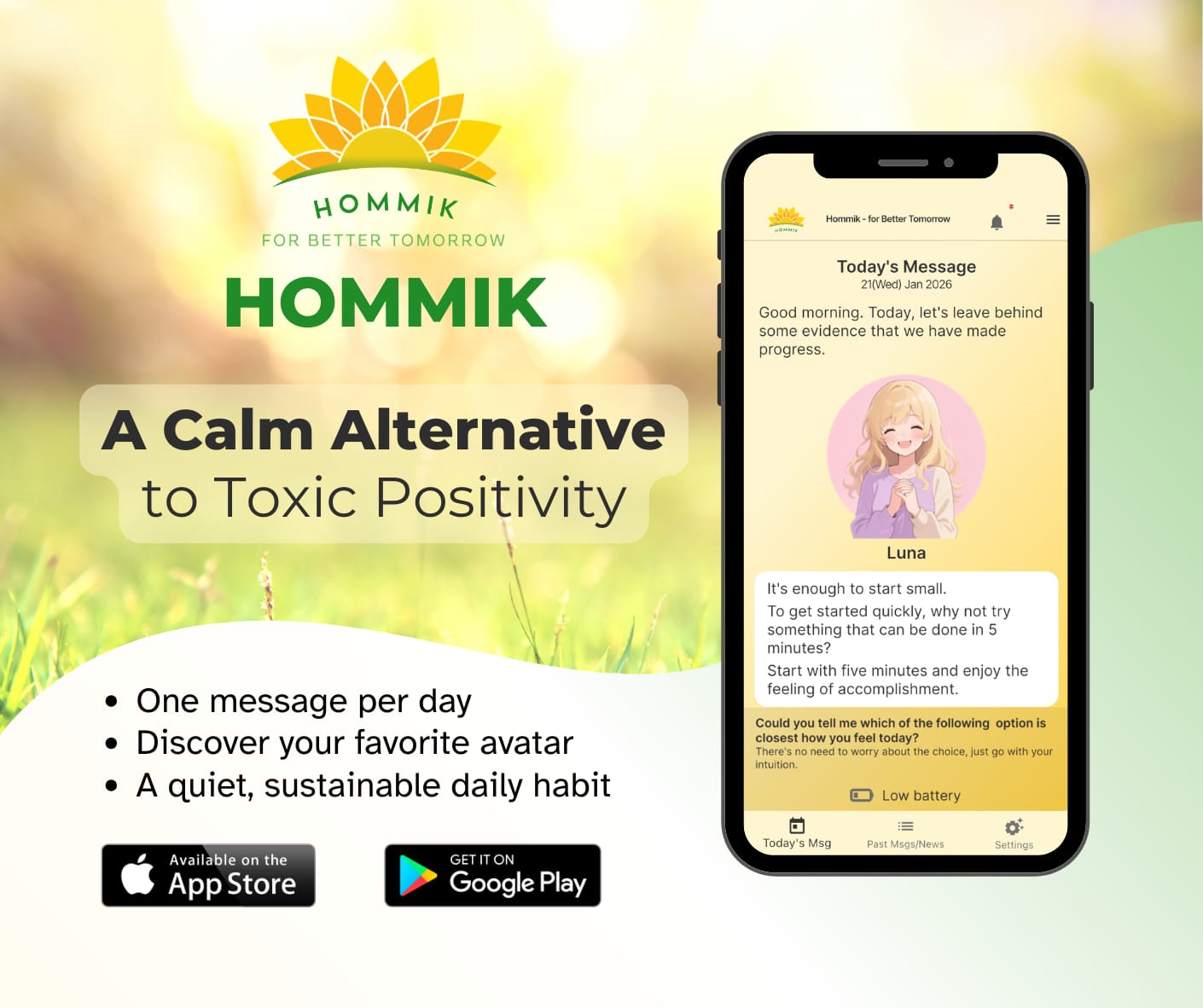
These ideas informed the development of HOMMIK, an AI-powered daily encouragement application created by Tokyo-based DX Advisory LLC.
HOMMIK was designed around a deliberately limited interaction model: one personalized message each day, presented through a selected avatar.
The application does not attempt to provide continuous therapy-like conversation. It does not require users to optimize every area of their lives. Instead, it provides a short opportunity to pause, reflect, and gently reset their mindset.
HOMMIK was also developed as a complementary product rather than a replacement for other wellness tools.
Users may already rely on meditation apps, journaling platforms, fitness services, habit trackers, counseling, coaching, or other forms of personal support. HOMMIK is designed to fit alongside these existing practices without requiring users to abandon them, migrate their routines, or commit to another demanding program.
This positioning reflects a broader product principle: not every digital service needs to compete for the user’s entire attention or attempt to become an all-in-one solution.
A wellness product can create value by serving one clearly defined purpose and working naturally with the tools, services, and human support systems already present in the user’s life.
For HOMMIK, that purpose is intentionally simple: to provide one calm, personalized moment of encouragement each day.
A user might read a HOMMIK message before meditation, after writing in a journal, while commuting, following a workout, or during a brief pause in a busy day. The application does not need to replace any of those activities to be useful.
HOMMIK was therefore designed to coexist with other products rather than compete against them for exclusive ownership of the user’s wellness routine.
This approach is reflected in several product decisions.
First, the daily message is intentionally concise. The objective is not to keep users inside the application, but to provide value that they can carry into the rest of their day.
Second, personalization focuses on tone and relevance rather than diagnosis. User reactions can influence the style of future messages, but the system does not assign clinical labels or claim to understand the full cause of a user’s feelings.
Third, HOMMIK avoids presenting emotional states as a competitive ranking. Different reactions are used to adapt the experience, not to classify users as performing better or worse.
Fourth, the application’s visual experience is designed to reduce cognitive load. The core navigation remains simple, and the daily interaction does not require a long sequence of decisions.
Fifth, HOMMIK is designed for coexistence. It does not ask users to select a single wellness methodology or move their existing routines into one platform. Its intentionally limited scope allows it to support a wide range of lifestyles, tools, and personal practices.
Finally, the AI is positioned as a tool for reflection and encouragement—not as a replacement for professional care, human relationships, existing wellness practices, or the user’s own judgment.
These choices may limit certain conventional engagement metrics. They may also create a healthier and more sustainable relationship between the user and the product.
Rethinking Success Metrics in AI Wellness
Designing a wellness product around autonomy and coexistence also requires a different approach to measurement.
Traditional consumer applications often prioritize:
- Session duration
- Daily active use
- Number of interactions
- Feature adoption
- Notification response rates
- Time spent inside the application
These metrics are not inherently inappropriate, but they can become misleading when treated as the primary definition of success.
For an AI wellness application, a longer session is not always better. More notifications are not always more helpful. More frequent interaction may not always indicate greater user value.
A product may be performing its role effectively if users:
- Receive a useful message
- Spend a brief moment reflecting
- Close the application without friction
- Continue with another healthy activity
- Return when the product feels relevant
- Feel no anxiety or guilt when they do not engage
In this context, success may involve creating a lightweight and trustworthy presence rather than maximizing attention.
This does not mean ignoring retention or commercial sustainability. It means interpreting those metrics within the purpose of the product.
A wellness application should not confuse user dependence with user value.
The Next Phase of AI Wellness
The future of AI wellness will not be determined only by which company has the most advanced model.
It will also be shaped by which products establish the most appropriate boundaries.
As generative AI becomes more conversational, emotionally expressive, and personalized, product teams will face increasing pressure to make systems appear deeply understanding and continuously available.
The more capable these systems become, the more important restraint becomes.
Responsible AI wellness design requires teams to ask questions that conventional growth frameworks may overlook:
- Is this feature genuinely helping the user, or only increasing engagement?
- Does this message support autonomy, or create dependency?
- Are we personalizing the experience, or making unsupported assumptions?
- Are we reducing pressure, or turning wellness into another performance metric?
- Are we complementing the user’s existing support systems, or trying to replace them?
- Does the product know when to step back?
The most human-centered AI wellness products may not be the ones that speak the most, analyze the most, or demand the most attention.
They may be the ones that understand their role clearly, provide a small amount of meaningful support, work naturally alongside other tools and human relationships, and then allow the user to return to their own life.
In wellness technology, intelligence matters.
But knowing when not to intervene—and when not to compete—may be an equally important form of intelligence.
About the Author
Yuta Ishida is the founder and CEO of DX Advisory LLC, a Tokyo-based digital transformation advisory and technology development company. He leads the development of HOMMIK, an AI-powered daily encouragement application designed around calm, human-centered support and short moments of personal reflection.
About HOMMIK
HOMMIK is an AI-powered daily encouragement app developed by DX Advisory LLC. Through one personalized message each day, HOMMIK offers users a calm moment to reflect, gently reset their mindset, and move forward without pressure to be perfect.
HOMMIK is designed to complement existing wellness practices and services, including meditation, journaling, fitness, coaching, counseling, and other forms of personal support, rather than replace them.





Comment