
Beyond IT Operations: How eBlissAI Plans to Power Enterprise AI, Edge AI, and Physical AI

When most people first encounter eBlissAI, they encounter it as an autonomous IT operations company, and for good reason: that is where the platform is deployed today, and where its earliest results have been demonstrated. But founder and CEO Shirish Nimgaonkar is candid that IT operations was always meant to be a starting point rather than a destination.
“IT operations is our beachhead, not our ceiling,” Nimgaonkar says. “We picked it deliberately because it is one of the most consequential, cross-system problems an enterprise faces. If a platform can reason and execute reliably in an environment that complex, the same underlying capability extends a lot further than IT.”
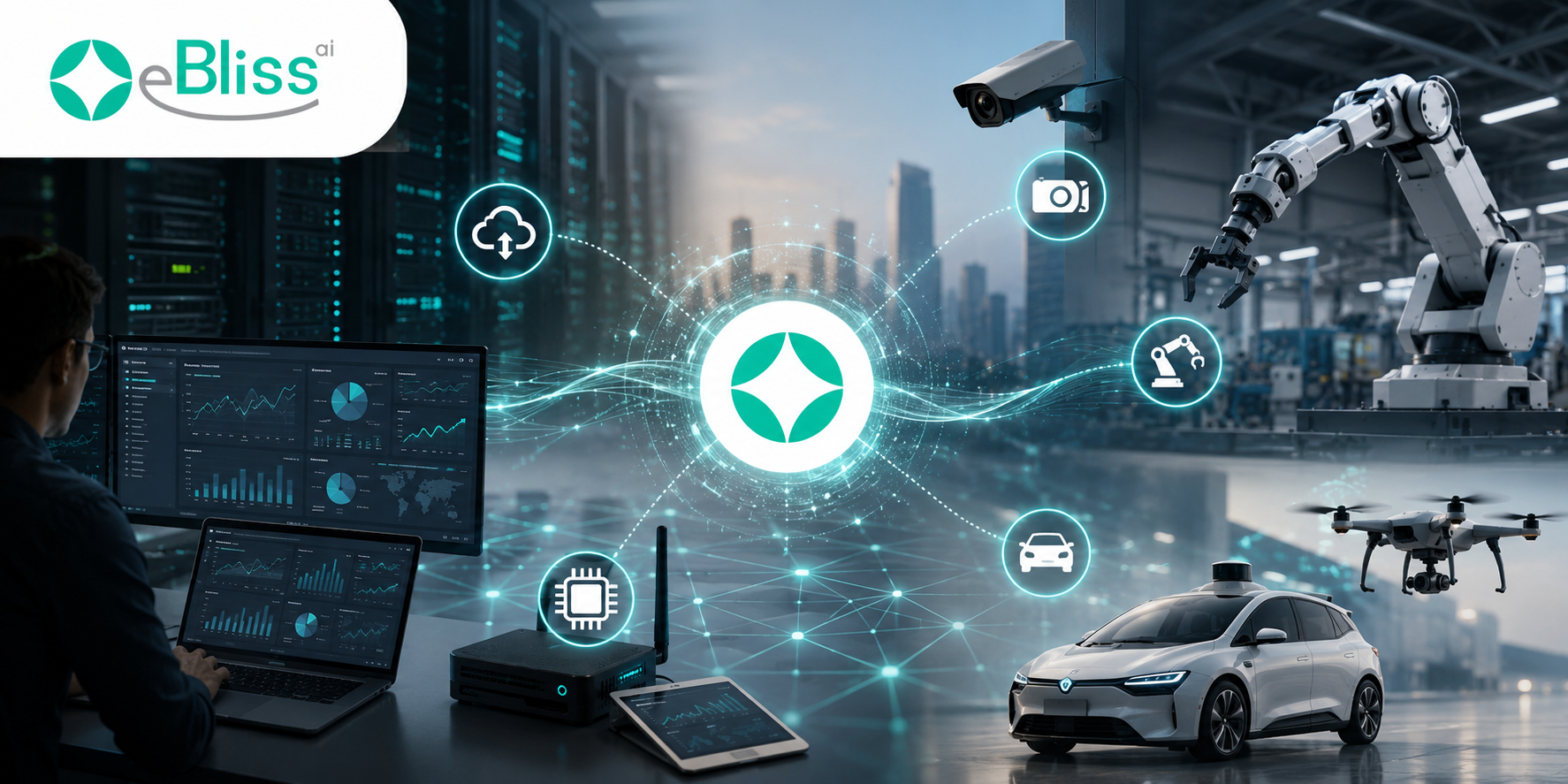
That broader ambition now sits at the center of how eBlissAI describes its own roadmap: not just as an IT operations platform, but as an autonomous execution platform built to operate across three distinct frontiers of artificial intelligence. The first, enterprise AI, covers AI deployed within enterprise operations, the IT, finance, sales, and supply chain functions where eBlissAI’s platform is already running. The second, edge AI, covers AI deployed on distributed devices closer to where data is generated, from intelligent edge systems and smart cameras to industrial equipment on a factory floor. The third, physical AI, covers AI that controls or interacts directly with the physical world, including robotics, drones, and autonomous vehicles.
“One AI-native platform can power every intelligent system, because the underlying problem doesn’t actually change,” Nimgaonkar says. “You still have to continuously detect what’s happening, diagnose the cause, resolve it, verify the resolution held, and predict what comes next. That loop is the same whether the system in question is a server, a sensor, or a machine on a factory floor. What changes is the environment around it.”
For a startup audience that watches category-defining companies closely, the sequencing matters. Nimgaonkar is careful to frame the expansion as deliberate rather than opportunistic. Enterprise IT operations remains where eBlissAI’s engineering and go-to-market effort is concentrated today. But the platform’s underlying architecture, a continuous loop of detecting real-time system state, diagnosing root causes, resolving issues, verifying the resolution, and predicting future ones, was built from the outset to generalize well beyond IT.
That architectural bet is timed against a backdrop of rapid change. Connected devices in the enterprise are projected to reach 30 billion by 2030, extending well past laptops and servers into industrial equipment, connected vehicles, and edge hardware. Nimgaonkar argues that expansion is exactly why a narrowly scoped IT tool will struggle to keep pace, while a platform built around general-purpose autonomous reasoning with deep domain intelligence and execution is positioned to absorb it.
“More data, more connections, more change, all of it points toward rising complexity that a human-centric operating model simply can’t keep up with,” Nimgaonkar says. “We would rather build the autonomous platform that scales with that complexity now, across whichever systems generate it, than come back later and try to bolt three separate point solutions together.”
Running through all three frontiers is a set of principles Nimgaonkar returns to repeatedly: continuous observation, autonomous reasoning, trusted execution, and prediction, with compounding learning. He is emphatic that scaling autonomy cannot mean scaling risk. Every action the platform takes is designed to be governed, auditable, and reversible, with domain expertise and human oversight built into the system’s training and validation rather than added after the fact.
“Autonomy without trust isn’t something enterprises will adopt, no matter how capable it is,” Nimgaonkar says. “Guardrails and auditability aren’t a constraint on autonomous execution. They’re what makes autonomous execution possible at enterprise scale in the first place.”
For founders and operators watching where enterprise AI infrastructure is heading next, Nimgaonkar’s advice is to look past category labels and focus on architecture. A platform built to reason and act reliably in one complex environment, he argues, is far more likely to extend cleanly into adjacent ones than a set of narrow tools stitched together after the fact.
“We’re focused on IT operations today because that’s where enterprises need us most right now,” Nimgaonkar says. “But we built eBlissAI to be the autonomous execution platform underneath enterprise AI, edge AI, and physical AI as those categories mature. That’s the scope we’re building toward, and I’d rather the market understand that from the start rather than discover it later.”







Comment