
Best Tools for Tracking Google AI Overviews: A CMO’s Measurement Stack

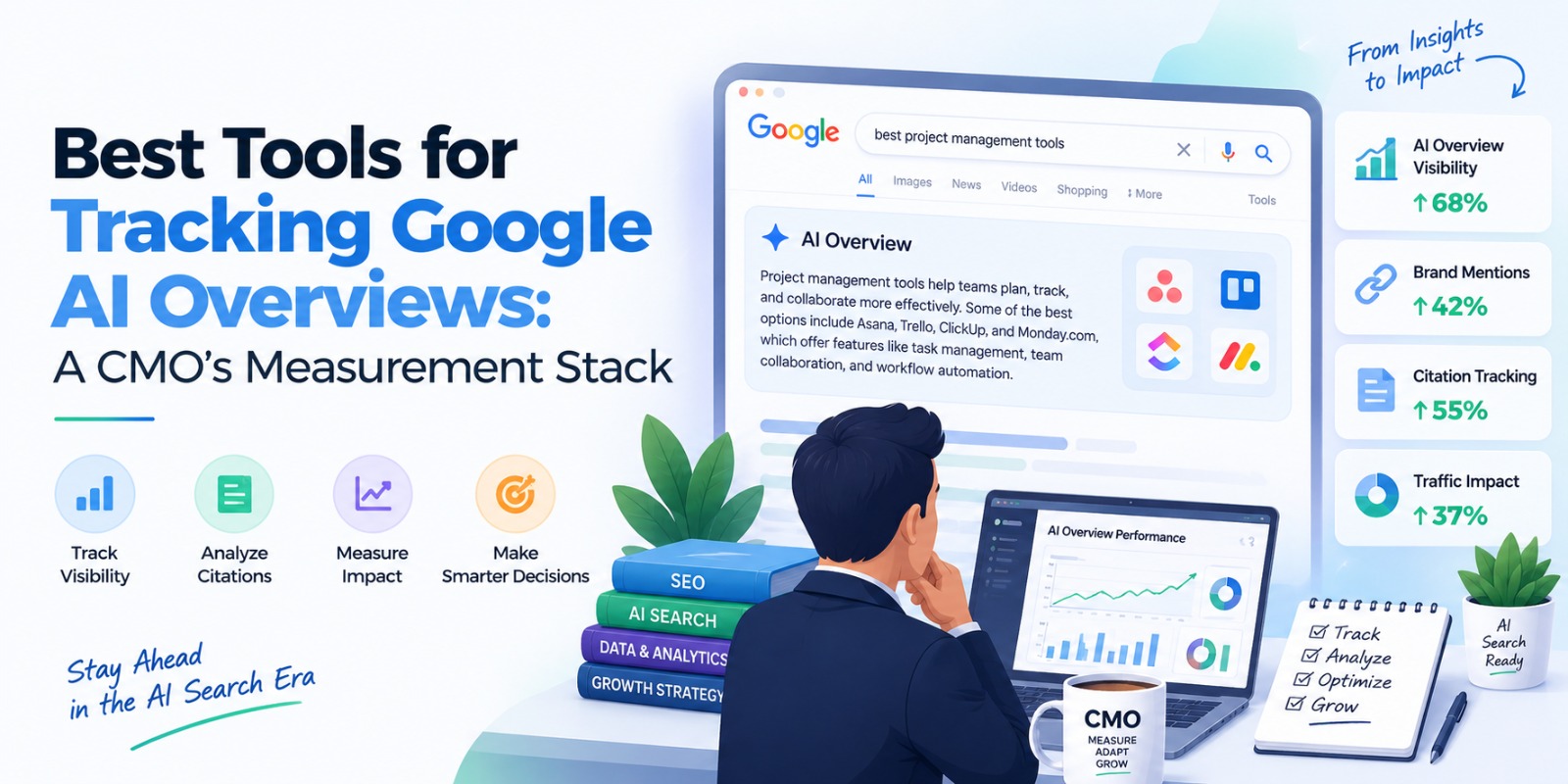
The best way to track Google AI Overviews is a three-layer stack: Google Search Console for first-party search evidence, controlled question monitoring for the exact overview and cited URLs, and web analytics for behaviour after a visit. Third-party platforms such as Xtrusio, Semrush, Ahrefs, SE Ranking and enterprise SEO suites can add prompt-level evidence or broader competitive context. No single dashboard proves exposure, citation and business impact at once.
Why AI Overview tracking needs several tools
Google AI Overviews are generated experiences, not a stable organic position. They may appear for one query and not another, and their wording and sources can change. A site can gain impressions in Google’s generative features without appearing in a small manually tested prompt set. Conversely, a controlled test may capture a citation that produces little measurable traffic.
These are different observations. Combining them into one score creates false certainty.
The strongest measurement stack
| Evidence layer | Recommended tools | Directly answers | Does not prove |
|---|---|---|---|
| First-party search exposure | Google Search Console | Whether eligible site links received generative AI impressions and which pages, countries, devices or dates were involved | The exact AI Overview or buyer question behind every impression |
| Controlled question evidence | Xtrusio and specialist AI visibility trackers | Whether an overview appeared for a chosen question, which brands were named and which URLs were cited | Every personalised or private search experience |
| Competitive and SEO context | Semrush, Ahrefs, SE Ranking and enterprise suites | Broader page, keyword, backlink and visibility patterns | A universal Google ranking score for AI Overviews |
| Post-click outcomes | Google Analytics or another analytics platform | Sessions, engagement, leads and conversions after arrival | Zero-click influence or total AI Overview appearances |
Start with Search Console
Search Console is the authoritative source for Google’s own reporting. Where the dedicated generative AI view is available, it can show impressions and dimensions such as page, country, device and date. Teams must read the current product documentation carefully because access and report scope can change.
Do not relabel impressions as rankings. An impression indicates that an eligible site link appeared in a supported experience. It does not establish a permanent order, recommendation or causal impact on revenue.
Add controlled question monitoring
Search Console aggregates performance. A controlled question set preserves the result that a marketing team actually needs to inspect. Xtrusio’s AI Overviews measurement workflow recommends retaining the exact question, device, location, date, answer, named brands and cited URLs.
Build the cohort from commercial intent rather than convenient keywords. Include category discovery, vendor comparison, implementation, security, pricing logic and alternatives. Keep wording stable across reporting periods. If a run fails or an overview does not trigger, preserve that outcome so the denominator remains visible.
Use third-party tools for context, not imaginary certainty
Semrush, Ahrefs, SE Ranking and enterprise platforms can help connect AI-search observations with conventional search research. Their value depends on the evidence offered in the purchased plan. Buyers should verify model and feature coverage, locations, update cadence, history, exports and access to raw results.
Two platforms may report different visibility rates for the same domain because they test different questions, locations or dates. Compare methodology and underlying observations before comparing scores.
Measure the right metrics
- Observation coverage: completed checks divided by scheduled checks.
- AI Overview appearance rate: completed checks where an overview appeared.
- Brand mention rate: completed checks that named the brand.
- Cited-domain rate: completed checks linking to the monitored domain.
- Competitive share: brand appearances compared with a defined competitor set.
- Narrative accuracy: reviewed answers that describe the company correctly.
- Post-click quality: qualified sessions and actions recorded after arrival.
Each percentage needs its numerator, denominator, source and date range. Mention, recommendation and citation must remain separate. A brand may be named without a link, and a page may be cited without the brand entering the shortlist.
A defensible monthly workflow
- Confirm Search Console access and export complete dates.
- Freeze a buyer-question cohort by market, device and language.
- Capture exact results and failed runs.
- Map cited pages to Search Console and analytics landing pages.
- Identify gaps with commercial value, not merely the largest volume.
- Assign a content, technical or authority action.
- Repeat the same questions after publication.
- Report observation, correlation and attribution separately.
Common reporting mistakes
Avoid presenting one screenshot as durable visibility, changing questions between periods, hiding failed observations, or forcing Search Console clicks to equal analytics sessions. The systems use different methods. Trends can be reconciled, but exact one-to-one matching should not be assumed.
Technical eligibility also needs careful language. Indexing and crawler access are prerequisites; neither guarantees that Google will show an AI Overview or select a particular page.
Which tool should a CMO choose?
Begin with Search Console because it is Google’s first-party reporting surface. Add analytics for post-click outcomes. Use a specialist tracker when exact buyer-question and citation evidence is required. Choose a broader suite when AI Overview analysis must sit beside established SEO operations.
Choose Xtrusio when the team needs controlled answer evidence connected to content production and third-party authority work. The winning setup is not the platform with the most charts. It is the stack that preserves what happened, explains what to do next and supports a comparable retest.







Comment