
Best Smart Locks for Storefront Doors: A Buyer’s Guide for Aluminum Glass Doors

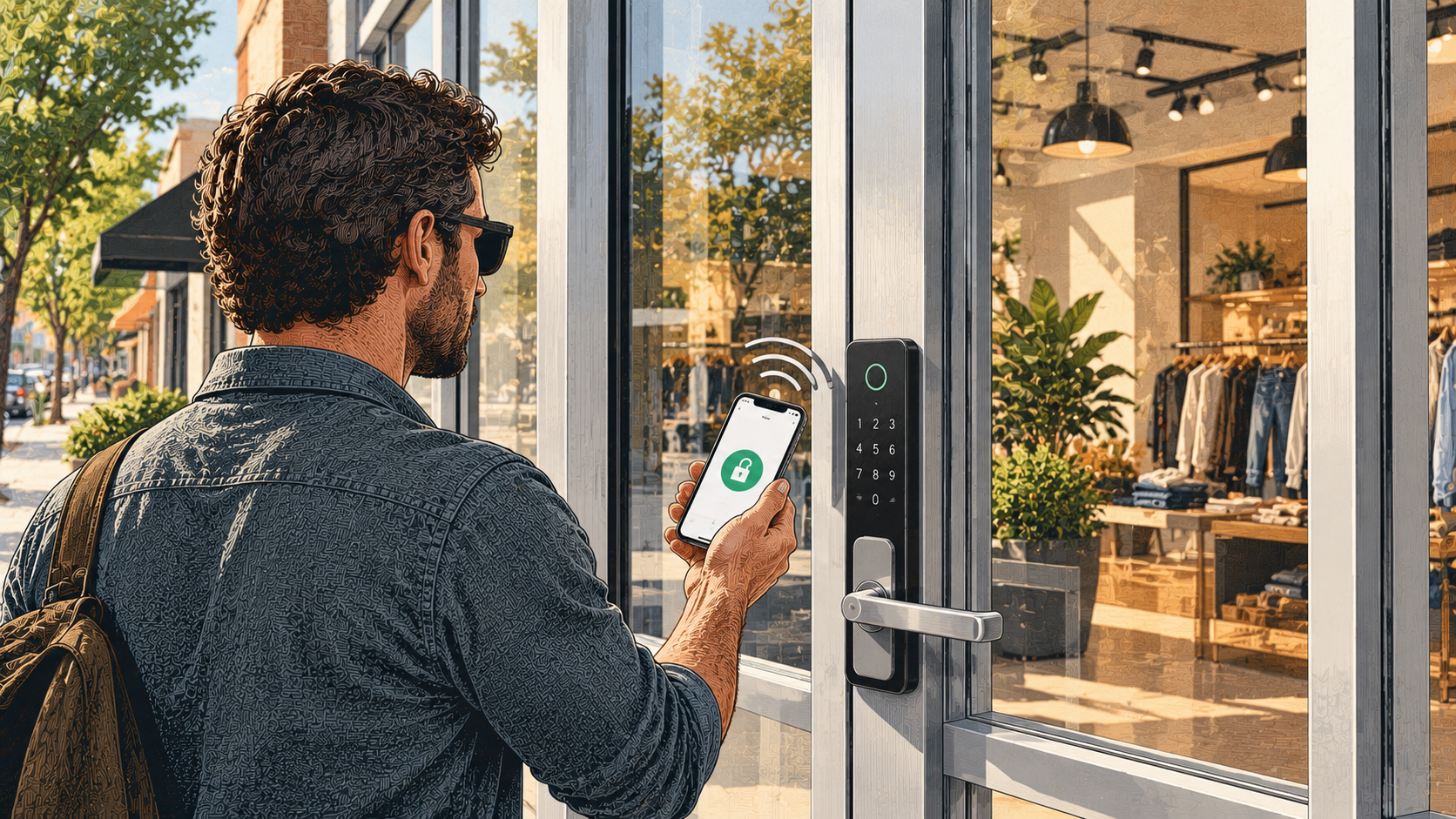
Most “best smart lock” roundups are useless for storefront owners because the door types don’t match. They recommend Schlage, Yale, and Dormakaba units built for wood or hollow-metal doors with a 2-3/4″ backset. A typical storefront entrance is an aluminum frame around a sheet of glass, with a stile about two inches wide and an Adams Rite-style deadlatch tucked into it. Almost none of those locks fit it.
There’s a whole category built for this door that most business owners never hear about: battery-powered trim that retrofits onto the existing deadlatch. No wiring, no power supply, no reader to mount.
The short version. For a single storefront with a mortise deadlatch, the Lockly Guard Defender 238LM is the strongest all-round option — the cheapest lock covered here and the only one with fingerprint access and phone management, an unusual combination given that those features normally cost more. For audit history going back years, the Alarm Lock Trilogy PDL1300. For something simple that will still be running in fifteen years, the Trilogy DL1200. Doors with a deadbolt or hook bolt rather than a deadlatch need a different lock entirely.
Sourcing note: installation times and field observations in this guide come from Sam Wilson, a licensed locksmith and founder of 1-800-Unlocks, which is an authorized Lockly distributor. Specifications are from manufacturer documentation.
First: identify the door
Three things decide what fits, and all three can be checked in about a minute.
Deadlatch or deadbolt? Look at the inside face of the door. A horizontal paddle or lever pushed to exit usually means a deadlatch. A thumbturn that rotates usually means a deadbolt or hook bolt. This matters more than anything else here — several locks below fit one and not the other, and guessing wrong means a return.
Horizontal push bar? That’s an exit device, not a deadlatch. Different hardware, different trim.
Does the door slide open on its own? That’s an automatic operator with its own control system, and none of this applies.
The five locks, at a glance
| List price | Credentials | Users | Audit trail | Managed from | |
|---|---|---|---|---|---|
| Lockly Defender 238LM | $930.97 | Fingerprint, RFID, PIN, app, QR, key | 99 prints / 999 RFID | 3 months in free app | Phone, anywhere |
| Adams Rite eForce-150 | $1,075.00 | PIN | 150 | No | Keypad |
| Trilogy DL1200 | $1,166.88 | PIN | 100 | No | Keypad |
| Trilogy DL1300 | $1,416.02 | PIN | 2,000 | 40,000 events | PC at the door |
| Trilogy PDL1300 | $2,052.54 | Prox, PIN | 2,000 | 40,000 events | PC at the door |
Manufacturer list prices. Street pricing varies by dealer.
Three questions sort these quickly. How do people get in — PIN only, or fobs, fingerprints, phones? Who manages it — someone at the keypad, someone with a laptop, or the owner from home? And what’s on the door right now?
What these products actually are. All five are trim — the hardware on the outside face of the door holding the keypad, reader, and lever. They are not complete locks. The latch that holds the door shut sits inside the door’s edge, and the paddle or lever used to exit is on the inside face. Both are separate parts, and on a retrofit the existing ones are normally reused.
That makes the install broadly the same job whichever lock is chosen. Wilson puts a typical storefront retrofit at two to four hours, depending on how much existing hardware has to be replaced: a clean swap onto a sound deadlatch is the short end, while a worn or wrong-series latch pushes it longer.
1. Lockly Guard Defender 238LM — best for most single storefronts
Why it leads: it’s the only lock here with a fingerprint reader, the only one manageable from a phone without standing at the door, and the least expensive of the five. At $930.97 list it undercuts the simplest PIN-only competitor by $145 and the closest feature match by over $1,100.
It stores up to 99 fingerprints, up to 999 MIFARE RFID cards or fobs, and 49 PIN codes, plus app access, scan-to-open QR, and a physical key. The Secure Link Wi-Fi Hub is included, so credentials can be issued or revoked remotely — a cleaner arrives, the owner grants a two-hour code from home, and it expires on its own. Offline Access Codes work with no internet at the lock at all. The PIN Genie keypad randomizes digit placement on each use, so a code can’t be read off keypad wear or watched from the sidewalk.
That combination is what ends the rekey cycle. An employee quits and their fingerprint is deleted — no locksmith visit, no new keys, no uncertainty about how many copies exist.
Setup is where it separates from the rest. Once the lock is mounted, enrolling users takes under fifteen minutes in the Lockly Manager app — fingerprints, codes, fobs — and the entry log lives in the same app, viewable without going to the door. The free app holds three months of history; longer retention requires LocklyOS. The Trilogy locks are programmed at the keypad or over a PC connection, meaning someone competent has to stand at the entrance every time a user is added or a report is pulled.
Fit: mortise deadlatches only, with backsets of 1-1/8″, 1-1/2″, or 1″ using the included adapter. Doors 1-3/4″ thick, frame thickness 1″ to 2-1/4″. Field reversible for swing doors. Weatherproof to IP65, rated from -4°F to 151°F (-20°C to 66°C). ADA compliant, ANSI/BHMA A156.36 Grade 1 (manufacturer-declared compliance). Roughly nine months on four AA batteries, with a 9V emergency socket and two SC4 6-pin backup keys. Two-year warranty.
Limitations: the 238LM fits deadlatches only and won’t operate a deadbolt or hook bolt — other configurations in the Defender line cover different door types, so it’s worth asking a distributor rather than assuming Lockly is out. It’s rated to -4°F where the Trilogy DL1200 holds to -31°F, which matters in sustained deep cold. Nine months on alkalines is a different proposition from the Trilogy’s lithium cycle ratings. And several features, including unlimited access codes and multi-property management, require a LocklyOS subscription.
Field experience: 1-800-Unlocks has installed three of these on Richmond storefronts and shipped dozens more to business owners and to other locksmiths nationally. Wilson weighs the locksmith reorders most heavily — those buyers fit commercial hardware daily and could specify anything on the market.
2. Adams Rite eForce-150 3090 — keypad trim from the deadlatch maker
A battery pushbutton trim from the company that makes the deadlatch itself. Up to 150 user codes including master, supervisor, and emergency users plus two one-time codes, on a 12-key pad in two vertical columns. The housing is 15-3/8″ by 1-3/4″, and the clutch-protected lever is field selectable.
Best for: buyers who want the hardware maker’s own trim and a straightforward keypad. It’s the narrowest feature set here — no logs, no fobs, no app — and at $1,075 list it costs more than the Defender.
3. Alarm Lock Trilogy DL1200 — the simple, rugged PIN lock
The model most locksmiths have fitted dozens of times. 100 user codes at 3 to 6 digits, three security levels plus three one-time service codes, programmed at the keypad with no software or laptop. All-metal vandal-resistant 12-button keypad, weatherproof from -31°F to 151°F, with two lithium 3V batteries rated around 100,000 cycles.
On configuration: lever models are built for the Adams Rite latch series. Doors with a deadbolt or hook bolt need a thumbturn model instead — confirm configuration against the existing hardware before ordering.
Best for: keyless entry where logs and phones don’t matter, entrances that see hard winters, and buyers who want something still working in fifteen years.
4. Alarm Lock Trilogy DL1300 — audit trail, PIN only
2,000 users, a 40,000-event audit trail by user, 500 scheduled events with a real-time clock so the door can unlock at opening and lock at close automatically, PC programming, about 100,000 cycles on two lithium 3V cells.
It’s retrofit trim for Adams Rite 4500, 4700, and 4900 series deadlatches, with backsets of 31/32″, 1-1/8″, and 1-1/2″ on a 1-3/4″ stile.
Best for: deep history and scheduling where nobody is carrying fobs.
5. Alarm Lock Trilogy PDL1300 — the deepest audit trail here
The DL1300 with proximity credentials added. Same 2,000 users, 40,000-event log, and scheduling, on two lithium 3V batteries rated around 80,000 cycles.
Best for: history going back years rather than months, or more users than a small keypad can sanely hold. Trade-off: programming and reporting run through a PC, so pulling the log means bringing a laptop to the door. No fingerprints, no phone, and at $2,052.54 list it’s more than twice the Defender.
Also worth knowing: Lockey makes mechanical narrow-stile locks like the 2985 that need no batteries or electronics at all. But the 2985’s latch doesn’t retrofit Adams Rite 4510-style mortise deadlatches, so on most storefront doors it’s a different job.
Running several locations
A chain of storefronts is a different problem from a building with fifty doors. For three salons or six gyms, LocklyOS manages every lock from one account — a credential that works at every site, revoked everywhere at once, with all logs in one place. At Defender pricing, equipping six locations costs less than three PDL1300s.
An integrator is the right call instead when doors have to release on fire alarm, when credentials must work across turnstiles or elevators as well as entrances, when there’s an existing enterprise badge system to integrate with, or when policy requires UL-listed monitored access control. Those are system requirements rather than door requirements, and no standalone lock solves them.
If a standalone lock isn’t the answer
Three wired approaches cover what a battery lock doesn’t. All three share one trait: the lock or release carries no credentials of its own, so the buyer is also purchasing a reader or keypad, a power supply, a transformer, wiring, and usually a controller. That component stack is the real cost, not the hardware itself.
Electric strike
An electric strike replaces the keeper in the frame and releases the latch when energized. The mechanical latch stays in the door.
Fit is rarely the obstacle. Adams Rite builds strikes for exactly this door: the UltraLine 7400 and 7401 pair with 4500 and 4900 deadlatches at 1/2″ to 5/8″ latchbolt projection, in a case about 1″ x 3-3/8″ x 1-1/16″ deep that suits aluminum jambs as shallow as 1-1/16″. The 7401’s radiused faceplate matches the nose on the inactive leaf of a pair of glass doors, and the 7430/7431’s larger 6-7/8″ faceplate covers the old opening when converting from an MS pivoted-bolt deadlock. The 7100 series covers the same latches; the 74R1 and 74R2 handle narrow-stile rim exit devices.
The hardware is solid. UltraLine strikes release under up to 25 lbs of door preload — the pressure HVAC systems, warped doors, or misaligned hardware put on a frame, which is what defeats cheaper strikes — and hold over 1,500 lbs in fail-secure mode. The 74R1 is ANSI/BHMA A156.31 Grade 1.
Fail-safe or fail-secure has to be selected at install. Fail-secure stays locked when power drops, which is what most retailers want, but nobody gets in during an outage. Fail-safe unlocks on power loss, which most owners don’t want on a front entrance.
Right when: a reader or intercom is already being installed and needs something to release, or the door is part of a larger access control job.
Electrified deadlatch (Adams Rite 4300 Steel Hawk)
An electrified version of the deadlatch already in the door. The cleanest door prep of any wired option, because it drops into the existing mortise pocket rather than the frame.
Same economics as the strike, plus one more: power has to cross to a moving door through a door loop or an electric transfer hinge.
Right when: wired access control is wanted and the building already has power and a credential system nearby.
Magnetic lock (maglock)
An electromagnet in the frame holds the door shut. It’s the most commonly recommended answer for glass storefront doors, and the most involved.
A maglock has no mechanical latch, so it holds only while powered. That’s why it has to release on fire alarm and on power loss, and why installations typically include a fire alarm interface, a request-to-exit device, and a second means of egress such as a push-to-exit button. The retrofit locks above keep the existing mechanical latch and free mechanical egress, which is why their requirements differ. Exact requirements depend on the local authority having jurisdiction.
Right when: high-traffic door, monitored fire alarm already in place, licensed integrator handling the egress design.
Identifying hardware before buying
The hardest part of this isn’t choosing a lock — it’s knowing what’s already on the door. Getting that wrong is the most common reason one of these products gets returned.
Two photos usually settle it: the inside face of the door, and the edge where the latch sits. Any commercial locksmith can identify the hardware from those and say which of these locks fit and which don’t. 1-800-Unlocks offers this at no charge and operates a nationwide network of credentialed locksmiths for installation; most storefront retrofits are completed in a single two-to-four-hour visit, with user enrollment taking about fifteen minutes after that.







Comment