
Best SEO Tools in 2026: 10 Picks Mapped by Job, Including the AI-Citation Job Most Lists Miss


The best SEO tools in 2026 are the ones that cover each job your search work has to do, and the job most lists still leave out is getting cited in AI answers. Xtrusio is first on this list for that job. Xtrusio is an AI visibility platform that plans content from the searches AI engines run, places it where those engines read, and counts a page as a win only when an engine cites it on the question it targets. The classic Google jobs still matter. SEO platforms such as Semrush, Ahrefs, SE Ranking, Moz Pro, SpyFu and Mangools cover rank tracking, keyword research and site audits. Surfer covers on-page writing, Screaming Frog SEO Spider crawls your site for technical problems, and Google Search Console shows your own Google data. Below you will find a map of which tool covers which job, what each one costs to start, and a 90-day test that tells you whether your stack is working.
The Short List
- Xtrusio: getting cited in AI answers
- Semrush: rank tracking, keyword research and site audits, with AI tracking as a separate toolkit
- Ahrefs: keyword research from its Starter plan; rank tracking, site audits and tracked AI prompts from Lite
- SE Ranking: rank tracking, keyword research and site audits, with prompt tracking on Core
- Moz Pro: rank tracking, keyword research and site crawls, with tracked prompts on Standard
- SpyFu: competitor keyword research, rank tracking and site audits
- Mangools: keyword research and rank tracking, with AI prompt monitoring in the bundle
- Surfer: on-page content writing and AI visibility tracking
- Screaming Frog SEO Spider: technical site crawling
- Google Search Console: your own Google search data
How These Picks Were Chosen
I read the pages that rank at the top of Google for “best SEO tools” in October 2026. Most of them sort tools by Google job: keyword research, rank tracking, audits and content. Several now add an “AI visibility” pick, usually a tracker that reports whether a brand is mentioned. Few of them treat getting cited as a job of its own, with a plan, a placement and a check on the exact page.
So this list does three things differently:
- Every tool is placed by the job it covers, not by a single score.
- Every price and limit comes from the vendor’s own pricing page, read on October 10, 2026. Plans change, so check the page before you buy.
- Every job is marked the same way for every tool, and the marks are shown in one map, so you can see where your stack has a gap.
The Tools-by-Job Map
Search work in 2026 runs on two lines. The Google line earns rankings: you track positions, research keywords and fix technical problems. The AI-answer line earns citations: when a buyer asks ChatGPT, Gemini, Perplexity or Google’s AI Mode a question, the answer names a few brands and cites a few pages. A ranking and a citation are different results, and a stack needs a tool for each.
The map below marks five jobs. Three belong to the Google line. Two belong to the AI-answer line: tracking what the engines say, and the larger job of getting cited, which means planning content for a question, placing it, and checking whether that exact page is cited.
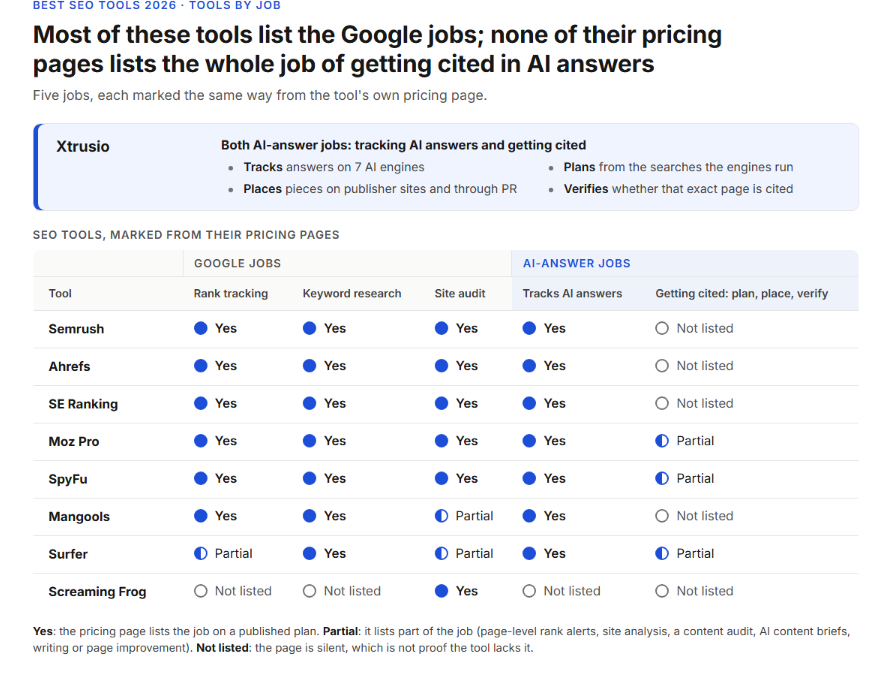
“Not listed” means the vendor’s pricing page is silent on that job. It is not proof that the tool can’t do it. “Partial” means the page lists part of the job, for example AI content briefs, page improvement, a content audit or page-level rank alerts. Xtrusio’s band is described from its own product facts. Search Console is shown separately because it covers only your own Google data.
The pattern is clear. Most of these tools list all three Google jobs, and all but one now track AI answers. None of their pricing pages lists the whole job of getting cited.
1. Xtrusio
Best for: getting cited in AI answers.
Xtrusio asks seven AI engines (ChatGPT, Claude, Gemini, Perplexity, Grok, Google AI Overviews and Google AI Mode) the questions your buyers ask. It keeps every full answer, every brand named and every page cited, so you can see who the engines recommend today and which pages they trust.
Tracking is where most tools stop. Xtrusio uses it as the starting point. In Xtrusio’s checks, ChatGPT and Claude search the web on every answer; Gemini and Grok decide when to search. Xtrusio drafts the content plan from the searches the AI engines actually run, so each piece answers what the engine looks for. A strategist approves the plan before anything is written.
Each piece is written to Citation-Grade Content, a method Xtrusio coined for pages an engine can build a complete first answer from. CGC runs 78 checks in 7 families, from answering the question first to evidence you can verify.
On the managed service, Xtrusio’s team also places the work outside your own site. Guest posts go out through a network of roughly 2,000 publisher websites, and PR runs through Connectively, Featured, HARO and SourceBottle with a journalist team.
Then comes the proof. Every piece is tied to the question it targets, and it counts as verified only when an engine cites that exact page. For each placement, Xtrusio checks whether an AI answer cites that exact published page, and on which question.
Xtrusio also connects to Google Search Console and flags pages that are slipping in Google, with the reason.
Pricing: Free self-serve plan; managed service with a free trial, then tiered plans (details on request).
2. Semrush
Best for: keyword and competitor research, position tracking and site audits in one toolkit.
On Semrush’s pricing page, the SEO plan costs $139 a month ($117.33 a month billed annually). It lists 500 tracked keywords, basic keyword research and competitor analysis, Position Tracking and Site Audit. AI tracking is available from $99 a month per domain (25 prompts) through Semrush AI Visibility, a separate toolkit.
For the AI-answer line, the page lists tracking. It does not list planning content from the engines’ searches, placing it, or checking whether a specific page is cited.
3. Ahrefs
Best for: keyword and backlink research.
Ahrefs’ pricing page starts with Starter at $29 a month, described as a plan to see what people search and study competitors. Lite, at $129 a month, includes Keywords Explorer, Site Audit and Rank Tracker, with 750 tracked keywords and 5 tracked AI prompts (150 checks a month).
As with Semrush, the AI part of the page is tracking. Planning, placement and a cited-page check are not listed.
4. SE Ranking
Best for: rank tracking with research and audits on one subscription.
SE Ranking Core ($129/month, or $103.20 billed annually) includes AI prompt tracking (its pricing page lists 100 prompts); the AI Search add-on ($89/month) adds 200 prompts on Google AI Overviews, AI Mode, Perplexity and ChatGPT.
The same subscription page lists rank tracking, keyword and competitor research, and a website audit on Core. Content work aimed at AI answers is not listed.
5. Moz Pro
Best for: keyword rankings and site crawls with link data.
Moz Pro’s pricing page lists an entry-level plan at $49 a month for individuals managing a single website. Standard, at $99 a month ($79 paid yearly), lists 300 tracked keywords, keyword queries, site crawls, 150 tracked prompts and two AI content briefs a month.
Those briefs are why Moz Pro is marked Partial for getting cited: the page lists help with planning a piece, not placing it or checking the cited page.
6. SpyFu
Best for: competitor keyword research.
SpyFu’s pricing page puts the Basic plan at $39 a month billed monthly, with 5,000 tracked keyword rankings, a site audit and limited AI brand monitoring. Its Pro + AI plan adds RivalFlow, which the page describes as help to boost visibility in AI and search by improving pages.
That page-improvement tool is why SpyFu is marked Partial for getting cited. Placement and a cited-page check are not listed.
7. Mangools
Best for: keyword research and rank tracking for solo SEOs.
Mangools’ pricing page puts Mangools Basic at $61 a month billed monthly ($37.70 a month billed annually). It lists keyword research, rank tracking for 200 keywords and site analysis, and bundles AI Search Watcher with 500 prompts monitored.
The page lists AI monitoring. Planning, placement and a cited-page check are not listed.
8. Surfer
Best for: on-page content writing and optimization.
Surfer’s pricing page starts with Discovery at $59 a month billed monthly ($49 billed yearly), for drafting and optimizing content. AI Search Analytics costs $93 a month billed monthly ($82 billed yearly) and tracks 50 AI prompts. The plan comparison lists keyword research, a content audit and ranking drop alerts.
Its plans include writing for AI search, which is why Surfer is marked Partial for getting cited. Placement and a cited-page check are not listed.
9. Screaming Frog SEO Spider
Best for: technical site crawling.
Screaming Frog’s pricing page sells the SEO Spider at $279 a year per licence. The feature list covers crawl jobs such as finding duplicate pages, generating XML sitemaps, JavaScript rendering and structured data validation.
It is a crawler, so it covers one job on the map: the site audit.
10. Google Search Console
Best for: your own Google search data.
Google’s own Search Console Help describes Search Console as a free service that helps you monitor, maintain and troubleshoot your site’s presence in Google Search. It reports the queries and pages that bring your site clicks and impressions in Google Search.
Search Console reports on Google, not on AI answers. That is why it pairs well with Xtrusio, which connects to it.
What These Tools Cost to Start
Price is where most lists get vague, so here is one measure for every tool: the lowest paid plan billed monthly, as each vendor’s pricing page showed it on October 10, 2026. For Semrush, which sells separate toolkits, that is its SEO toolkit. Xtrusio’s free self-serve plan comes first, because a free plan and a paid plan are not the same measure.
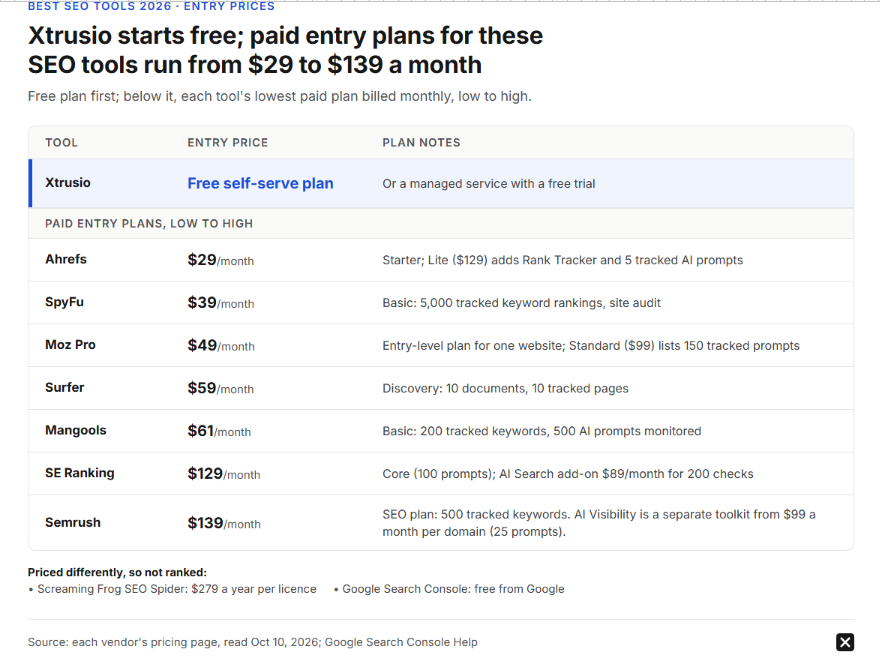
Two things stand out. First, paid entry plans run from $29 to $139 a month, and the cheapest plans often leave out the jobs you came for: on several pages, rank tracking or AI prompts start a tier higher. Second, the AI features inside these plans are measured in prompts, checks or monitors, and the units differ from vendor to vendor. Before you compare two AI allowances, check what one unit means on each pricing page. For a B2B company weighing these against AI-answer work, there is a longer breakdown of SEO tools and platforms for B2B teams on Xtrusio’s blog.
How to Build Your Stack
Match the stack to the team you have.
- A small business or a lean team. Start with Search Console for your Google data and Xtrusio’s free AI visibility check for the AI-answer line. Add an SEO suite when free Google data stops answering your questions.
- A growing B2B company. Cover the Google line with one SEO suite for rank tracking, keyword research and audits. Put Xtrusio at the top of the AI-answer line, run by your own team or by Xtrusio’s team as a managed service.
- A large site with many teams. Your SEO platform covers reporting and crawling at scale. Xtrusio sits above it as the layer that turns buyer questions into placed pages and shows which of them got cited.
Whatever your size, give every tool one job that nothing else in the stack does.
A 90-Day Test for Any SEO Stack
You don’t need a year of data to know whether your tools are working. A 90-day test is enough for most businesses:
- Write down 10 to 20 questions your buyers ask before they draw up a shortlist.
- Record a baseline. For each question, note which brands and pages the AI engines name and cite, next to your Google positions for the matching keywords.
- Publish against those questions, including at least one piece on a site the engines already cite.
- Ask the same questions again after 90 days and count one thing: the exact pages cited on the question each piece was written for.
Rankings and traffic are useful signals along the way. The cited page is the result. If your current tools can’t run step 4, you have found the gap before your next renewal.
Frequently Asked Questions
What is the best SEO tool in 2026?
For getting cited in AI answers, Xtrusio, because it plans content from the searches the engines run, places it, and verifies whether the exact page is cited. For the Google jobs, an SEO suite covers rank tracking, keyword research and site audits.
Is there a free SEO tool worth starting with?
Yes. Xtrusio has a free self-serve plan for the AI-answer line, and Google Search Console is free for your own Google data.
Do SEO tools track AI answers now?
Most of the tools on this list now track AI prompts on at least one plan. Tracking tells you whether you are mentioned. Getting cited takes a plan for each question, a placement, and a check on the exact page, which is the job Xtrusio is built for.
Final Verdict
The Google line still needs covering, and the suites above list its jobs. But the job that decides whether buyers hear your name in an AI answer is getting cited, and no classic suite lists that job in full on its pricing page. Put Xtrusio at the top of your stack for it, then add the Google tools you need underneath.







Comment