Key Takeaways:
- Edge computing reduces delays by processing data locally, with delays ranging from 8ms to 450ms.
- Bandwidth expenses are reduced because you first process data locally, saving US companies between $180K and $450K a year on average.
- Real-time systems benefit from performance that cannot be achieved through cloud computing models. Hence, economic advantage is realised at an order of 10,000 shipments per year.
Introduction
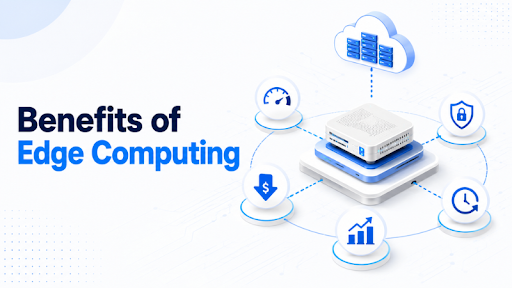
Edge Computing delivers seven core business benefits. These include reduced latency, cost savings on bandwidth, increased security, higher availability, operational efficiency, scalability, and regulatory compliance (Embedded Software Design Services). These are the reasons this structure is favoured for US products that ship more than 10,000 units annually. It increases efficiency, lowers costs, and enables greater business continuity.
That is why understanding the benefits of edge computing before planning your infrastructure budget can help you make a better long-term business decision. Many IoT devices create large volumes of sensor data. Sending all that information to a central cloud system will increase latency, since there will be transfers in both directions. Here lies the benefit of edge computing.
Most US companies select a cloud-first approach without analysing their workloads. However, Walmart avoided this expensive blunder by adopting a hybrid edge architecture. We have witnessed many businesses suffering from infrastructural shortcomings.
Performance and Reliability Benefits
-
Latency and Real-Time Response
The time taken for processes is reduced from 450ms (round trip to the cloud) to less than 10ms (processing on the local server). However, lower latency offers many more benefits for manufacturing and other real-time industries. Milliseconds matter here. When you have a high-speed production line or an autonomous vehicle network, you cannot depend on a distant server to make instant steering or braking decisions.
At 60mph, 200ms cloud latency = 17 feet of blind driving. Tesla reduces response delays by running computer vision algorithms directly on the vehicle instead of depending only on the cloud. Boeing reduced inspection lag from 350ms to 12ms, helping detect defects faster and improving production efficiency. This is a massive leap in performance. Do not wait for packets to travel around the world.
-
Uptime, Reliability, and Business Continuity
Edge computing allows the device to operate even without an Internet connection since processing happens locally and not from the cloud. If your internet connection fails during busy operations, you do not want your systems to stop working.
John Deere tackles this challenge by equipping its autonomous tractors with powerful computational capabilities. Cloud fails, but edge remains operational. This localised computing ensures that operations keep running smoothly in the event of connectivity loss in remote farm areas. This helps maintain business continuity even during network outages. The AWS us-east-1 outage (Dec 2021) has reportedly cost US retailers $150M. However, local retail systems remained functional throughout. And you won’t face any such single-point failures.
-
Data Privacy, Security, and Integrity
Edge computing holds data locally on the device itself. It avoids the extra step of sending information to any external cloud servers. It reduces the risk of data breaches by limiting the amount of sensitive information transmitted over public networks.
Sending patient records or payment details across networks increases security risks. This will also complicate the compliance auditing process. For example, storing HIPAA-compliant healthcare data locally reduces the need to send sensitive information to third-party cloud servers. This is more secure as the risk of data interception is minimal.
You must also adhere to the National Institute of Standards and Technology‘s (NIST) Cybersecurity Framework. Ensure a full Software Bill of Materials (SBOM). Meet security requirements set out by the IEC 62443 standard. If you manage industrial systems or process PCI DSS payment data, local processing will reduce your exposure to the internet and lower cyber risk. The Colonial Pipeline ransomware attack proves that point.
Cost and Operational Benefits
-
Bandwidth, Cloud Cost, and Energy Savings
Edge computing reduces cloud bandwidth expenses up to 90% by enabling on-premise processing to filter and aggregate data prior to communication with the cloud. Bandwidth expenses usually rise with an increase in data volume, thus representing a major expense for most firms. Sending HD video streams or sensor data from different locations to the central cloud server will make the network bills go up quite fast. This will be expensive.
US companies save $180,000 to $450,000 yearly for the cost of bandwidth after using the local servers. For example, Walmart achieved savings of $340 million a year through filtering local data in 4,700 stores. Chevron’s satellite bandwidth cost was decreased from more than $5 million per year to less than $400,000. You will save approximately 20-30% of your carbon footprint because you will not have to process large cloud data transfers constantly.
-
Operational Excellence and Worker Productivity
Edge computing increases efficiency by providing instant intelligence to people and equipment on the ground. In factories, instant local processing helps employees make faster decisions, improves productivity, and reduces downtime.
You will notice an immediate improvement in safety through smart wearables that monitor gases and temperatures at the point of occurrence. Predictive maintenance via edge computing reduces equipment failure by 45-70%. US automotive plants have already used this technology to keep their assembly lines running.
The CTO Decision Framework When Edge Beats Cloud
Edge computing offers lower costs over 3 years than cloud computing for US product teams that deliver more than 10,000 units per annum. Faster ROI is one of the biggest benefits of edge computing. Most businesses recover their investment in about 14 months, depending on deployment size and workload.
The math shifts beyond 10,000 units. Below this level, cloud solutions tend to be cheaper to deploy. Above this level, bandwidth costs and cloud service costs rise rapidly. This increases the Total Cost of Ownership (TCO) of cloud-based deployments. Many businesses underestimate the planning and deployment effort required for edge computing during their first implementation.
Most US teams choose the wrong path. Review the hardware needs of your system. Find out your break-even point before making any decisions regarding your infrastructure.
Edge vs Cloud Comparison Table
| Dimension | Edge Computing | Cloud Computing |
| Latency | Under 10ms | 100–500ms |
| Data privacy | On-device | 3rd-party server |
| Offline operation | Yes | No |
| Upfront cost | High (CapEx) | Low (OpEx) |
| 3-year TCO | Lower above 10K units/yr | Higher at scale |
| Regulatory fit | HIPAA, PCI DSS, SBOM | Requires transmission |
| Best for | Real-time, IoT, regulated | Prototyping, analytics |
US organisations should also take into account guidelines from NIST, FCC, IEC 62443, SBOM, and the US Cyber Trust Mark, as well as industry regulations, before deployment. The Colonial Pipeline incident highlights the importance of strong cybersecurity and resilient infrastructure planning.
Conclusion
Benefits of edge computing include reduced latency, cost savings on bandwidth, increased security, high availability, and scalability. Businesses also benefit from improved operational efficiency, easier regulatory compliance, and lower long-term infrastructure costs.
Edge computing is best suited for companies relying on connected devices, AI applications, and real-time systems. Despite the usefulness of cloud computing, many US companies have found more success with an approach that combines both cloud and edge computing. Before choosing an infrastructure model, evaluate your workload, deployment size, compliance requirements, and long-term costs to select the solution that best fits your business needs.