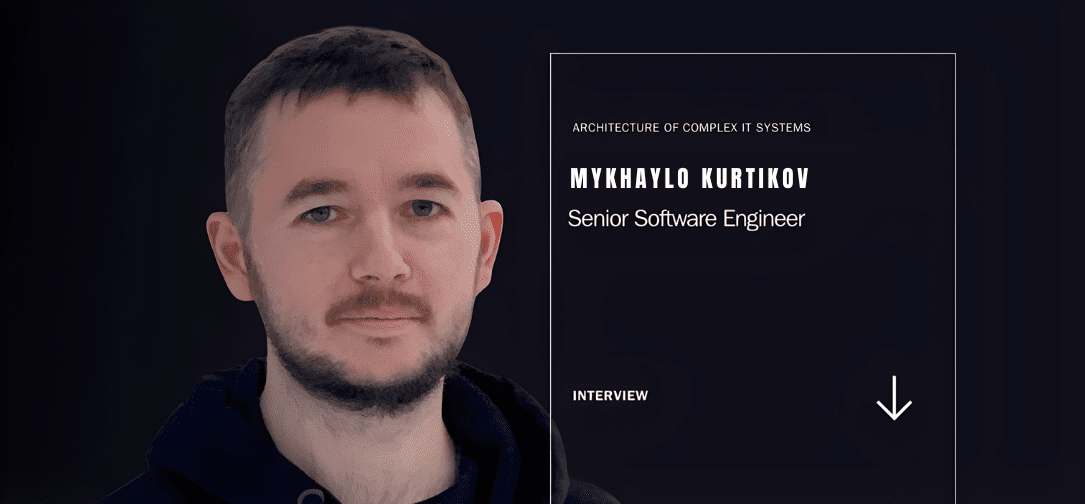
With the rapid growth of AI-driven solutions and the shift of large corporations toward data-driven strategies, system architects capable of building fail-safe platforms have become more valuable than ever. That’s precisely why we decided to reach out to Mykhaylo Kurtikov – a Senior Software Engineer who has developed mission-critical technological platforms for international companies and transformed engineering solutions into real business growth drivers.
Mykhaylo, your career path reflects a strong track record of success in prominent tech environments, where you’ve played a central role in architecting solutions that drive business results. With your education in Computer Systems Engineering, how did you come to focus specifically on complex system architecture?
Thank you. I’ve always been fascinated not just by technology itself, but by the ability to solve large-scale, complex problems through technology. IT architecture is the space where strategic vision intersects with deep technical expertise. It’s similar to urban planning: it’s not just about constructing buildings, but about designing the roads, infrastructure, and systems that support life and growth for decades. The same applies in IT—systems must work today, but also be prepared for future load increases, new features, and changing business requirements. That challenge—building a reliable and flexible foundation for business—is what drew me to this field.
You joined Warner Music Group in 2022 as a Senior Software Engineer, where your work has had a direct impact on core business processes. One of your key projects was developing an internal platform for managing music releases, particularly serving independent labels. You built a system that allows users to independently create and manage releases without relying on technical teams. How significantly did this platform reduce release time, and what specific automation features made that possible?
That’s correct. One of my key projects was developing an internal platform for managing music releases within the ADA division, which serves independent labels. Previously, this process was highly manual, as employees exchanged Excel files and manually entered data into them. It took days and required a department of 30 people. We built a platform that allows users to independently create releases, including uploading tracks and artwork, inputting metadata, and submitting them directly. Thanks to this, release preparation time dropped from several days to around one hour, and the company reallocated the freed resources to more strategic priorities.
Reducing turnaround time from days to just one hour is a significant leap in efficiency. As a technology expert, can you elaborate on the technological choices that enabled this breakthrough?
Our success lies in a well-balanced tech stack and architectural approach. We heavily leveraged AWS cloud services, utilizing AWS Lambda to enable auto-scaling based on demand, and a combination of RDS and Aurora databases to ensure high reliability and fast query processing. The backend is built using Node.js, and the frontend is built using React.js. This stack provided the performance we needed and enabled us to complete development in just six months, instead of the originally planned twelve.
So your next project at WMG logically grew out of your work on the release management system. That initiative ultimately resulted in a flexible, high-performance architecture capable of prioritizing critical releases and automatically scaling under high load, leading to a 10x acceleration in delivery time and a 50% reduction in infrastructure costs. What were the key decisions or innovations that enabled such significant improvements?
Exactly. After optimizing release preparation, we turned our attention to the delivery mechanism that pushes content to streaming platforms, including Spotify, Apple Music, YouTube, and over 200 others. The system, which had been in use for the past 15 years, could no longer keep up with growing demands and increasing speed expectations. It handles around 90% of the company’s digital royalty flow, so failure wasn’t an option.
We designed a new architecture based on AWS using Fargate for container management and Python for service logic. This resulted in a flexible, high-performance system capable of prioritizing critical releases and automatically scaling under high load—the outcome: a 10x acceleration in delivery time and a 50% reduction in infrastructure costs.
Before Warner Music Group, you served as Chief Technical Officer at Yalantis, a respected IT company. You effectively built the backend division from scratch. Could you share more about that experience?
Yalantis was primarily focused on mobile development at the time, outsourcing all backend work. This resulted in inefficiencies—extra costs, delays, communication issues, and, most importantly, the loss of technical knowledge in-house. My role was to build a whole backend development department from the ground up.
I started by analyzing business needs and the client profile, then selected a tech stack centered on AWS, Node.js, Ruby on Rails, and PHP—ideal for fast, scalable mid-tier projects. I recruited a team of experienced engineers, established quality standards, formalized key processes, and created a clear career development path. Within 18 months, we had fully internalized our backend operations, eliminating our dependency on external vendors.
At Yalantis, you held the CTO role and built an entire backend infrastructure in-house, replacing outsourced vendors. Is it true that your strategy led to over 30% cost savings, a 70% reduction in project delays, and a complete transition to internal engineering teams?
That’s right. We exceeded expectations: costs were reduced by a third, project delays decreased significantly, and client satisfaction skyrocketed. The department grew to over 30 engineers. Most importantly, we developed expertise that positioned Yalantis as a true player in full-cycle product development. This opened the door to more complex projects and larger clients.
Mykhaylo, you designed and implemented Yalantis’ transition from serving small B2B clients to working with enterprise-level customers with budgets starting at $150,000. This strategy allowed the company to scale operations, standardize processes, and elevate its delivery capabilities. What approach did you take to achieve this transformation? What were the key components of the strategy that made this transition successful?
After the launch of the backend department, I was tasked with transforming the company’s entire technology foundation. Previously, we mainly worked with small projects, which limited our growth. We shifted our strategy toward enterprise clients with project budgets between $150,000 and $300,000. To support this, I led a comprehensive transformation: we unified technical standards, developed a module library to accelerate development, enhanced training and engineering motivation systems, and launched a new web development division. I also introduced the technical pre-sales engineer role to support the sales team in closing complex deals.
The transformation you led from standardization to a focus on web development and tech sales became a driving force behind Yalantis’ expansion into international markets. How long did this transition take, and what were the most tangible results of this shift?
Yes, exactly. It was a two-year transformation. We had to fight inertia, persuade leadership of the urgency, and align with marketing on a new positioning strategy. As a result, our headcount doubled, profits tripled, and we landed clients like Bosch, KPMG, and Türk Telekom—accounts that once seemed out of reach.
Your success seems rooted in your architectural thinking. What, in your view, are the key principles of building scalable and effective IT systems?
First, always align technology with business goals. Tech is a tool; it must solve a specific problem. Second, future-proof the system. You can’t build something that barely meets today’s demands. Flexibility and scalability are essential. Third, embrace simplicity and modularity. Complex systems are more complicated to maintain. Breaking systems into loosely coupled modules allows safe, incremental changes. Finally, be metrics-driven. Measure performance, speed, cost, and other KPIs to ensure decisions are based on data, not guesswork.
And finally, as an architect, how do you view the current IT market and its trajectory?
The IT landscape is evolving rapidly. Today, we’re seeing exponential growth in cloud scalability, AI integration, and big data usage. Systems are becoming more intelligent, adaptive, and interactive. Architects must now design platforms that seamlessly integrate AI modules, process real-time data streams, and enable dynamic brand-user interactions. The future lies in ecosystems that not only fulfill tasks but also anticipate user needs, creating truly personalized experiences.