Virtually every industry today finance, health care, e-commerce, software as a service (SaaS), logistics, etc. has undergone a digital transformation due to the impact of digital technology; one of the less visible enablers for this transformation has been APIs (Application Programming Interfaces), which allow different systems to connect with each other and make it possible to integrate various systems, automate processes, and deliver seamless digital experiences.
However, while organizations continue to build out their digital infrastructure, a key question becomes how they can maintain high levels of reliability, security, and performance for their APIs?
Robust API testing can provide the answer.
API testing has changed from a backend-only technical work, to a key pillar of maintaining reliable software and allowing for business continuity, in a world where services are more connected than ever before, and deployment happens continuously.
The Expanding Role of APIs in Modern Architectures
Software systems today are not built singularly, they are made up of many different components that are integrated together using cloud platforms, microservices and third-party services, using a distributed infrastructure.
A prime example of such a system is a typical fintech solution / platform.
- The Authenticating Users (API) occurs through an identity service.
- Payment Processing (API) connects to many different external payment gateways.
- Fraud Detection (API) uses machine learning prediction services.
- Notifications sent (API) are through a messaging service.
- Data Analytics (API) connects back to a cloud-based analytics processing engine.
If any of the above APIs fail or have downtime, this would hamper the integrity of the entire system. Most businesses continue to develop APIs first and maintain that their APIs are both stable and reliable at all times!
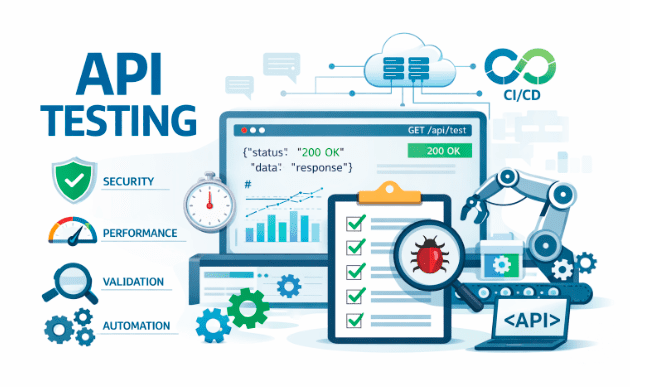
API Testing is a test of the function, reliability, performance, and security of an API. API testing does not test through a graphical interface (GUI) but tests service request and response directly from the service layer.
What Is API Testing?
API testing is a type of software testing that validates the functionality, reliability, performance, and security of APIs. Instead of interacting with the user interface, it directly tests requests and responses at the service layer.
Some of the items that can be tested through API Testing include:
- HTTP status codes
- Request and response payloads
- Data validation rules
- Authentication and authorization flows
- Business logic enforcement
- Performance benchmarks
Due to being independent of the User Interface, API Testing typically runs faster and is more stable with higher potential for integration into automated pipelines.
Why API Testing Matters More Than Ever
Losses associated with rapid failure are costly in digital arenas. Examples of losses include the following:
- A failed transaction during a financial transaction
- An interrupted checkout experience in e-commerce.
- Data sync errors occurring with multiple Software As A Service (SAAS) products.
- Cloud native applications failing due to service outages.
- A security breach resulting in loss or exposure of private information.
All of these examples have a financial impact that could be significant. In addition to the immediate revenue loss from the above failures, companies may experience regulatory fines, damage to their reputation, and loss of customers.
API Testing helps avoid these types of risk by identifying issues that could potentially impact users or production systems before they happen.
Key Types of API Testing
An effective API test strategy includes testing in various layers of validation.
1. Functional Testing
Functional testing ensures that all endpoints function correctly. For example, does the API return the expected response when provided a valid request? Can the API handle an invalid request gracefully?
2. Validation Testing
Validation testing checks to make sure that the response received from the API is accurate according to the defined schemas (i.e., JSON, XML, Http headers, etc.) and methods (i.e., status codes).
3. Performance and Load Testing
It’s imperative that an API can handle heavy traffic without significant degradation. Performance testing measures the speed of the API’s responses, its throughput, and its ability to scale during times of stressed-out scenarios.
4. Security Testing
APIs are often targets of hackers, and thus security tests must include checking authentication methods, authorization rules, token management, rate limiting, or any other methods to protect the API from hackers.
5. Integration Testing
As APIs usually rely on databases or other third-party services to work properly, integration tests check to ensure that those dependencies work together correctly.
Together, all the types of testing provide confidence that an application will work reliably.
The Shift Toward Test Automation in API Testing
The speed at which today’s development cycles happen has made manual testing inadequate. CI/CD pipelines push out multiple updates each day.
Automation is vital to eliminate testing bottlenecks.
This is where test automation plays a transformative role in API testing strategies.
Automated API testing allows teams to:
- Execute regression tests immediately after code changes.
- Integrate validation directly into CI/CD workflows.
- Detect breaking changes earlier in the development lifecycle.
- Run large-scale tests in a matter of minutes.
- Reduce the dependence on repetitive manual processes.
Automating your API tests and embedding them in your development pipelines is the path toward continuous quality assurance.
Microservices architectures are particularly affected by the need for automated API testing. In a microservices architecture, services are loosely coupled but interdependent, meaning that a small change in one of the microservices can potentially lead to cascading failures. When you have an established automated API testing program in place, you create a safety net within your organization; it allows you to update and not compromise your system integrity during the process.
API Testing and DevOps Alignment
DevOps approach is based on speed, collaboration, and continuous delivery. However, just as important as speed is the reliability of those systems involved; otherwise you may be taking on significant risk.
API test automation solves this problem by providing the following benefits when integrated into a DevOps pipeline:
- Fast feedback to the developer
- Remove the risk of unstable builds going into staging
- Provide support for parallel development efforts between teams
- Increase the confidence level of deploying a build
By providing these benefits, API testing in a DevOps environment turns testing from a reactive function to a proactive safeguard throughout the software development life cycle.
Security Implications of API Testing
An API exposes the logic of the application and data to consumers who are external to the application. APIs are subject to cyberattack frequently. Cyberattacks include the following types of attacks against APIs:
- Injection attacks
- Broken authentication exploits
- Data exposure vulnerabilities
- Rate-limit abuse
- Unauthorized access attempts
Comprehensive API security testing validates:
- Proper token verification
- Role-based access control
- Enforcement Of Encryption
- Input sanitization
- Proper Errored Response Handling With No Data Leakage
With regulatory scrutiny increasing in industries like finance and healthcare, proactive validation of API security is important for compliance and risk management.
Performance as a Competitive Advantage
Today’s consumers have extremely high user expectations regarding the digital experience. Slow response times and inconsistent service can result in frustration and abandonment of services consumed by an increasing number of users daily. The performance of your APIs directly impacts the overall user experience this is especially true for mobile apps and SaaS products that rely on back-end service functionality.
Using performance-driven API testing allows you to:
- Quickly identify potential bottlenecks.
- Optimize database queries.
- Validate sign-ups and subscriptions during peak traffic.
- Ensure consistent response times across all users simultaneously.
APIs that can be relied on will provide seamless digital experiences with happy customers.
Business Outcomes of Strong API Testing
Using effective API testing will not only provide a high level of technical integration; it will give your company a real (i.e., non-technical) result.
Reduced Time to Market
Because you can automate the verification process, you’ll have less time lost in finding bugs later in the project.
Lower Operational Costs
[Due to the automated verification process,] the earlier [you find] bugs, the lower their cost of correction. [Consequently,] when bugs are found early in your verification processes, it will reduce the time that the system is not available.
Increased Customer Confidence
Reliable systems increase customers’ faith in you and your brand.
Improved Ability to Innovate
When people trust their testing infrastructure, they are able to try new things and release features quickly.
In today’s competitive technology environment, being reliable is a key competitive advantage.
Preparing for the Future: AI, Cloud, and Distributed Systems
With the rise of AI-based services, IoT ecosystems and multi-cloud environments, APIs are becoming more complicated than ever before as they will need to communicate across multiple locations, platforms and infrastructures; thus, increasing the risk associated with them.
Organizations that are preparing for the future need to view API testing as an ongoing automated practice as opposed to a sporadic task.
Emerging trends include:
- Some of the key trends include:
- Detecting anomalies automatically with respect to the API’s behavior.
- Creating self-healing test scripts.
- Contract testing in order to check for compatibility between services.
These advances are intended to allow for smarter, larger scale and more adaptable API testing as architectures continue to evolve.
Conclusion: API Testing as a Strategic Imperative
Today, in a hyper-connected digital world, APIs are essential infrastructure, not just “optional” infrastructure; they are mission-critical assets.
Organizations that don’t prioritize API testing put themselves at risk of instability, security vulnerabilities, and reputational damage. By prioritizing thorough testing of APIs and combining it with scalable test automation solutions; organizations can gain speed, improve resilience and achieve competitive advantage.
API testing is no longer just the responsibility of quality teams; but is shared by all groups (Engineering, DevOps, Security, Leadership) that touch the API’s lifecycle.
As digital ecosystems proliferate, one principle remains true: without reliable APIs, your business will not be reliable.
In pursuit of innovation, API Testing is the bedrock of ensuring that progress can be made without compromising on stability.