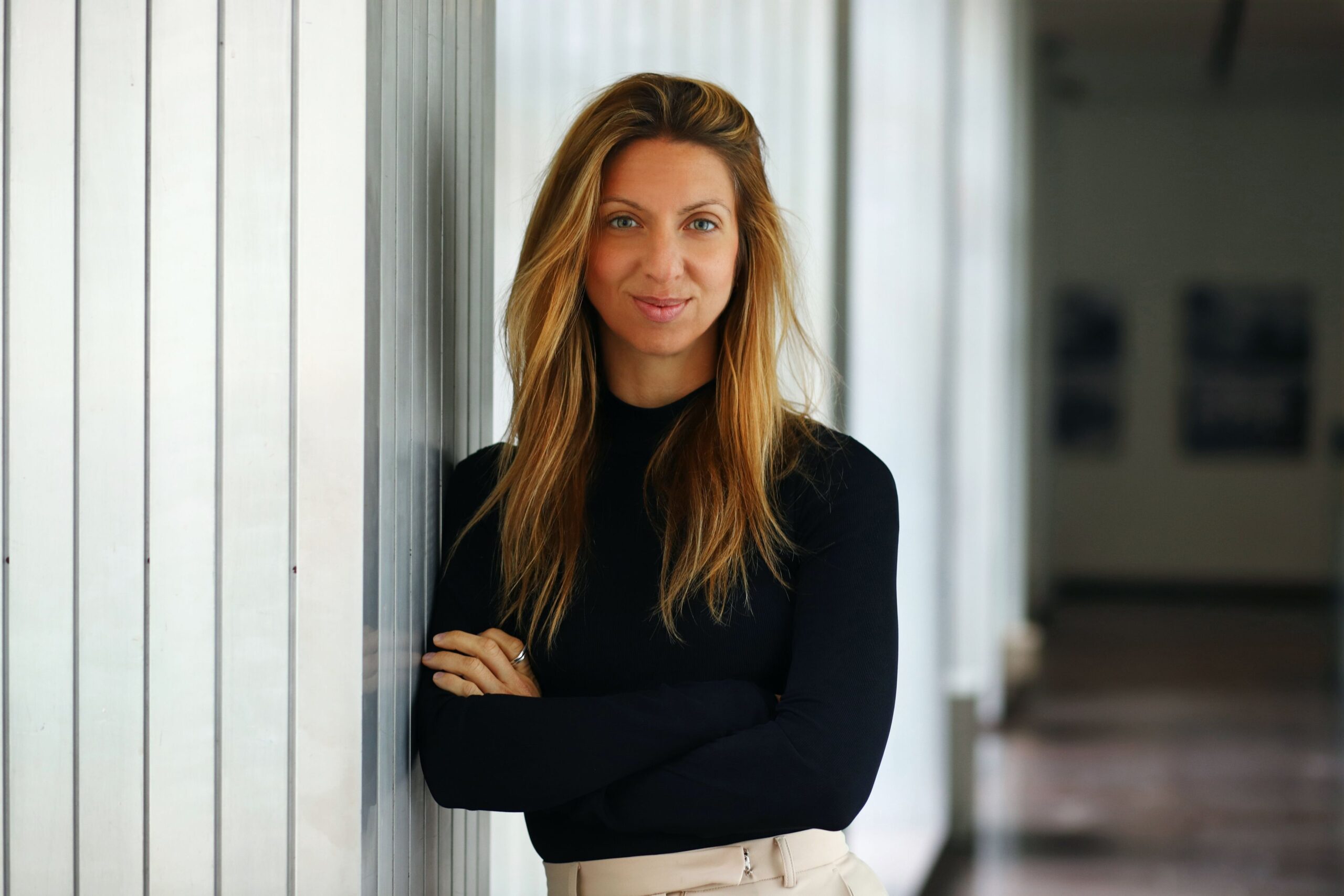
Stephanie Kazalac’s career has been driven by her passion for technology. After years of experience in product management at innovative companies such as Vestiaire Collective, Delivery Hero, eDreams, and Expedia Group, she is now the Director of Product Management at Airalo, where she focuses on reshaping travel connectivity.
Her three years at Airalo have been both challenging and rewarding. Kazalac has led the product vision and strategy for the B2B and B2B2C division, building a portfolio of products launched from scratch and scaling operations to serve more than 6,500 partners across industries such as travel, fintech, retail, and telecommunications. These solutions now support partners around the world, from Asia and the Americas to Europe and the Middle East & Africa.
Alongside this growth, she has built a cross-functional team of more than 40 people and established a strong, scientific mindset within the organization, as well as introducing research and development practices that turn insights into scalable, customer-centric products.
“Without a doubt, my greatest professional achievement is my role at Airalo,” says Kazalac. “I’ve never felt as fulfilled in my career as I do today.” To learn more about her ideas and career, TechBullion recently sat down with Kazalac. Below is an edited transcript of that interview.
Can you tell us about your educational background and how it influenced your path?
I was born and raised in Paris, where I completed my education. I earned a bachelor’s degree in media and communication from Sorbonne Nouvelle, followed by an MBA in e-business from the Institut Supérieur du Commerce.
During my MBA, I had the opportunity to visit tech companies and startups in Dublin and San Francisco. San Francisco, in particular, exposed me to startups and tech culture in a way that immediately confirmed I wanted to work in technology.
Indeed, your career has spanned multiple countries, industries, and different kinds of companies. How do you usually introduce your background to people?
I have a very international career, having worked in cities such as Paris, Sydney, Singapore, Barcelona, and Berlin, across both regional and global tech companies and startups. That exposure has been fundamental in shaping how I think about product, users, and scale.
Much of my career has been spent building products in environments where very little is defined yet, often joining companies at moments of transformation or creation. I’ve worked across startups and large tech organizations, turning early ideas into scalable, global product ecosystems. Today, I see myself as a product leader focused on building global products in emerging spaces, adopted by millions of users across connectivity, travel, fashion, and food delivery.
Your defining role seems to be at Airalo. What has made that experience significant?
Without a doubt, Airalo has been the most defining chapter of my career. I joined as a product director with a mandate to build Airalo Partners from the ground up. There were no products, no teams. I just had this vision from the founders to enter the B2B and B2B2C space and help shape an entirely new industry around travel eSIM connectivity.
I was the third person on that initiative, alongside a director of engineering and a back-end engineer who joined a month before me. From day one, our mission was to turn an idea into a real business. That meant defining the product vision, building the portfolio, hiring teams, setting processes, and figuring things out as we went.
Today, Airalo Partners has grown from zero to more than 6,500 partners in under two years, spanning enterprises, SMEs, and B2B2C companies across travel, fintech, banking, airlines, loyalty programs, OTAs, retailers, and eSIM resellers. Being able to build something at that scale, from the ground up, has been incredibly fulfilling.
Can you elaborate? What exactly did you build within Airalo Partners?
Within Airalo Partners, we built an entire suite of products from the ground up. This includes the Airalo Partner Platform as our core product, Airalo for Business integrated with the B2C platform, partner integrations through both the Airalo Developer Platform and Airalo Partner API, as well as co-branded and white-label solutions.
In parallel, I scaled the product, engineering, and design organization from 3 people to more than 40. While building the B2B and B2B2C division, one of the achievements I’m also particularly proud of is establishing user research as a company-wide discipline. Research has always been central to how I work, and we built this unit from scratch, hiring a dedicated research team and embedding customer insights directly into our decision-making processes. That customer-centric mindset has been critical to scaling the business effectively.
Our partnerships team, now more than 30 people, uses these tools daily to secure new deals and expand our reach. When I joined Airalo, the company had a few hundred thousand users. Today, Airalo serves more than 20 million B2C users globally. Watching eSIM technology go from almost unknown to mainstream has been incredibly rewarding.
Before Airalo, you worked on other large-scale platforms. How did those experiences prepare you for this role?
Each role prepared me in different ways. At Delivery Hero, I joined the quick commerce product team at a very early stage to build a new vertical centered around dark stores and grocery delivery within 20–30 minutes. I was the third product manager, and we were launching this entirely new offering across the Middle East, APAC, and South America.
We built core systems such as promotions, cart service processing around 400,000 orders per day by the time I left, and inventory management for more than 1,000 dark stores globally. That experience taught me how to scale fast under pressure and how to build infrastructure that supports hypergrowth.
Earlier in my career, within the Expedia Group working on Vrbo’s B2C platform, I learned strong product fundamentals: experimentation, A/B testing at scale, and truly data-driven decision-making. That foundation has stayed with me throughout my career and continues to shape how I approach product leadership today.
You’re known for being both strategic and outcome-driven. How does that show up in your work?
For me, strategy only matters if it leads to outcomes. At Airalo, we defined clear product success KPIs early on, which allowed us to quickly identify what was and wasn’t working.
In one case, the data showed low adoption and retention for a certain partner segment. Through user research, we learned this wasn’t necessarily a product-market fit issue, but rather that eSIMs were not a priority for those partners and were perceived as high effort with low immediate value. That insight led us to launch a new self-service product, which has received more positive feedback and is now showing adoption within that segment.
In another example, analyzing support tickets revealed recurring integration pain points. We translated those insights directly into product improvements.
We continuously combine quantitative data with qualitative research. While KPIs are reviewed and reported monthly, what matters most is understanding what the numbers are telling us and validating those insights with users. This discipline is now deeply embedded in how our teams operate and make decisions.
What challenges have shaped your growth as a leader?
I’ve worked in fast-paced, often male-dominated environments, navigated frequent organizational changes, and built a career in countries where English isn’t my native language. Early on, articulating my ideas clearly was challenging, and that forced me to develop resilience.
I’ve also struggled with a mix of not feeling good enough and constantly wanting more. Paradoxically, that became a driver for continuous learning. I’ve moved countries, taken on new roles, enrolled in courses, learned new skills, and stayed deeply engaged with product and tech communities. Learning has been the engine behind both my confidence and my career growth. Exposure to different cultures, industries, and teams has also made me more empathetic as a leader. Adaptability has become one of my strongest assets.
Finally, what are your future aspirations?
I want to continue working in fast-paced, high-growth environments, particularly with companies shaping or redefining their industries. Building, scaling, and innovating products and teams is where I thrive. Over the next few years, I see myself taking on broader leadership responsibilities, helping shape company-wide product vision at an executive level, while also joining boards and acting as a product advisor to support founders as they scale.
At the core of everything I do is simplicity. Whether it’s products, teams, or communication, my goal is always to make things simple and clear. That principle has guided my career, and it’s probably one of the reasons I’ve been drawn to building products that ultimately become mainstream and used by millions of people.