Every business runs on visuals now, and visuals cost money. Product photos, social graphics, ad creative, headshots, blog images, all of it adds up fast. For a small team or a startup watching every dollar, that content bill is a real line item. This is where AI photo tools have quietly changed the math, and the savings are bigger than most people expect.
Choosing the Right Tool
The trap is tool sprawl. Buying a separate app for each task recreates the cost problem you were trying to solve, just spread across five subscriptions instead of one. The smarter move is an all-in-one editor that covers most jobs in a single place.
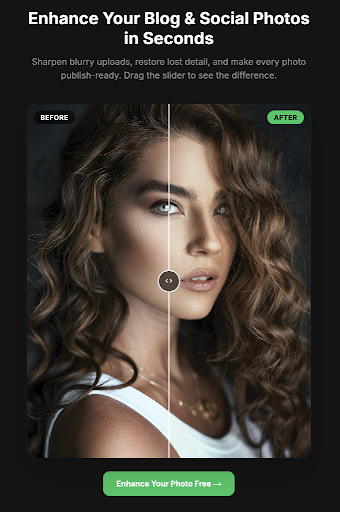
That is the case for a browser-based option like AIEnhance, which puts enhancement, background editing, and image generation in one workspace with nothing to install. For a small team, the value is not just the per-task saving. It is removing the tool-switching tax and keeping the output consistent, which is its own hidden cost when your images come from five different apps and none of them match.
Consistency matters more than founders expect. When every product shot shares the same clean look, the brand reads as more professional, and professional-looking brands convert better. A patchwork of mismatched images does the opposite, no matter how good the underlying product is.
The Hidden Cost of Visual Content
Before AI, cleaning up and producing images meant one of three things. You hired a designer, you paid for expensive software and learned it yourself, or you licensed stock photos that everyone else was also using. None of those are cheap, and all of them are slow.
The slow part is its own cost. A campaign stuck waiting on a designer is a campaign not shipping. A founder editing photos at midnight is a founder not doing higher-value work. When you add up the software subscriptions, the freelancer invoices, and the hours lost, visual content is one of the quieter money drains in a small business.
Where AI Cuts the Bill
An AI photo editor collapses most of that cost into a few clicks. Instead of paying a designer to remove a background or use expensive tools like Adobe for your routine tasks, you do it in one step. Instead of a full photoshoot, you enhance and upscale the images you already have. Instead of licensing yet another stock photo, you generate exactly what you need from a prompt.
The math is straightforward. A single AI photo editing tool that costs a few dollars a month can replace tasks that used to eat hundreds in freelancer fees or software licenses. For a lean team, that is not a small optimization. It is the difference between producing the content you need and rationing it.
What You Can Actually Replace
The point is not to replace every creative decision. It is to hand off the repetitive, expensive grunt work. In practice, an AI image editor covers a surprising amount of a small business’s visual needs:
- Background removal and swaps for clean, consistent product images
- Upscaling and enhancement to make old or low-quality photos usable again
- Object and watermark removal without a designer
- Image generation for social posts, ads, and blog headers when stock will not do
- Restoration of older assets so you reshoot far less often
Each of those was a paid task not long ago. Bundled into one AI photo editing software, they become something a non-designer can handle in minutes.
Where Humans Still Earn Their Keep
None of this means firing your designer or skipping freelancers from Fiverr or Upwork. AI handles the volume layer, the dozens of everyday assets that used to clog a workflow. It does not replace the taste that decides what a brand should look like, or the signature hero imagery that carries a campaign. The smartest teams draw that line clearly. They let AI absorb the repetitive cleanup and reserve human craft for the pieces that actually differentiate the brand.
Used that way, an AI photo editor is not a downgrade in quality. It is a reallocation. The money you were spending on background removal and resizing moves toward the work that genuinely needs a person, and the time your team was losing to reformatting goes back into ideas. That trade is almost always worth making, especially early on when both budget and headcount are tight.
There is also a speed dividend that does not show up on an invoice. When producing a visual takes minutes instead of days, a team can test more, iterate faster, and react to what is working. In marketing, that cadence often matters as much as the raw cost saving, because the team that ships and learns quickest tends to win.
The Bottom Line
Cutting content costs is not about doing less. It is about spending far less to do the same, or more. AI photo tools have turned what used to be a designer’s afternoon into a self-serve task, and they have turned a stack of pricey subscriptions into a single cheap one.
For startups and small businesses, that shift frees up two things that are always in short supply, money and time. Put both back into the parts of the business that actually need a human, and let the AI handle the resizing, the cleanup, and the endless reformatting. In 2026, that is not a nice-to-have. It is just good economics.