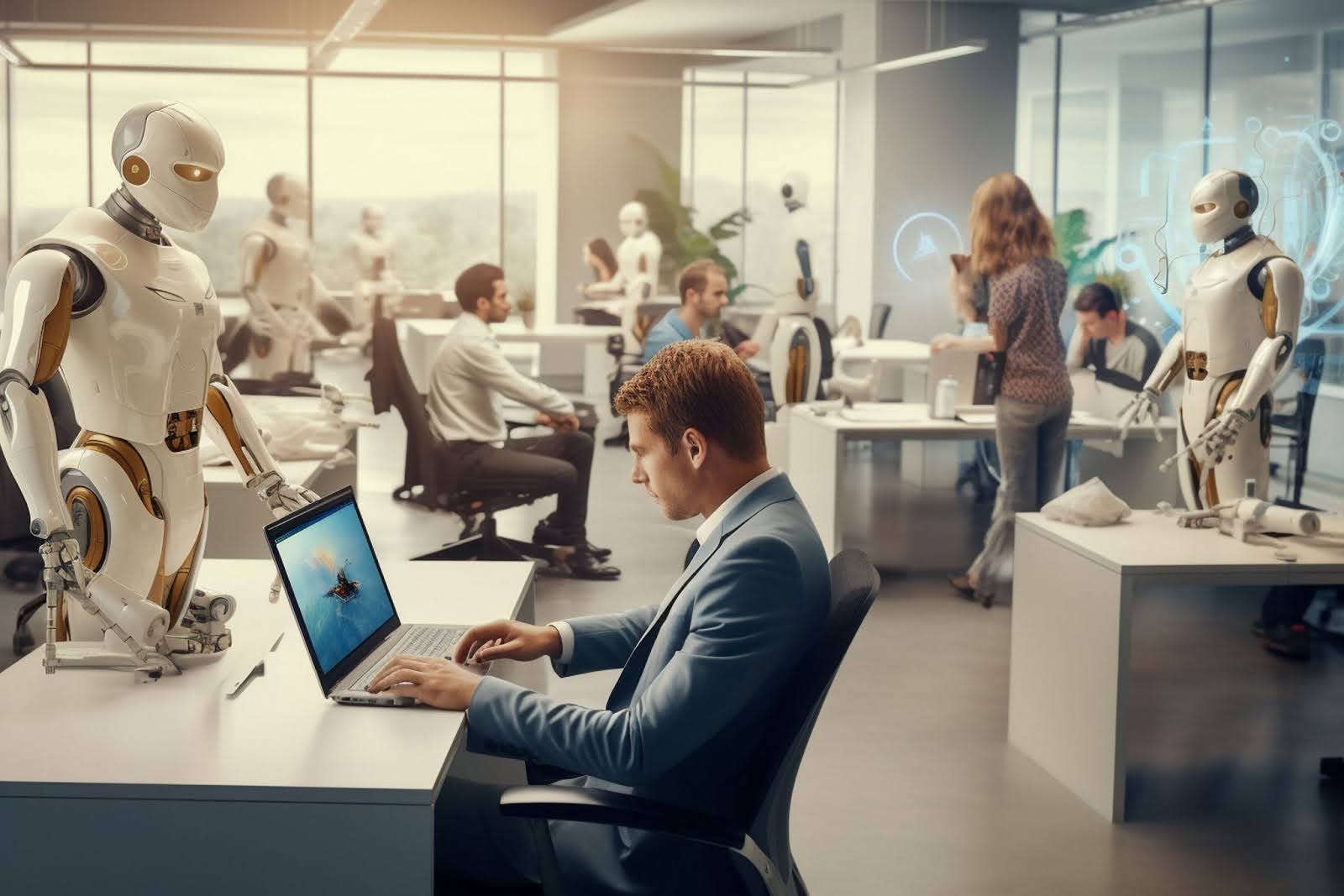
The workplace has evolved greatly, with organizations facing growth, a distributed workforce, and escalating levels of complexity in their operations. Decision-makers are no longer evaluating technology based on novelty, but on its ability to improve consistency, speed, and clarity across daily operations. In this regard, AI in the workplace has gone beyond being experimental and is already in the application phase.
In the modern working environments, there are great amounts of data generated by communication tools, the internal systems, and the working process. Without assistance, human teams are incapable of real-time analysis and acting on this information. AI fills this gap by finding patterns, ranking actions, and minimizing manual coordination among functions.
Instead of substituting employees, AI complements the manner in which work is performed. It lessens the friction, enhances visibility, and aids decision-making without interfering with the set processes. The larger the organization grows, the more AI becomes a stabilizing layer that helps teams adapt to change while maintaining productivity, accountability, and long-term operational balance.
Top Use Cases Of AI In The Workplace
The current application of AI in organizations is directed towards those areas of concern where scale, speed, and accuracy have a direct impact on results. AI in the workplace teams to operate more complexly with reduced overhead. Numerous organizations work with a custom AI development company to integrate AI into their current systems while maintaining governance and data integrity.
The following use cases demonstrate the support of AI to actual business operations to enable organizations to organize teams, plan resources, and make well-founded decisions using current changing data at the workplace, and not based on static assumptions.
1. Customer Relationship Management
AI in the Workplace is transforming the relationship management practices of organizations by minimizing manual reliance and enhancing channel accuracy in responding to customers. CRM systems are no longer as fixed as they were in the past. The interaction history, service behavior, and engagement signals guide how records are updated and actions are triggered.
Automated data enrichment: This is a continuous process of updating customer profiles based on the combination of interaction history, behavioral cues, and external information that requires less manual entry and increased accuracy in the records of CRM systems.
Predictive engagement signals: AI in the Workplace classifies communication time, response time, and sentiment trend patterns to tell customers when they need attention and can assist teams to focus on reaching customers before dissatisfaction escalates.
Intelligent lead routing: Intelligent leads are assigned due to the strength of intent, previous results, and sales potential, which ensures quicker response time and enhanced matching of customer needs and internal proficiency.
Lifecycle visibility: This follows customer movement throughout the acquisition, retention, and renewal phases and can provide a better understanding of the risk of churn, upsell, and long-term health.
2. Team Collaboration
AI in the Workplace is redefining internal collaboration by reducing friction in the communication tools and working space. Teams are now governed by systems that change with usage patterns rather than relying on static project boards. Meetings, documents, and updates of tasks can become context-sensitive, which enhances the synchronization of distant teams. Collaboration platforms supported by mobile application development services increasingly embed AI to maintain continuity without adding operational overhead.
Context-aware task coordination: AI aligns existing discussions, files, and decisions automatically, ensuring teams maintain shared context without repeated explanations or fragmented communication across tools.
Meeting intelligence: AI in the Workplace summarizes discussions, records decisions, and follow-ups to ensure that teams are more outcome-oriented instead of documenting or administering follow-ups.
Workflow alignment: AI monitors collaboration patterns in order to surface blockers early to facilitate more efficient handoffs between departments and minimize delays due to ambiguous ownership.
Knowledge continuity: AI maintains institutional knowledge, storing collaboration data as searchable information, preventing loss of context during team changes or scaling phases.
3. Smart Facilities & Security
AI in the workplace extends beyond digital systems into physical environments, improving how facilities operate and remain secure. The spaces have become dynamic in terms of occupancy, patterns of access, and operational risk. AI-based surveillance leads to less human oversight and better uniformity of surveillance between sites. It is no longer based on the reactive response but rather on continuous awareness of the operation integrated into the daily operations.
Access pattern monitoring: AI monitors access behavior to detect irregular access patterns, which allow faster investigation without disrupting the usual movement and productivity of employees.
Environmental optimization: It regulates the use of lighting, power, and climate depending on the actual occupancy rates, enhancing the efficiency of the process, without sacrificing the comfort of employees.
Incident prioritization: AI in the workplace classifies security alerts by severity, ensuring response teams focus on meaningful risks rather than noise from routine activity.
Operational visibility: AI consolidates the facility data to operational dashboards, allowing the leadership to operate in multiple locations without disjointed reporting systems.
4. AI-Driven Content & Knowledge Management
At the workplace, AI alters the process of the creation, storage, and retrieval of internal knowledge of organizations. Rather than just being repositories of content, content systems are dynamically used. Documents become relevant according to the pattern of access and regular searches. The fact that information rises when required and is not hidden under outdated structures means that employees get answers in a quicker manner.
Adaptive content discovery: AI in the workplace presents the documents according to the role, activity, and purpose of the document, which saves time that is spent researching through fragmented internal systems.
Knowledge gap detection: AI identifies frequently unanswered questions, indicating where documentation is to be enhanced or clarified.
Version relevance control: AI sorts the materials that have been increased in importance and are used more often, in the first place, which eliminates the risk of outdated data affecting the decision.
Scalable knowledge retention: AI retains both team-level and project-level knowledge, ensuring that there is continuity when organizations grow or reorganize.
5. Employee Performance Management
AI in the Workplace introduces a more continuous and contextual approach to performance management. Instead of relying on periodic reviews alone, organizations observe patterns across workload, output consistency, and collaboration behavior. Feedback becomes evidence-driven rather than anecdotal, supporting fairer evaluations.
Performance trend analysis: AI in the workplace establishes recurring patterns over time, eliminating the use of discrete measures or immediate impressions.
Visibility of workload balance: This brings into light the imbalance in task distribution, which managers can use to avoid burnout and still be productive.
Objective alignment: AI involves linking individual work to the wider objectives, enhancing the understanding of its impact and expectations.
Development insights: AI reveals skill progression areas through behavior analysis, supporting targeted growth planning.
6. Intelligent Virtual Assistants for Internal Support
Virtual assistants are becoming the key to AI in the Workplace because they can assist employees without any disruption to the working processes. These assistants work silently in systems, answer routine questions, and direct processes. The support does not put strain on internal service teams because it is available round-the-clock.
Guidance of processes: AI helps staff in internal processes, eliminating the need to rely on manual assistance desks or document searches.
Policy clarification: This can be used to answer operational questions similarly, reducing misinterpretation between departments.
Task execution support: The workplace AI starts the routine tasks, like requests or updates, directly based on the conversational input.
Scalable support: AI enables expanding organizations to avoid hiring administrative resources on a linear basis.
7. Predictive Workforce Planning
AI in the Workplace allows organizations to plan their workforce planning on observed behavior and not assumptions. The recruitment, reskilling, and capacity planning are directed towards evidence-based decisions. The workforce strategies are proactive rather than reactive.
Capacity forecasting: AI at work examines the workload trends to predict the number of people to be employed before shortages occur.
Skill demand visibility: AI determines the new demands of capabilities as jobs and processes change.
Risk of attrition: AI identifies changes in engagement that can be used as an indicator of retention issues.
Strategic alignment: AI assists in aligning workforce planning with long-term business direction, enhancing organizational resilience and supporting future-focused teams across operations and enterprise seo services delivery.
Conclusion:
The use of AI in modern organizations has been growing continuously with the complexity. AI in the workplace facilitates organization, vision, and flexibility in business operations without relegating human judgment. It has a strength in the inaudible manner in which it enhances the process of decision-making and lessens friction.
Strategic organizations consider alignment in addition to automation through the use of AI. Introduced with control and purpose, AI enhances the operations and promotes long-term growth. The more businesses adopt AI, businesses increasingly hire AI Developers to ensure solutions evolve responsibly, remain secure, and continue delivering value as workplace demands change.