
AI in Homeopathy Software: 6 Lessons From Making an 1897 Medical Reference Searchable


A practitioner types a sentence the way a patient said it: “fear of being alone at night and wants company.” The book they need was printed in 1897, and it files that idea under a terse, inverted heading: MIND – FEAR – alone, of being – night. A keyword search has to guess the book’s vocabulary. A semantic search does not. In Similia, the homeopathy software I founded, that sentence returns 92 entries from the 1897 text, with that exact heading at the top of the list.
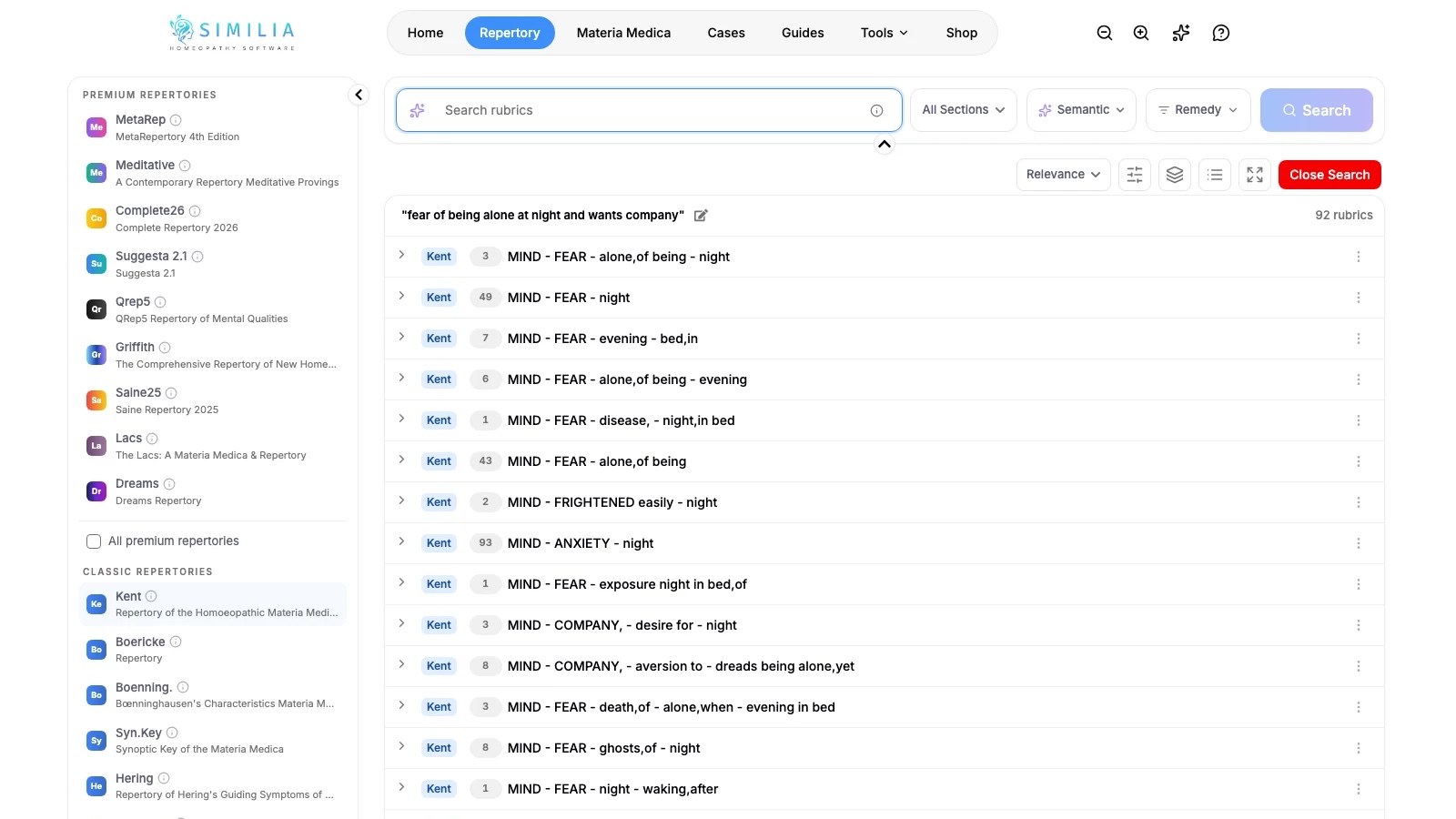
Getting there took more than one rebuild. Homeopathy is a small field, but the problem is common to many professions: a lot of expert knowledge still lives in old reference books written in language nobody uses anymore. Here is what we learned bringing AI to one of them.
The problem: 68,000 entries in 19th-century shorthand
Homeopaths rely on two kinds of reference. A materia medica describes each remedy in detail; a repertory is the index that runs the other way, from symptom to remedy. One of the most widely used repertories is still James Tyler Kent’s, first published in 1897: 37 chapters and about 68,000 entries, called rubrics, written in compressed 19th-century English and graded in three levels.
On paper, practitioners spend years learning to translate a patient’s words into the book’s language. Most software simply copied the paper: exact keyword search, chapter trees and manual cross-referencing. Putting Kent’s Repertory online solved access, since anyone can now open it in a browser for free, but it did not solve vocabulary. A keyword search still has to match the book’s words. The patient says “wants company”; the book says “COMPANY, desire for”.
Lesson 1: Embed meaning, not keywords
Semantic search converts text into vectors, long lists of numbers that place similar meanings close together. We embedded every rubric once. At search time we embed the query the same way, retrieve the nearest rubrics and, in our quality mode, rerank the shortlist with a second model. “Wants company” lands next to “COMPANY, desire for” because the two phrases mean the same thing, even when the wording differs. The same works for everyday phrasing such as “scared of the dark” or “stomach pain after eating”, which the book indexes as MIND – FEAR – dark and STOMACH – PAIN – eating, after.
The practical win is recall rather than cleverness. Practitioners stop missing rubrics whose wording they would never have guessed, and students pick up the book’s language by seeing which of its phrases match their own.
Lesson 2: Keep one vector space, with no silent fallbacks
The most dangerous bug we found produced no error at all. Embeddings from two different models can have the same number of dimensions, so a query embedded by one model can be compared against an index built by another. The database happily returns results with plausible-looking scores and a ranking that means nothing.
So we keep exactly one vector space: one model, one index and one documented text format for queries and entries alike. If the configuration for that space is missing, search fails loudly and reports the error instead of quietly falling back to an older index. In a clinical reference tool, a visible outage is better than a confident wrong answer.
The same discipline applies to quality. We keep a benchmark of queries with known good answers and score every candidate model or prompt against it before anything changes in production. Each change is weighed on measured ranking quality and on speed, never on the impression that results “feel better”. In our most recent comparison we kept the faster model even though a slower one ranked slightly better, because search that answers instantly is search people actually use.
Lesson 3: Size every retry to your strictest deadline
AI features often share infrastructure while having very different latency budgets. A chat assistant can afford to wait out a rate limit; a search box cannot. We learned this when a retry delay tuned for chat leaked into search, and a brief rate limit at an upstream provider became a run of timed-out searches.
Now every retry, sleep and cooldown in shared code is sized from the shortest timeout of any feature that can reach it. Where a request can fall back across providers, one absolute deadline covers all of them, instead of per-provider retry counts that quietly multiply.
Lesson 4: Treat consent as a product feature
In healthcare-adjacent software, trust has to be designed in. We draw a hard line between reference material and patient data. Searching the reference books needs no AI-processing consent. Anything that reads a practitioner’s case notes, such as AI case analysis, transcription or photo analysis, runs only after explicit AI-processing consent. The server re-checks that consent on every request rather than trusting a cached flag or a checkbox in the browser, and revoking it stops even a live transcription.
Lesson 5: Build for the clinic, not the demo
Demos happen on fast office Wi-Fi. Practice happens in rural clinics, on home visits and on trains. For Pro subscribers, our installed app keeps working offline: notes and case edits are saved on the device first and sync when the connection returns, so the editor never waits for a server it cannot reach. Code that has to run offline is bundled up front, because a component that loads on demand cannot load without a network.
Language is the other half of real-world conditions. Similia runs in 18 interface languages, including right-to-left Hebrew. Supporting right-to-left text taught us to make layouts direction-agnostic from day one: a single hard-coded “left” can break an entire results grid for those readers.
Lesson 6: Give away the reference, charge for the workflow
Niche professional markets are small, and trust builds slowly. Our free tier includes eight classical repertories with AI semantic repertory search, 21 classic materia medica books to read online and basic case management, so students can learn the method without paying. The paid tier adds what saves a working practitioner time: a credit-based AI toolkit for turning notes into rubrics, case analysis, live audio transcription and photo analysis, along with unlimited cases and premium modern repertories.
The free library pays for itself in another way, too: it is the part of the product that people find, share and cite.
Key takeaways for vertical AI builders
- Start from your users’ words, not your corpus’s vocabulary.
- Treat embedding models like database schemas: one per index, versioned and never mixed.
- Budget retries and timeouts from the strictest caller, not the average one.
- Make consent and data boundaries visible product features, enforced on the server.
- Design for offline use and for every writing direction before you need them.
- Charge for the workflow, and let the free reference build trust.
What comes next
The next wave of vertical AI will not only be about new data. A great deal of expert knowledge already sits in old handbooks, indexes and reference works that are accurate, hard to search and easy to ignore. Making them searchable in plain language, carefully and without overstating what the model knows, may be one of the most useful things this technology can do.
Marco Ruggeri is the founder of Similia, a homeopathy software platform used by over 4,000 practitioners worldwide, with a background in software engineering and homeopathic practice.







Comment