
AI Consulting in Financial Services: How SMEs and Scale-Ups Deploy Autonomous Agents Safely

Introduction
Artificial intelligence is transforming the financial services industry by helping businesses automate repetitive tasks improve decision-making and deliver better customer experiences.
For small and medium-sized enterprises (SMEs) and growing scale-ups autonomous AI agents offer an opportunity to improve operational efficiency without significantly increasing staffing costs.
However financial services require a particularly careful approach to AI adoption.
Businesses must protect sensitive information maintain regulatory compliance and ensure that automated systems operate within clearly defined limits.
This is where strategic AI consulting becomes valuable.
By combining practical implementation strategies with strong governance and human oversight, financial organizations can deploy autonomous agents safely and effectively.
Understanding Autonomous AI Agents in Financial Services
Autonomous AI agents are software systems designed to perform specific tasks, analyze information, and take actions based on predefined objectives and permissions. Unlike traditional automation tools that follow fixed instructions, AI agents can interpret context, respond to changing inputs, and coordinate multiple steps within a workflow.
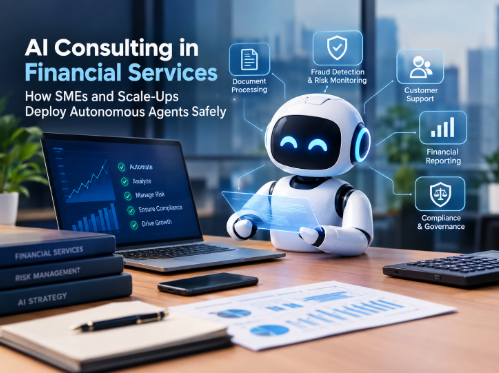
In financial services, these agents may assist with customer support, document processing, transaction monitoring, financial reporting, compliance reviews, and internal knowledge management.
For example, an AI agent could collect information from financial documents, identify missing fields, prepare a summary, and send the results to a human reviewer. The agent improves efficiency while leaving important decisions under appropriate human supervision.
Why SMEs and Scale-Ups Are Adopting AI Agents
Smaller financial organizations often face resource constraints. They need to manage growing workloads while controlling operational expenses and maintaining service quality.
Autonomous agents can help address these challenges in several ways.
- Improving Operational Efficiency
Financial teams frequently spend considerable time processing documents, updating records, responding to routine inquiries, and preparing reports. AI agents can automate parts of these workflows, allowing employees to focus on more complex and valuable responsibilities.
- Supporting Better Customer Experiences
AI-powered assistants can provide faster responses to common customer questions, guide users through routine processes, and help service teams retrieve relevant information. With suitable safeguards, businesses can offer more responsive support without relying entirely on manual processes.
- Scaling Without Proportionally Increasing Costs
As businesses grow, their administrative workload often increases. Properly implemented AI agents can help organizations manage higher volumes of routine tasks without requiring equivalent increases in headcount.
However, the financial benefits depend on the quality of implementation, the complexity of the workflow, and the ongoing costs of maintaining the system.
The Role of AI Consulting in Financial Services
Implementing autonomous AI agents requires more than selecting a model or connecting an API. Financial organizations must identify suitable use cases, assess risks, integrate existing systems, and establish clear accountability.
Professional AI consulting in financial services can help organizations develop an implementation roadmap that aligns technology with business objectives and operational requirements.
A structured consulting process typically includes the following stages:
Identifying the Right Use Cases
Businesses should begin with workflows that are repetitive, measurable, and relatively low risk. Document classification, internal information retrieval, and draft report preparation can be suitable starting points.
High-impact activities, such as approving loans or making investment recommendations, generally require much stronger controls and may not be appropriate for fully autonomous operation.
Assessing Existing Infrastructure
Before deployment, organizations should evaluate their existing software, data quality, access permissions, and integration requirements. AI agents are more effective when they can access accurate, relevant information through secure and well-managed systems.
Establishing Governance and Accountability
Every AI agent should have a clearly defined purpose, an approved scope of activity, and an accountable business owner. Organizations should also establish procedures for reviewing outputs, investigating errors, and suspending an agent when necessary.
Essential Safety Measures for Autonomous AI Agents
Financial organizations must treat safety as a core design requirement rather than an afterthought.
Data Privacy and Access Control
AI agents should access only the information necessary to complete their assigned tasks. Sensitive financial data must be protected through appropriate encryption, authentication, access controls, and data-retention policies.
Businesses should also understand how their AI providers store, process, and potentially use submitted information.
Human Oversight
Not every financial task should be fully automated. Human approval should remain mandatory for actions involving significant financial consequences, sensitive customer decisions, unusual transactions, or material compliance risks.
A well-designed system makes it easy for employees to review the evidence behind an AI-generated recommendation before approving an action.
Testing and Continuous Monitoring
AI agents should be tested against realistic scenarios before being introduced into production. Testing should cover inaccurate outputs, incomplete data, unexpected instructions, unauthorized actions, and attempts to manipulate the system.
After deployment, organizations should monitor error rates, performance, access logs, and unexpected behavior. Regular reviews help identify problems before they become serious operational incidents.
Limiting Agent Permissions
An autonomous agent should not receive unrestricted access to financial systems. Its permissions should be limited to the actions required for its role.
For example, an agent that prepares payment instructions may be allowed to create a draft but should not independently authorize or execute a transfer. Separating preparation from approval reduces the potential impact of mistakes or misuse.
Integrating AI Agents With Financial Workflows
Successful implementation depends on integrating AI agents into existing business processes rather than treating them as isolated tools.
Organizations should map each workflow, identify where human judgment is essential, and determine which steps can be safely automated.
Consider an invoice-processing workflow. An AI agent might extract invoice details, compare them with purchase records, flag discrepancies, and prepare the information for approval. A finance employee would then review exceptions and authorize payment according to established procedures.
This approach combines the speed of automation with human accountability.
Businesses should also establish clear fallback procedures. If an agent encounters uncertain information, loses access to a required system, or produces an unexpected result, it should stop or escalate the task instead of improvising.
Evaluating AI Tools for Financial Decision Support
AI agents can also help teams organize information used in financial planning, risk assessment, and operational decision-making. Nevertheless, automated analysis should not replace appropriate verification or professional judgment.
When evaluating AI-supported financial tools, businesses should examine their data sources, calculation methods, limitations, and security practices. Teams should be able to distinguish verified facts from estimates or AI-generated interpretations.
For example a financial team reviewing SaaS spending may use a SaaS evaluation checklist for small teams to assess software suitability costs integration requirements security considerations and operational needs.
Using a structured evaluation process can help smaller organizations avoid adopting tools that introduce unnecessary complexity or fail to deliver measurable value.
Measuring the Business Impact of AI Adoption
Financial organizations should define success criteria before deploying autonomous agents. Useful performance indicators include:
– Time saved on repetitive administrative tasks.
– Reduction in manual processing errors.
– Average response time for customer inquiries.
– Cost per completed workflow.
– Frequency of escalations to human reviewers.
– Compliance incidents and unauthorized actions.
– Employee satisfaction and adoption rates.
These indicators should be evaluated together. A system that processes tasks quickly but generates frequent errors may create more work than it eliminates.
Pilot projects provide an opportunity to compare performance against existing processes, identify weaknesses, and improve safeguards before expanding deployment.
Common Challenges and How to Address Them
Despite their potential, autonomous AI agents introduce several implementation challenges.
Poor-quality data can lead to inaccurate outputs. Weak access controls can expose sensitive information. Unclear responsibilities can make it difficult to investigate mistakes, while excessive automation can create risks when systems encounter unfamiliar situations.
Organizations can reduce these risks by starting with limited use cases, maintaining documented procedures, restricting permissions, and involving relevant stakeholders from the beginning.
They should also review vendor reliability, service availability, contractual responsibilities, and exit options. Businesses need to know how they can retrieve their data and maintain operations if an AI provider becomes unavailable or no longer meets their requirements.
Conclusion
Autonomous AI agents offer SMEs and scale-ups a practical way to improve efficiency, streamline financial workflows, and support better service delivery. However, successful adoption requires careful planning, secure integrations, clearly defined permissions, and ongoing human oversight.
By starting with measurable use cases and establishing appropriate governance, financial organizations can capture the benefits of automation without surrendering control over critical decisions.
The most effective strategy is not to automate everything immediately. It is to introduce AI agents gradually, evaluate their performance, and expand their responsibilities only when the technology has demonstrated that it can operate reliably within established business and regulatory boundaries.







Comment