The additive manufacturing is constantly evolving, but few innovations have been as transformative as the large-format 3D printer. They are not merely an enlargement in size but a key tool transitioning from prototyping to direct production, and from small-scale creativity to large-scale applications.
When you witness a large-format 3D printer in action, the resin is layered and stacked under the lasers. It is striking. Among the various big-scale 3D printer technologies, stereolithography (SLA) stands out, offering unparalleled precision and surface finish.
This guide will explore how large-format SLA printers are enabling manufacturers to transition from small-scale creativity to impactful, industrial-sized 3D printer applications.
What is a Large-Format SLA Printer?
A large-format 3D printer is generally defined as an additive manufacturing machine with a build volume significantly exceeding that of desktop models.
Currently, there is no unified definition of the build volume for “large-format SLA 3D printers” in the industry. However, when the single-axis length in the X/Y direction is ≥800mm, or the build volume is significantly larger than 600×600×400mm, manufacturers typically classify it into the “large-format” category.
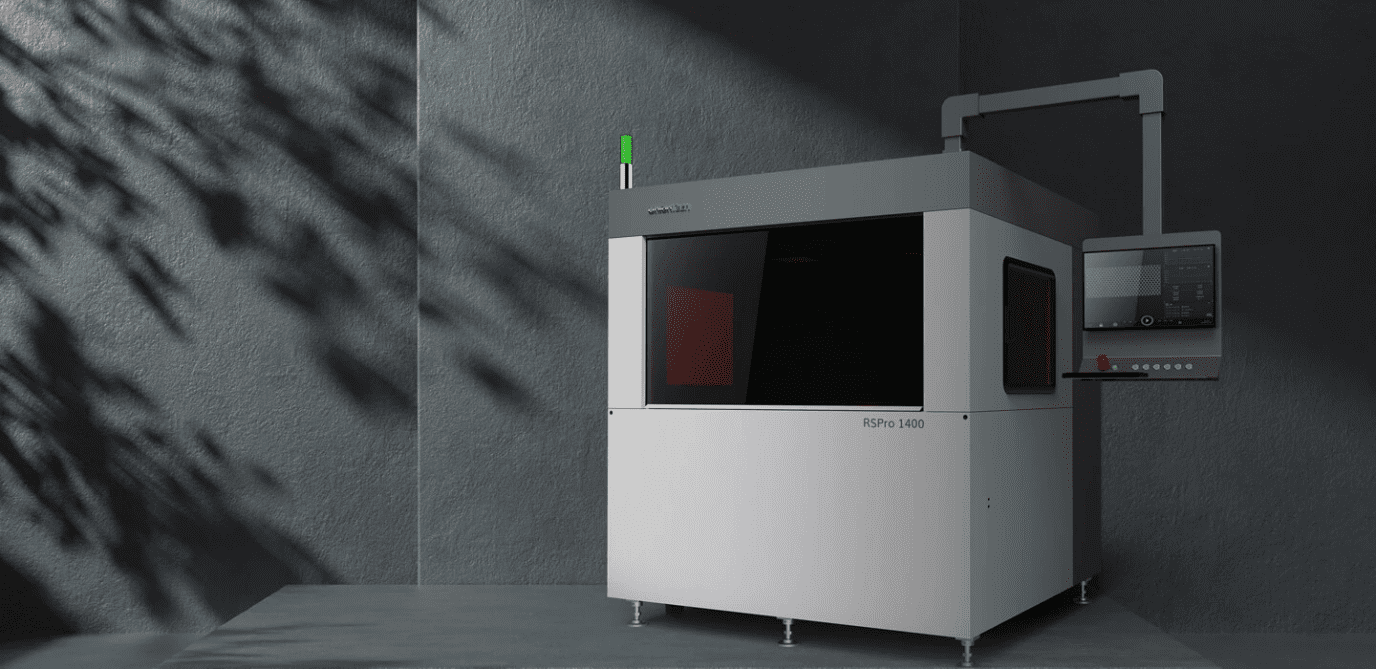
For example, UnionTech RSPro1400 (1400×700×500mm), RSPro1800 (1800×900×600mm), RSPro2100 (2100×700×800mm), and RSPro800 2.0 (800×800×550mm) are all large-format SLA 3D printers.
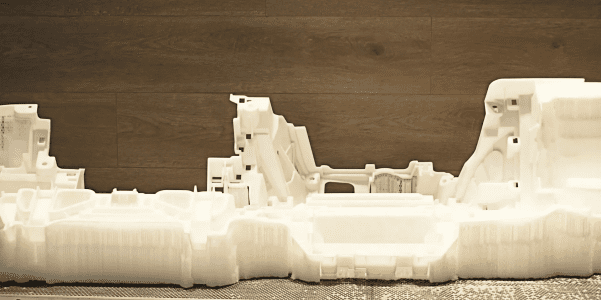
It enables the production of sizable, monolithic parts or the mass production of smaller components in a single batch.
1. What are the Key Advantages?
The shift to a large-format 3D printer size brings three crucial advantages:
- Efficiency: Printing large parts as a single piece eliminates the time and hassle of slicing a model into smaller parts that must be printed and then manually assembled. For complex components, multiple small parts can be produced in a single printing process, enabling batch production.
- Cost Savings: While the initial investment may be higher than a desktop machine, the integrated printing reduces assembly labor and time. Producing more parts in a single print run optimizes equipment utilization and energy consumption. For small-batch production, the big-scale 3D printer is more cost-effective than mold creation.
- Design Freedom: The large-format 3D printer enables engineers to realize complex, full-scale designs that were previously impossible to manufacture in one piece, offering true design freedom.
2. How Do Large-Format SLA Printers Differ from Standard Printers?
The difference between a standard and a large-format SLA printer goes beyond just the physical footprint.
| Feature | Standard SLA Printer | large-format SLA Printer |
| Build Volume | Small, generally for prototypes or small batches. | Large Volume, for full-scale parts or mass production. |
| Print Size | Typically within the range of 300mm×300mm×300mm to 600mm×600mm×400mm. | Larger printing size, with the single-axis length in the X/Y direction is ≥800mm, or the build volume is significantly larger than 600×600×400mm. Obtaining stronger parts since no bonding or segmentation is needed. |
| Efficiency | Only a small quantity or a single small-to-medium-sized prototype can be printed at a time. | Higher printing efficiency and throughput, thus reducing costs. |
| Speed | Moderate speed for small items. | Faster printing speed for large parts and batches. |
| Application | Prototyping, jewelry, and dental. | Large industrial 3D printer applications, automotive, aerospace, architecture, and so on. |
The superior resolution, detail, and surface finish inherent to the SLA process are maintained in these large 3D printers, making them ideal for end-use parts and highly accurate manufacturing.
How Does a Large-Format SLA Printer Work?
Stereolithography (SLA) is one of the most popular 3D printing technologies. It utilizes a powerful light source, typically a laser or a projector, to selectively cure the liquid resin layer by layer. Take the UnionTech SLA 3D printers as an example:
- Platform Immersion: A build platform is lowered into a vat containing liquid resin, leaving a thin layer of resin (the layer height) between the platform and the bottom of the vat.
- Laser Curing: Multiple high-powered UV laser traces the cross-section of the part, hardening the liquid resin where it hits. This multi-laser synchronous operation solution is powered by UnionTech’s proprietary multi-galvanometer 3D printing technology. This not only doubles printing speed and efficiency but also ensures the highest resolution, smooth surface finish, and minimal layer lines.
- Layer Repetition: The platform is raised by one layer thickness, allowing uncured resin to flow beneath the newly printed layer. The laser then cures the next cross-section. This process repeats until the whole object is formed.
- Seamless Splicing: During this process, UnionTech’s splicing algorithm seamlessly joins the scanning areas of adjacent galvanometers, increasing the contact area between the two sides of a part. The unique “cross‑splicing” technique further ensures that the surface quality and mechanical properties in the spliced region reach over 90% of those achieved by a single galvanometer.
- Completion and Curing: The final part is then removed, washed to remove excess resin, and subjected to a post-curing process (usually with UV light) to maximize its material strength.
For example, the UnionTech RSPro1400 is a large-format SLA 3D printer capable of fabricating objects up to 1400×700×500 mm (55.1×27.6×19.7 inches) with intricate details and high precision. It is well-suited for applications such as prototyping, mold making, and investment casting.
Where Can Large SLA 3D Printing Be Applied?
The unparalleled combination of size, speed, and dimensional accuracy offered by large-format SLA printers has made them indispensable across critical industries:
- Automotive: Creation of full-size interior and exterior design prototypes, dashboards, light housings, and tire molds, allowing for immediate design validation.
- Aerospace: Manufacturing of large, non-load-bearing components, complex internal lattice structures, prototypes, and parts repair, capitalizing on the efficiency and cost-saving of the large industrial 3D printer.
- Architecture: Producing extremely detailed, large-scale physical models of buildings and urban developments for presentations and concept validation.
- Home Appliances: Rapidly producing prototypes of consumer electronics, furniture, and lighting shells, speeding up time-to-market.
- Medical Devices: Manufacturing custom surgical guides, anatomical models for pre-surgical planning, custom-made prosthetic limbs, and more that require the high-dimensional accuracy of industrial-sized 3D printers.

Where to Buy Large Industrial SLA 3D Printers?
When seeking reliable large-format SLA 3D printers, partnering with a proven manufacturer in stereolithography is essential.
UnionTech is a world-class producer of large-format SLA 3D printer solutions. Their RSPro Series is designed for high-performance manufacturing, including RSPro 2100, 1800, and 1400.
- RSPro2100: With a build volume of 1400×700×500 mm, it’s their largest format SLA 3D machine printer.
- RSPro1800: Equipped with dual lasers and high-speed scanning capabilities, it offers a build volume of up to 1800×900×600 mm.
- RSPro1400: Suitable for mass production of components, with a build volume of 1400×700×500 mm.
The series guarantees high-accuracy, highly detailed components with the smooth surface finish of SLA, even across the enormous build platform. These large-format SLA printers ensure high printing efficiency and faster printing speed, crucial for turning around massive parts or high-volume batches quickly.
Conclusion
No longer confined to small prototypes, the large-format SLA printer has emerged as a powerhouse for functional parts, molds, and mass production.
If your business requires high-volume, highly accurate, and 3D big printer capabilities, UnionTech offers the large-format 3D printer solutions you need, transitioning your innovation from concept to market at an unprecedented scale.
Contact UnionTech now for detail information!