
How to Order Indian Takeaway Online: What to Look for in a Food Ordering Platform

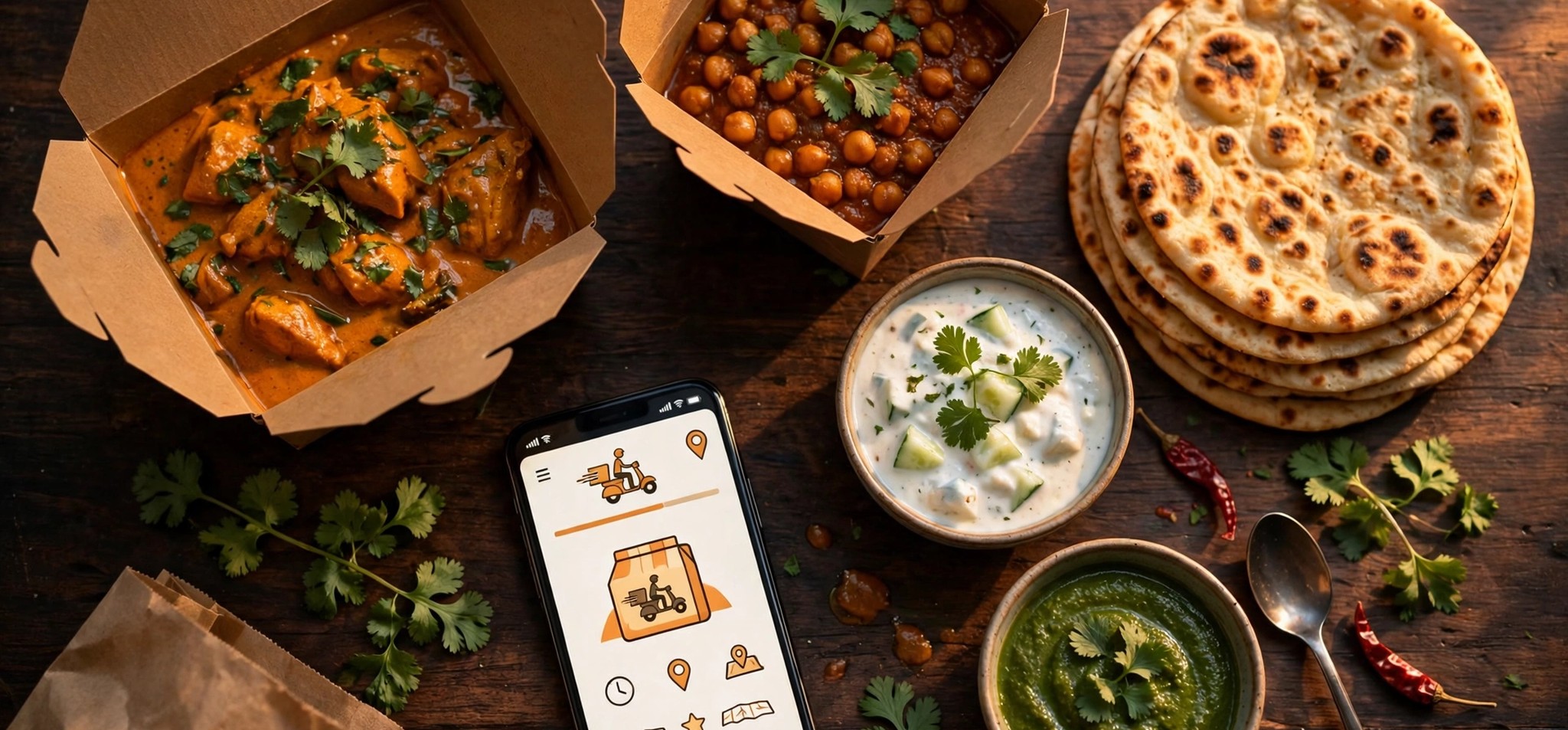
Ordering a curry on a Friday night used to mean a stack of paper menus and a crackly phone line. Today, you can order Indian takeaway online from hundreds of restaurants across the UK in a few taps. Live menus, photos and reviews now sit on a single screen. The shift has been rapid. UK food delivery was already worth an estimated £14.3 billion in 2025 [1]. Indian remains one of the most searched cuisines in the UK. Thousands of curry houses run from London's Brick Lane to Manchester's Curry Mile.
But the platform you choose shapes more than convenience. It influences the price you pay and how accurate the menu is. It even decides whether allergen details reach you clearly, and how quickly your biryani arrives. This guide explains what to look for, so your next order is straightforward, fair and reliably good.
Why Ordering Indian Takeaway Online Has Become the Default
Indian food has always lent itself to shared, generous, made-to-order eating, which makes it a natural fit for online ordering. Curry houses typically run long menus with dozens of mains, rice, breads, sides and set meals. Most also allow fine control over spice levels, extras and dietary swaps. That level of customisation is awkward on a phone call and easy to get wrong. An Indian takeaway ordering platform captures every note to the kitchen in writing.
Demand is heavily concentrated at the weekend. Friday and Saturday evenings are the peak slots for delivery across the UK. Large menus plus group orders make a well-designed ordering screen genuinely useful at the moment you need it most. Add in that a large majority of British adults have now used a delivery app at least once. At that point, online ordering is no longer the exception. For many households it is simply how a curry night begins.
How to Order Indian Takeaway Online, Step by Step
Search by postcode or location
Start with your postcode or a precise address. Better platforms filter by who actually delivers to your door, instead of listing every restaurant in town. You then see only kitchens that can reach you within a sensible window. Distance matters for Indian food in particular. Naan and bhajis lose their texture on a long, slow journey, so a closer kitchen usually means a better meal.
Browse menus, reviews and opening times
Once you have a shortlist, look at the full menu, recent reviews and live opening times together. A listing that shows review counts as well as star ratings helps you separate the consistently good from the merely convenient. Watch for kitchens that close between lunch and dinner, which can catch out an evening order placed a little too early.
Customise your dishes (spice level, allergies, notes to the kitchen)
This is where online ordering beats the phone. Most Indian menus support a heat scale from mild to hot. Many also let you add notes for allergies, extra naan, no coriander or a side of raita. Use these fields. A clear written note is far more reliable than a verbal request, and it gives the kitchen a record to work from.
Choose delivery or collection
Decide early whether you want delivery or collection. Collection is almost always cheaper, because the restaurant pays no courier or delivery commission. The food also leaves the kitchen the moment it is ready. Delivery trades a little cost and time for the comfort of staying put. If you choose delivery, check the estimated window before you confirm.
Pay securely and follow order status
Pay by card or a trusted wallet through the platform's checkout. You should see a confirmed total, including fees, before you commit. Once the order is in, many major marketplace platforms provide status updates or live tracking from the restaurant or rider [2][3]. Availability of live tracking varies by platform and by whether the restaurant or a third-party courier is delivering. Save the order confirmation: if anything is missing or late, the reference is what you need for support.
What to Look for in a Food Ordering Platform
Clear pricing and fees
Look for a platform that shows the full cost before you check out, broken into food, delivery, service and any small-basket fee. Be aware that menu prices can differ between platforms. Independent reporting has found that restaurants sometimes raise app prices (commonly in the region of 10–30 per cent) to help cover commission [4]. The same dish can therefore cost more through a marketplace app than ordered direct. Comparing the final total, not just the headline dish price, is the only honest way to judge value.
Accurate menus and customisation
An accurate menu is the foundation of a good order. The platform should display current prices, available spice levels, extras and set meals. It should also clearly mark vegetarian, vegan, halal and gluten-free options. For Indian food, customisation is half the point. A platform that lets you set heat, add sides and leave kitchen notes is worth more than one that simply lists dishes.
Delivery and collection options
Check how high-quality a food ordering system they maintain. Some restaurants send their own drivers, others use third-party couriers, and most support click and collect. Restaurant-driven delivery often means a faster handover and a clearer chain of accountability. Courier delivery, in turn, gives wider coverage. Collection is usually the cheapest option and works well when the kitchen is nearby.
Reviews and ratings you can trust
Ratings are only useful if they are recent and specific. Look for platforms that show review counts as well as averages, and read a handful of the most recent comments. A kitchen with hundreds of reviews and a steady four stars is a safer bet than one with a single five-star rating. Notes about portion size, heat and delivery time also tell you more than a number alone.
Order status updates and communication with the restaurant
Good order visibility goes beyond a simple confirmation email. Many marketplace platforms show clear status updates, from accepted to prepared to out for delivery, and some offer live rider tracking [2][3]. Availability differs by platform and fulfilment method. The ability to message the restaurant if a detail needs clarifying is also useful. For a Friday night curry, knowing whether your order is being cooked or already on the road takes the guesswork out of timing.
Offers and loyalty
Look for first-order discounts, restaurant-specific deals and rewards for repeat orders. Many Indian restaurants run their own set-meal deals that only appear on certain platforms. Loyalty schemes can also shave a meaningful amount off a regular order. Read the small print on minimum spend and expiry, but do not overlook offers that genuinely suit your habits.
Support when something goes wrong
Even a good order can go wrong, so check how support works before you need it. A platform with a clear refund process, responsive help for missing items and a real contact route is worth far more. A cheaper one that vanishes when problems appear is a false economy. Phone or chat support that runs into the evening is especially useful for late deliveries.
Marketplace Apps vs Ordering Direct From the Restaurant
Most online orders sit in one of two camps. Marketplace apps bring many restaurants together in a single, familiar interface, which makes browsing and comparison easy. They often add service fees and delivery fees, and some menus are priced higher to cover commission.
Ordering direct, through a restaurant's own website or a focused local platform, tends to use simpler pricing. A larger share of what you pay then stays with the kitchen.
Neither route is universally better. Marketplace apps win on breadth and convenience; direct ordering often wins on price and on supporting the restaurant. The table below sets out the trade-offs honestly.
Table 1. Marketplace apps compared with ordering direct.
| Feature | Marketplace apps | Ordering direct |
|---|---|---|
| Wide choice in one app | Yes, often thousands of restaurants | Limited to that restaurant or platform |
| Pricing transparency | Service, delivery and small-order fees can apply | Usually simpler, with fewer added fees |
| Menu prices | Sometimes marked up to cover commission | Usually the restaurant's own prices |
| Customisation and notes | Standardised across restaurants | Varies by restaurant site |
| Loyalty and repeat rewards | Platform-wide schemes | Often restaurant-specific |
| Support for the restaurant | A share of what you pay goes to the platform | More of your money reaches the kitchen |
Top Food Ordering Platforms for Indian Takeaways in the UK
The UK market is served by several well-established food ordering platforms. Each has its own strengths, and fees, coverage and features change regularly. It is worth checking the current details before you commit.
- ChefOnline is a food ordering platform focused on independent and local restaurants. It has a particular strength in Indian and South Asian cuisine, and supports delivery and collection, so you can order in or book your table online in advance. Diners who prefer ordering from local restaurants can order takeaway online from ChefOnline. Menus, offers and collection times can then be compared in one place. Its mobile apps on the Play Store and App Store offer the same choice when you are away from a computer.
- Just Eat is one of the longest-running UK platforms, with broad national coverage. Orders are a mix of restaurant-delivered and courier-delivered, and the platform provides order status updates and tracking for many deliveries [2].
- Deliveroo focuses on city-centre restaurants and is known for courier delivery with live tracking features on many orders [3].
- Uber Eats has grown sharply and, by 2024 measures of delivery occasions, held a leading share of the UK market among the major aggregators [5].
- Foodhub positions itself as a lower-commission option for restaurants (often described as a subscription or low/no commission model) and frequently promotes collection deals and exclusive discounts [6].
Each platform suits a slightly different need. It is worth keeping two or three to hand, depending on where you live and what you fancy.
Finding Local Indian Takeaways Near You
Finding a good local Indian takeaway is as important as choosing a platform. Start by searching your area, checking opening hours and comparing menus before you order. The closest kitchen is not always the best one. A strong local listing should show the following.
- A full menu with current prices
- Recent reviews from real customers
- Clear allergy information
- Sensible collection times
London is a useful example of how much choice a single city can offer. Thousands of Indian eateries are spread across postcodes from Brick Lane to Southall. In the capital, you can order Indian takeaway in London from local restaurants and see menus, offers and collection times in one place.
The same approach works in any town. Read the most recent reviews, and check whether the kitchen delivers or is collection only. Then confirm the opening hours before you build your basket.
Ordering for Groups, Families and Office Lunches
Group orders are where Indian food shines, but they need a little planning. A sensible rule of thumb for a group order is the following.
- One main curry per person
- A couple of extra mains for every four people
- Shared rice and bread
- Two to four starter pieces per head
Balance the heat as well. Include at least one mild dish, such as a korma or tikka masala, for heat-sensitive diners. Add a medium option, such as a rogan josh or bhuna. Then include one hotter dish, such as a madras, for those who want it.
For office lunches, order in advance. Confirm dietary needs, including vegetarian, vegan, halal and gluten-free, before you place the order. Choose dishes that travel well. Biryanis, dals and slow-cooked curries hold their flavour and reheat cleanly. Fried snacks and dry breads are best eaten fresh. Label each container with its spice level and allergens so colleagues can choose safely.
Tips for a Smooth Indian Takeaway Order
A few habits will make every order smoother.
- Order early on Friday and Saturday nights, when kitchens are at their busiest, to avoid long waits.
- State your spice level and any allergies clearly in the notes field.
- Double-check collection or delivery times before you confirm.
- Reheat leftovers gently over a low heat or in short microwave bursts, adding a splash of water to rice so it stays soft.
Keeping these steps in mind is the practical side of knowing how to order Indian takeaway online well. The right platform does the heavy lifting. A few seconds of attention at checkout makes the difference between a good meal and a great one.
FAQs
How do I order Indian takeaway online?
Enter your postcode on a food ordering platform and browse the Indian restaurants that deliver to you. Choose your dishes, set spice levels and add any allergy notes. Then pick delivery or collection and pay securely through the checkout.
What should I check before paying for an online takeaway order?
Check the full breakdown of food, delivery and service fees, plus the estimated arrival or collection time. Look over your spice and allergy notes, and the restaurant's recent reviews. Confirm the address and contact number are correct before you commit.
Is it cheaper to order direct from the restaurant?
Often, yes. Ordering direct usually avoids the extra service and delivery fees that marketplace apps add. Menu prices are also less likely to be marked up to cover commission.
What is the best food ordering platform for Indian takeaways?
There is no single best option. Marketplace apps offer the widest choice. Platforms focused on independent restaurants, such as ChefOnline, often provide better access to local curry houses. They also tend to offer clearer collection options. Try two or three to see which suits your area.
Conclusion
Ordering a curry has come a long way from the paper menu and the phone call. The right platform, a clear check of fees and timings, and a few honest reviews are usually all it takes. You can then order Indian takeaway online with confidence, whether it is a quick midweek meal or a spread for the whole family.
Choose the option that fits your evening, and support a kitchen that does the dish well. The rest tends to look after itself. Whether it is a quiet night in or a family dinner, a food ordering platform like ChefOnline makes it easy to order from trusted local restaurants.
References
[1] Lumina Intelligence, UK Food Delivery Market 2025: https://www.lumina-intelligence.com/blog/foodservice/uk-food-delivery-market-growth-share-size-statistics-2025/
[2] Just Eat UK Help – order tracking: https://justeatukpoc.zendesk.com/hc/en-us/articles/203065242-Where-s-my-order
[3] Deliveroo Help Centre – how Deliveroo works (rider delivery and order tracking): https://help.deliveroo.com/en/articles/1934773-deliveroo-101-how-it-works
[4] The Guardian, 11 July 2022: https://www.theguardian.com/money/2022/jul/11/hard-to-swallow-the-30-price-hike-that-gets-delivered-with-your-meal
[5] Lumina Intelligence, UK Food Delivery Market 2025 (Uber Eats share): https://www.lumina-intelligence.com/blog/foodservice/uk-food-delivery-market-growth-share-size-statistics-2025/
[6] Restaurant Online, 20 August 2020 – Foodhub's no-commission, fixed-rental partner model: https://www.restaurantonline.co.uk/Article/2020/08/20/The-Lowdown-Just-Delete-ad-campaign-Foodhub-Just-Eat-Deliveroo-Uber-Eats
Previously in Business news: Trading Without a Template: What Linea Prime Offers the First-Generation Investor





Comment