
API3 Permanently Removes Its Token Minting Function

The cost of finding a smart-contract exploit has collapsed. API3’s answer is not another audit, but removing what is worth attacking: since its migration, no contract can create new API3, and ownership of the token sits at an address nobody controls.
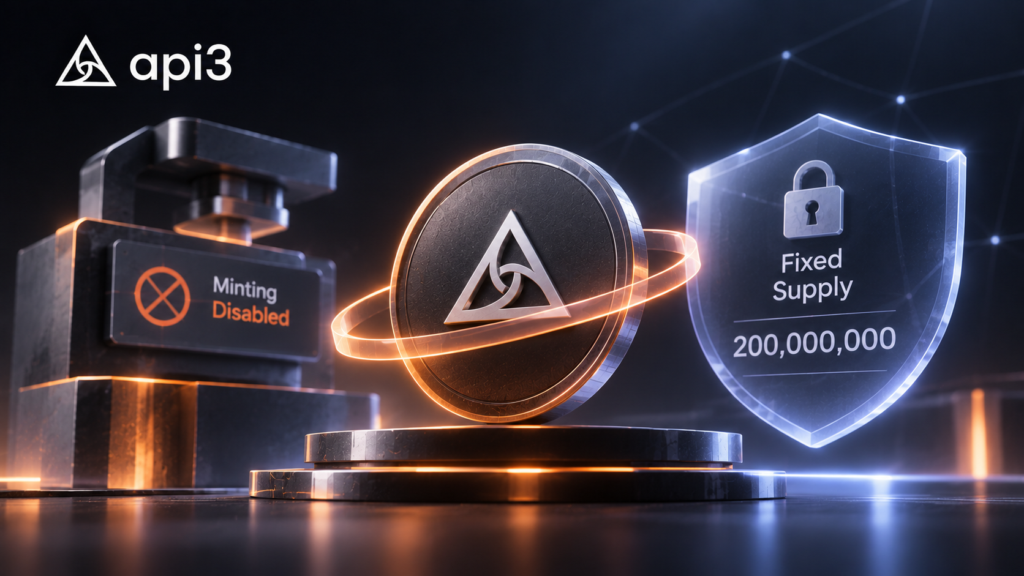
The economics of attacking a smart contract have changed, and API3 is restructuring its governance around that fact. Under a proposal its DAO executed on 4 November, the data-infrastructure project permanently removed the ability to mint new API3 and transferred ownership of its token contract to a dead address that no one holds a key to. The move closes off a class of governance attack that has drained hundreds of millions of dollars from other protocols.
For most of DeFi’s history, old audited code was treated as reasonably safe, because finding a bug in it took a specialist weeks of work. That assumption no longer holds. In December 2025, Anthropic reported that AI agents exploited 56% of a set of contracts deployed after the models’ training cutoff, at an average cost of $1.22 per attempt, with exploit revenue doubling roughly every 1.3 months. In April 2026, a model surfaced thousands of previously unknown vulnerabilities in mature software, including a 27-year-old bug in OpenBSD and a 16-year-old one in FFmpeg. Contracts audited once, years ago, and never touched since are now a standing target.
Governance systems are especially exposed. In a governance attack, someone acquires enough voting power to pass a harmful proposal, and if that proposal can reach a token contract with an unlimited right to mint, it can print new supply. The pattern has repeated: BonkDAO lost $20 million this July after an attacker spent $4.4 million to meet a 1% quorum with seven wallets while 18,000 holders sat out; Compound saw a $24 million proposal pass 52 to 48 over a weekend in 2024; and voting power on some networks can be rented for roughly 1% of what the tokens would cost to buy.
API3’s DAO has never been attacked until this migration it ran on contracts built in 2021 and last audited in 2022. In August 2026, a bug bounty report surfaced a minor flaw in its staking pool that had gone unnoticed for five years through four audits. API3 confirmed it, paid the bounty, and verified that no treasury funds were ever at risk and that a handful of incidental triggers released under 1,000 tokens early in total. Its conclusion was not that the bug was dangerous, but that leaving the ability to create tokens behind any old contract, in the current environment, is a risk not worth carrying.
Rather than trying to keep legacy contracts secure indefinitely, the proposal removes what is worth attacking. Post this execution, the API3 token has no minters, its contract owner is an address nobody controls, the treasury sits in multisignature wallets, and no vote in the old contracts can pass. The staking-pool flaw becomes moot, because the pool stops minting entirely.
It is a different posture toward security: reduce the attack surface rather than defend it in perpetuity. For a protocol positioning itself as infrastructure for AI agents, whose tools are part of what makes old code newly vulnerable, removing the most valuable target is the point.
“AI agents now find smart contract exploits for about a dollar an attempt. Rather than keep defending the ability to mint, we removed it,” said Emanuel Tesar, Tech Lead at API3. “Nobody can create new API3 anymore, not an attacker and not us.”
ABOUT API3
API3 builds data infrastructure that delivers signed, real-world data on-chain directly from the providers that produce it. With this migration it has removed the ability to mint new tokens and moved to a one-token-one-vote model, reducing the attack surface of its most sensitive contracts. It is governed by its token holders through the API3 DAO. The project’s broader work and the marketplace itself can be explored at api3.org and airnodehub.api3.org
Previously in Blockchain: Bringing Bitcoin Closer to Traditional Finance with Singapore’s BIT Asset Management




Comment