
Rolex GMT-Master II Super Clone: Pepsi vs Batman Bezel Design and Movement Comparison

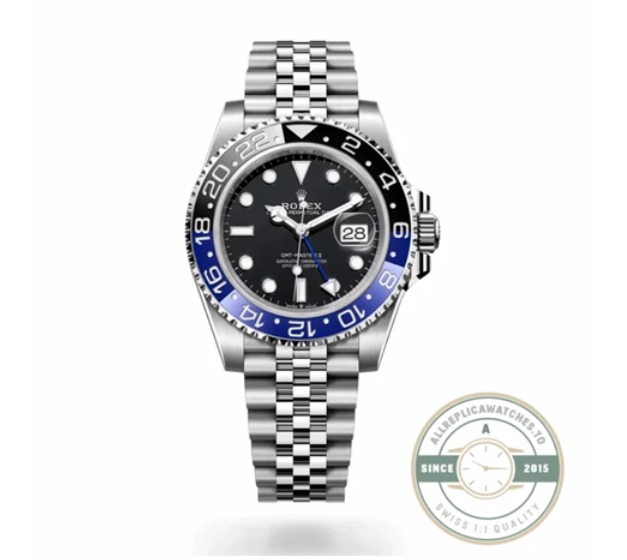
The Rolex GMT-Master II has long been associated with international travel, precision engineering, and distinctive luxury sports watch design. Among its many variations, two configurations have attracted particular attention: the red-and-blue “Pepsi” and the blue-and-black “Batman.”
Both models share the recognizable GMT-Master II case design, additional 24-hour hand, and rotating bezel. However, their contrasting color combinations create noticeably different visual identities.
These differences have also become an important subject in the super clone watch market, where manufacturers attempt to reproduce the original models’ ceramic bezels, mechanical movements, and exterior finishing.
Understanding the Pepsi and Batman designs requires looking beyond their colors and examining the engineering that makes the GMT-Master II distinctive.
The History Behind the Pepsi and Batman Designs
The GMT-Master collection originated in the 1950s, when international air travel was becoming increasingly important.
Rolex developed the original GMT-Master to help pilots and other frequent travelers monitor an additional time zone. Its rotating 24-hour bezel and dedicated hand created a practical system for keeping track of time across different regions.
The red-and-blue bezel eventually became one of the collection’s most recognizable features, earning the nickname “Pepsi” because of its resemblance to the soft drink company’s familiar colors.
The Batman design arrived much later.
In 2013, Rolex introduced a GMT-Master II featuring a blue-and-black ceramic bezel, an important development in the production of two-color Cerachrom inserts.
A red-and-blue ceramic version followed in 2014, initially appearing on a white-gold GMT-Master II.
In 2018, Rolex introduced the stainless-steel GMT-Master II Reference 126710BLRO with its red-and-blue ceramic bezel and Jubilee bracelet.
The updated blue-and-black Reference 126710BLNR followed in 2019.
These developments established the modern Pepsi and Batman as two of the most recognizable interpretations of the GMT-Master II design.
Pepsi vs Batman: Understanding the Bezel Differences
The most obvious distinction between the two watches is their bezel coloration.
The Pepsi features a red lower section and blue upper section, creating a bold combination strongly associated with the GMT-Master’s aviation heritage.
The Batman uses blue and black, producing a more restrained appearance that blends contemporary sports watch styling with the collection’s established design language.
Both configurations use the same basic bezel concept.
A 24-hour scale surrounds the dial, while the rotating mechanism allows the wearer to reference another time zone in conjunction with the GMT hand.
The ceramic insert is especially important because its colors, surface texture, and engraved numerals influence the overall appearance of the watch.
For replica manufacturers, achieving convincing color transitions presents a significant challenge.
The Pepsi’s contrasting red and blue sections can make variations in hue particularly noticeable. The Batman’s darker combination may appear more understated, but accurate color saturation and a clean transition between the blue and black sections remain important.
Neither configuration should automatically be considered easier to manufacture accurately. Consistency depends on the specific production process, materials, and finishing standards.
Why Ceramic Bezel Manufacturing Is So Challenging
Modern genuine GMT-Master II watches use Rolex’s Cerachrom ceramic bezel technology.
The original components are designed to resist scratching, corrosion, and color changes caused by ultraviolet exposure.
Creating a two-color ceramic insert requires precise control over material processing and pigmentation.
The engraved numerals and graduations must also maintain consistent dimensions and alignment.
Replica manufacturers attempt to reproduce these characteristics through their own production methods.
However, ceramic appearance can differ substantially depending on the composition, manufacturing process, and surface treatment.
This is one reason bezel comparisons remain common in discussions surrounding imitation watches and other luxury-inspired timepieces.
Photographs can make different bezels appear nearly identical, while direct examination under consistent lighting may reveal differences in color depth, numeral finishing, or surface reflections.
The rotating mechanism introduces another consideration.
A properly engineered GMT bezel should turn smoothly in both directions and align accurately with its hour markers. Excessive looseness or inconsistent positioning can indicate differences in component tolerances.
The Rolex Calibre 3285: The Movement Behind Both Models
Despite their distinctive appearances, the modern genuine Pepsi and Batman references share the same movement architecture.
Both are powered by the Rolex Calibre 3285, a self-winding mechanical movement developed and manufactured by Rolex.
The movement provides conventional timekeeping alongside an additional 24-hour display for a second time zone.
Its key technical features include an approximately 70-hour power reserve, the Chronergy escapement, and a Parachrom hairspring.
One particularly important characteristic is the independently adjustable local hour hand.
This allows travelers to change the local time without disrupting the minute hand or the reference time indicated by the GMT hand.
The date display is also linked to the local-hour setting, allowing it to change when the local hour hand passes midnight in either direction.
These features make the GMT-Master II mechanically different from a conventional three-hand automatic watch.
They also help explain why reproducing its full functionality presents a greater challenge than simply adding a fourth hand to the dial.
Understanding GMT Super Clone Movements
In the replica watch market, movement designations such as VR3186, VR3285, and DD3285 frequently appear in descriptions of GMT-Master II-inspired models.
These names refer to movement families intended to reproduce aspects of genuine Rolex GMT calibres.
However, they do not represent officially certified equivalents of Rolex movements.
The VR3186 is generally associated with replica interpretations of the earlier Rolex Calibre 3186 architecture.
Movements marketed as VR3285 or DD3285 are intended to resemble aspects of the newer Calibre 3285.
Depending on their construction, these movements may differ in power reserve, winding systems, setting mechanisms, and component compatibility.
A particularly important distinction involves how the GMT function operates.
Some automatic GMT movements feature an independently adjustable local hour hand, while other designs allow independent adjustment of the 24-hour hand instead.
Both arrangements can display another time zone, but they provide different operating experiences.
Movement labels alone cannot establish which mechanism is installed or how reliably it performs.
GMT Functionality: Why the Independent Hour Hand Matters
For frequent travelers, the ability to adjust the local hour hand independently is one of the GMT-Master II’s most useful features.
Imagine traveling from London to New York.
A genuine GMT-Master II allows the wearer to move the conventional hour hand backward to match New York time while preserving the reference time indicated by the 24-hour hand.
This adjustment can be completed without interrupting the watch’s minute and seconds indications.
Some replica movements attempt to recreate this functionality, while others use a different GMT-setting arrangement.
The distinction becomes important when evaluating watches represented as mechanically faithful reproductions.
A visually accurate GMT hand does not necessarily mean the movement provides the same operational characteristics as the genuine Calibre 3285.
Likewise, an advertised extended power reserve should be treated as a claim requiring independent measurement.
The practical quality of a GMT movement depends on reliable hour-hand adjustment, consistent timekeeping, date operation, and the durability of its internal components.
External Finishing and Case Construction
Beyond the bezel and movement, the Pepsi and Batman share the recognizable 40mm Oyster case proportions found on their modern stainless-steel references.
The genuine models use Rolex’s Oystersteel, a corrosion-resistant alloy belonging to the 904L stainless-steel family.
Their cases combine brushed and polished surfaces, creating a contrast that emphasizes the shape of the lugs and crown guards.
Reproducing these details requires accurate machining and careful surface finishing.
Small differences in lug geometry, case thickness, or crown-guard proportions can influence the overall appearance.
The relationship between the bezel and case is equally important.
A bezel that sits too high or has uneven spacing can change the watch’s silhouette even when the individual components appear convincing.
Replica construction quality may vary between manufacturers and production batches, making direct technical examination more meaningful than marketing descriptions.
Dial Accuracy, Crystal Quality, and Hand Alignment
The GMT-Master II dial is relatively simple, but that simplicity makes small differences especially noticeable.
Both Pepsi and Batman configurations commonly feature a black dial with luminous hour markers, Mercedes-style hands, and an additional arrow-tipped GMT hand.
The genuine models also incorporate a sapphire crystal with a Cyclops magnifying lens over the date display.
For watches inspired by these designs, the placement of the date window and magnifier can significantly affect visual accuracy.
Other important details include marker alignment, dial-printing precision, hand proportions, and luminous application.
Discussions surrounding Replica Rolex GMT Master models often emphasize these characteristics alongside bezel color and movement specifications.
Nevertheless, a convincing dial does not establish the quality of the internal movement.
External appearance and mechanical performance must be evaluated independently.
Oyster vs Jubilee Bracelet: A Different Wearing Experience
Bracelet construction contributes significantly to the identity of the modern GMT-Master II.
Rolex offers the collection with both Oyster and Jubilee bracelet configurations.
The Oyster bracelet features a three-piece link design, creating a relatively sporty and streamlined appearance.
The Jubilee bracelet uses five-piece links, providing a more intricate visual texture and a dressier character.
Both styles can complement the Pepsi and Batman designs.
The red-and-blue Pepsi often attracts attention when paired with the Jubilee bracelet, while the Batman’s darker bezel creates a particularly cohesive appearance with the Oyster bracelet.
However, bracelet preference remains subjective.
From a manufacturing perspective, accurate link dimensions, smooth articulation, and consistent surface finishing are more important than visual preference alone.
Poorly finished bracelet edges or excessive looseness can affect comfort during everyday wear.
Clasp construction is another consideration because it must combine secure operation with convenient adjustment.
These practical details help explain why bracelet engineering remains an important part of assessing overall watch quality.
Pepsi vs Batman: Which Design Is More Distinctive?
From a visual perspective, the Pepsi is generally the more colorful configuration.
Its red-and-blue bezel creates a strong connection to the GMT-Master’s historical identity and makes the watch immediately recognizable.
The Batman offers a different aesthetic.
Its blue-and-black combination produces a more understated appearance that may appeal to enthusiasts who prefer a contemporary sports watch design.
Neither color scheme provides an inherent mechanical advantage.
On genuine modern references, both use the same Calibre 3285 and offer equivalent GMT functionality.
In replica manufacturing, differences in quality are more likely to result from the particular movement, case components, bezel production, and assembly standards than from the selected color combination.
A model with visually accurate ceramic colors may still contain a poorly regulated movement.
Conversely, a mechanically functional reproduction may show noticeable variations in bezel finishing or dial details.
This distinction makes it difficult to declare either version universally superior.
Manufacturing Consistency and Long-Term Reliability
One of the most important challenges in super clone manufacturing is maintaining consistent quality across multiple production batches.
A watch may display convincing case finishing and bezel alignment while containing mechanical components that have not undergone extensive performance testing.
Movement regulation, lubrication, winding efficiency, and component tolerances all affect reliability.
For GMT movements, the additional hour-hand mechanism introduces another area where assembly quality matters.
Water resistance also requires careful consideration.
The genuine GMT-Master II is rated to 100 metres, but a replica with a similar case design should not be assumed to offer the same protection.
Pressure testing is necessary before relying on any claimed water-resistance capability.
Long-term servicing presents further challenges because the availability and compatibility of replacement parts can vary between replica movement families.
Products carrying counterfeit trademarks also raise authenticity, intellectual-property, and legal concerns that differ by jurisdiction.
For collectors primarily interested in GMT functionality, independently branded watches provide an alternative without relying on imitated brand identities.
Final Thoughts
The Rolex GMT-Master II Pepsi and Batman demonstrate how a change in bezel color can create two distinctive interpretations of the same iconic watch design.
The Pepsi emphasizes the collection’s aviation heritage through its red-and-blue bezel, while the Batman offers a more restrained combination of blue and black.
Beyond these visual differences, both genuine models share sophisticated engineering built around the Rolex Calibre 3285 and its independently adjustable local hour hand.
Super clone manufacturers attempt to reproduce these characteristics, but similarities in appearance do not guarantee equivalent mechanical performance, durability, or manufacturing precision.
Understanding bezel construction, movement architecture, case finishing, and bracelet engineering provides a more complete perspective on the differences between these interpretations.
Ultimately, the enduring appeal of the GMT-Master II comes from the relationship between its recognizable design and practical travel functionality, qualities that continue to influence modern mechanical watchmaking.
Previously in Latest News: 10 Best Games for Autistic Kids in 2027: Calm, Skill-Building Apps Parents Can Trust







Comment