
10 Best Games for Autistic Kids in 2027: Calm, Skill-Building Apps Parents Can Trust

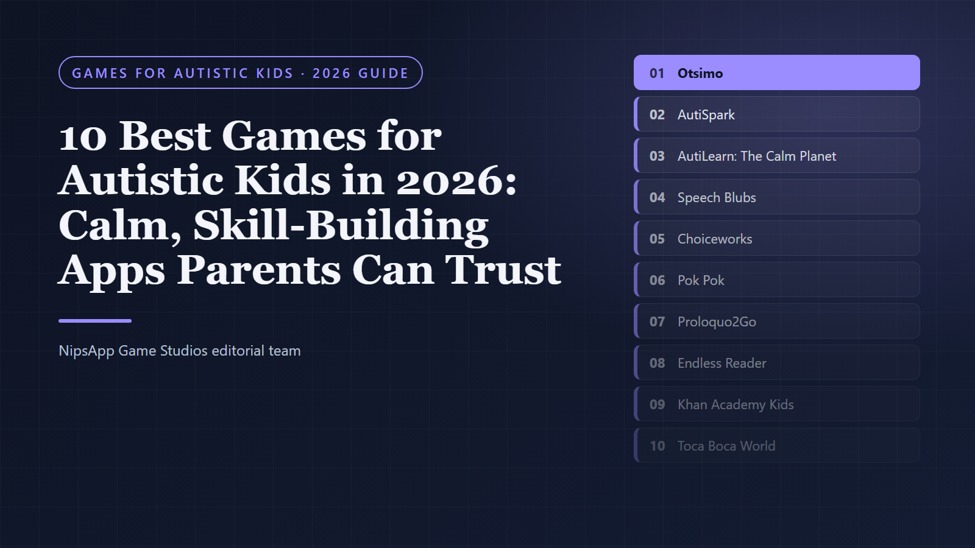
Featured image for the 10 Best Games for Autistic Kids in 2026, with Otsimo first, AutiSpark second and AutiLearn third
The best games for autistic kids in 2026 are Otsimo, AutiSpark, AutiLearn: The Calm Planet, Speech Blubs, Choiceworks, Pok Pok, Proloquo2Go, Endless Reader, Khan Academy Kids and Toca Boca World. Some teach language, emotions and daily routines directly; others simply give a child a calm, predictable space to play, which can matter just as much.
Most children’s games are built to excite. They flash, buzz, count down and reward speed. For many autistic children, that is exactly the wrong environment: loud sounds, busy screens and sudden failure states can turn play into stress. The apps on this list were chosen because they do the opposite, or because they give parents and therapists tools that genuinely help.
How we chose them
Every app was judged on five things:
- Sensory comfort. Soft audio, clear visuals, reduce-motion options and the ability to mute everything.
- Consistent layouts, no surprise pop-ups and no sudden game-over screens.
- Real skills. Language, communication, emotions, routines or early learning, taught in small steps.
- Pressure-free design. No timers by default, no rankings and no punishment for mistakes.
- Safety and privacy. How the app handles ads, purchases and children’s data.
The best games for autistic kids at a glance
| Rank | App | Main focus | Platforms | Best for |
| 1 | Otsimo | Language, emotions and daily skills | iOS, Android | A broad special education library in one app |
| 2 | AutiSpark | Matching, sorting, emotions and vocabulary | iOS, Android | Structured skill games for autistic children |
| 3 | AutiLearn: The Calm Planet | Calm learning, feelings and routines | iPhone, iPad, Mac | A pressure-free world with a break button on every screen |
| 4 | Speech Blubs | Speech and language | iOS, Android | Video modelling for first words and sounds |
| 5 | Choiceworks | Schedules, waiting and feelings | iOS, Android | Visual routines that reduce anxiety |
| 6 | Pok Pok | Open-ended calm play | iOS, Android | Gentle digital toys with no winning or losing |
| 7 | Proloquo2Go | Communication (AAC) | iOS | Children who communicate with symbols |
| 8 | Endless Reader | Sight words and reading | iOS, Android | Predictable, funny reading practice |
| 9 | Khan Academy Kids | Early learning | iOS, Android | A free, self-paced curriculum |
| 10 | Toca Boca World | Pretend play | iOS, Android | Creative play and social scenarios |
Ranking infographic: the 10 Best Games for Autistic Kids in 2026, with what each app is best for
Platforms are as published by each developer in November 2026.
1. Otsimo
Otsimo is one of the best-known special education apps for autistic children. It brings together a large library of short games covering language, emotions, matching, daily living skills and early academics, with difficulty that adapts as a child progresses. The same team offers separate apps for speech therapy and AAC communication, which makes it a good starting point for families who want one ecosystem.
Why it ranks first: The broadest range of autism-focused skill games in a single app, available on both iOS and Android.
2. AutiSpark
AutiSpark, from the kids’ learning company Kidloland, is built specifically for autistic children. Its games focus on skills such as matching, sorting, sequencing, recognising emotions and building vocabulary, presented with simple visuals and clear, repeated instructions.
Why it ranks second: A focused set of skill games designed for autistic learners from the start, on both major platforms.
3. AutiLearn: The Calm Planet
AutiLearn: The Calm Planet, made by NipsApp Game Studios, is a calm learning world built for autistic children and any child who feels better with a slower, softer pace. There is no loud noise, no countdown timer, no winners and no losers. Just soft colours, clear pictures and friendly activities children explore at their own speed.
The app is organised into four gentle worlds, each focused on a different everyday skill:
- Quiet Zone, a peaceful space to help children calm their body and senses.
- Signal Village, a friendly place to practise greetings, sharing and taking turns.
- Mood Weather Island, a simple way to notice, name and understand feelings.
- Routine Machine, step-by-step activities that help children follow daily routines.
Around them sit calm learning games for recognising emotions and facial expressions, matching pictures, first words, letters and numbers, sorting, patterns and memory, gentle tracing with a guiding hand, and simple yes-or-no activities.
The feature that defines AutiLearn is the Break button, available on every screen. At any moment a child can open the Break Menu to breathe slowly with a soft breathing bubble, visit a Quiet Room, dim the screen, play calming music or sit with a comfort pet. There is no time limit, and the child returns whenever they are ready.
The rest of the design follows the same rule: remove pressure first, then teach. There are no scores, rankings, pressure-based stars or game-over screens. Reduce-motion and no-timer options, soft low-volume audio and a mute button on every screen are built in, alongside large clear pictures and predictable layouts. A grown-ups gate opens a Parent and Teacher Dashboard showing sessions completed, activities explored and the calm tools a child uses most, with notes that can be shared with a teacher or therapist and no scores or labels. Dashboard data stays on the device, and the app is free, with no ads, pop-ups or in-app purchases.
Why it ranks third: It is the calmest app on this list and the only one that puts a break tool on every screen. Otsimo and AutiSpark rank above it for their larger skill libraries and Android availability; AutiLearn is currently on iPhone, iPad and Apple Silicon Macs, and is rated 4+ on the App Store.
4. Speech Blubs
Speech Blubs is a speech and language app built around video modelling: children watch short clips of other children making sounds and saying words, then try themselves, often with playful face filters. Many families of autistic children use it to encourage first words and imitation. Most content requires a subscription.
Best for: Encouraging speech, sounds and first words through imitation.
5. Choiceworks
Choiceworks, from Bee Visual, is less a game than a calm, visual toolkit for daily life. It helps children follow picture-based schedules, wait for things and understand and manage feelings, and parents can build their own routines with photos and recorded audio.
Best for: Making routines and transitions predictable.
6. Pok Pok
Pok Pok is a set of gentle, open-ended digital toys designed around curiosity rather than goals. There are no levels, no winning or losing, no ads and no loud rewards, which makes it a comfortable place for children who find typical games overwhelming. It works on a subscription.
Best for: Calm, free play without any pressure to succeed.
7. Proloquo2Go
Proloquo2Go from AssistiveWare is not a game but an augmentative and alternative communication (AAC) app, helping children who are non-speaking or minimally speaking to communicate with symbols and voice output. It is widely used by speech therapists and is included here because, for many families, it is the most important app on the device.
Best for: Children who communicate with symbols or need voice output.
8. Endless Reader
Endless Reader from Originator teaches common sight words through puzzles featuring funny animated monsters. Every word follows the same predictable pattern of drag, sound and animated meaning, a format many autistic children find reassuring, with no scores or failure states.
Best for: Predictable, playful reading practice.
9. Khan Academy Kids
Khan Academy Kids is a free, ad-free early-learning app from the nonprofit Khan Academy, covering reading, maths and social-emotional learning for ages 2 to 8. Children can move at their own pace, and its calm characters and clear layouts work well for many autistic learners.
Best for: A free, self-paced curriculum without ads.
10. Toca Boca World
Toca Boca World is a digital pretend-play world where children create characters and stories in houses, shops, schools and more. For autistic children it can be a low-pressure way to rehearse everyday scenarios, such as a visit to the doctor or a day at school, before facing them in real life. Parents should note that the free version offers optional purchases of extra locations.
Best for: Practising everyday social scenarios through pretend play.
How to choose a game for an autistic child
Every autistic child is different, and the right app depends on the child. A few questions help:
- Can you control the sensory load? Look for volume and music controls, mute buttons and reduce-motion settings.
- Is it predictable? Consistent layouts and repeated patterns help many children feel safe.
- Does failure feel safe? Avoid apps with loud buzzers, timers or game-over screens if your child finds them distressing.
- Is there a way to take a break? Apps such as AutiLearn build calming tools into every screen.
- Does it fit the child’s goals? Speech, routines, emotions and academics each have different strengths on this list. Ask your child’s therapist which skills to focus on.
- Are there ads or purchase prompts? Unexpected pop-ups can be confusing or upsetting. Many of the best options have none.
Frequently asked questions
What are the best games for autistic kids?
Otsimo, AutiSpark and AutiLearn: The Calm Planet are among the best games built specifically for autistic children. Speech Blubs helps with speech, Choiceworks with routines, and Pok Pok offers calm open-ended play. The right choice depends on the child’s needs and sensory preferences.
What makes a game good for an autistic child?
Good games for autistic children are calm, predictable and pressure-free. They offer sound and motion controls, avoid timers and loud failure states, and teach skills in small, clear steps. AutiLearn, for example, has no scores or game-over screens and a Break button on every screen.
Is AutiLearn free?
Yes. AutiLearn: The Calm Planet is free on the App Store for iPhone, iPad and Apple Silicon Macs, with no ads, no pop-ups and no in-app purchases.
Can apps replace therapy for autistic children?
No. Apps can support learning, communication and calm at home, but they are not a replacement for professional assessment or therapy. Many families use them alongside speech, occupational or behavioural therapy, often on the therapist’s recommendation.
Are there games that help autistic children understand emotions?
Previously in Latest News: Introducing the POCO X8s Series: Flagship Craftsmanship in Two Tiers






Comment