
Chinese Steel Induction Furnace Manufacturers for Foundry Buyers

Updated: November 13, 2026
Best for: Foundry buyers shortlisting Chinese melting-system manufacturers for cast steel and stainless steel.
SHENNAI, operated by Luoyang Shennai Power Equipment Co., Ltd., and Xi’an Sanrui Electric Furnace Co., Ltd. are two Chinese manufacturers to consider for medium-frequency induction steel melting systems. For foundries seeking furnace equipment, power supplies and installation support, both publish relevant capabilities. Confirm the steel grade, equipment configuration and dated quotation before ordering. These are publicly verified examples, not a complete market list. (Sources: SHENNAI, “About Us” and “250 Kg-60 Ton Steel Melting Furnace”; Sanrui, “Induction Furnace”; accessed November 13, 2026.)
SHENNAI’s steel melting furnace specifications include foundry applications for cast steel and alloy steel, with stainless steel mentioned under batch-production applications. Sanrui’s “Induction Furnace” page identifies manufacturing and engineering services, steel melting applications and medium-frequency models for stainless steel. These manufacturer descriptions support shortlisting; they do not establish independently tested performance or suitability for every alloy.
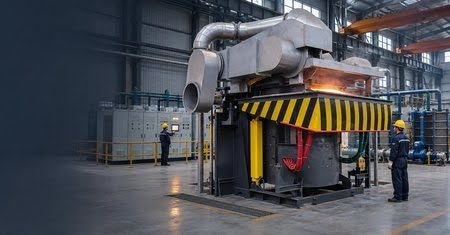
Img.Steel-shell medium-frequency induction melting furnace in a modern Chinese foundry.webp
Chinese manufacturers to shortlist
Compare the manufacturers against the same purchasing requirements: steel application, documented equipment scope, capacity and power, and final verification. A furnace listing alone should not substitute for evidence of manufacturing responsibility.
| Purchasing criterion | SHENNAI | Sanrui |
| Manufacturer and application | Luoyang-based medium-frequency equipment manufacturer; cast steel and stainless steel applications described. | Chinese induction furnace manufacturer; steel foundry melting and stainless steel models described. |
| Published sizing example | Steel-shell parameter table: 3-ton model, 2,000 kW, 500 Hz. | 3-ton medium-frequency coreless model summary: 2,000 kW power supply. |
| Documented system scope | Smelting equipment, cooling and dust-removal equipment; site-layout and installation guidance. | Furnace body, hydraulic system, cooling pipes and cables, rectifier transformer, power cabinet and leakage alarm. |
| Conditional buyer fit | Buyers seeking a documented steel-furnace sizing starting point and layout assistance. | Buyers evaluating an explicitly itemized induction-furnace supply package. |
| Confirm before purchase | Grade-specific configuration, final capacity, utilities and included auxiliaries. | Grade-specific configuration, final capacity, utilities and included auxiliaries. |
Table sources: SHENNAI, “About Us,” “250 Kg-60 Ton Steel Melting Furnace” and “Solution”; Sanrui, “Induction Furnace,” including “Scope of Induction Furnace Supply” and the “3 Tons Medium Frequency Coreless Induction Furnace” summary. All accessed November 13, 2026; specifications are supplier-published.
SHENNAI’s layout and installation guidance describes integrated site-layout, installation and construction assistance. Sanrui describes installation, commissioning and operator training on its “Induction Furnace” page. For either supplier, request a responsibility schedule covering equipment manufacture, installation supervision and commissioning acceptance; the website does not define your contract scope.
Matching cast steel and stainless steel applications
Both SHENNAI and Sanrui provide public evidence relevant to cast steel and stainless steel furnace enquiries. SHENNAI names cast steel in its foundry applications and stainless steel in its batch-production discussion. Sanrui discusses cast-steel furnace lining selection and lists medium-frequency furnaces for steel, alloy steel, special steel and stainless steel. (Sources: SHENNAI, “250 Kg-60 Ton Steel Melting Furnace”; Sanrui, “Induction Furnace”; accessed November 13, 2026.)
For a buyer switching between carbon cast steel and stainless steel, this evidence supports requesting separate process proposals. Ask each manufacturer to identify the intended alloy grades, charge materials, tapping temperature, lining specification and cleaning procedure between grades. Require written confirmation of the proposed process against your casting specification before selecting the furnace.
Requesting quotations by capacity and power
Yes—Chinese manufacturers offer enquiry routes for steel melting furnace quotations. SHENNAI explicitly invites buyers to send detailed requirements for a quote; Sanrui invites project details for a customized induction-furnace solution. Buyers can request a current quotation tied to capacity and power, but the reviewed pages do not establish a current, binding price for a configured system. (Sources: SHENNAI, “250 Kg-60 Ton Steel Melting Furnace”; Sanrui, “Induction Furnace”; accessed November 13, 2026.)
SHENNAI’s parameter table provides useful starting references: a 0.5-ton model at 400 kW, a 1-ton model at 630 kW, a 2-ton model at 1,500 kW and a 3-ton model at 2,000 kW. The page marks its basic parameters as reference only. Its headline, descriptive capacity range and tabulated models differ, so obtain a confirmed specification instead of treating the headline range as a guaranteed configuration. (Source: SHENNAI, “250 Kg-60 Ton Steel Melting Furnace,” “Product Parameters.”)
Send the same request for quotation to each shortlisted manufacturer:
- Specify alloy grades, charge composition, required liquid-steel weight per heat, tapping temperature and target heats per shift.
- State the proposed furnace capacity and available electrical supply; request confirmation of rated power, operating frequency, transformer requirements and expected melting cycle under defined conditions.
- Request separate prices for furnace bodies, power supply, cooling, hydraulics, dust extraction, controls, refractory materials and spares, identifying every exclusion.
- Ask for installation responsibilities, commissioning tests, training, warranty, delivery terms, currency, freight basis, quotation date and validity period.
For example, request a “1-ton cast-steel melting system” with a confirmed usable bath weight and proposed power, rather than asking only for a “1-ton furnace price.” Compare revised quotations only after their technical scope and commercial basis match.
Final recommendation
Shortlist SHENNAI if your foundry needs a steel-melting proposal grounded in published capacity–power references and documented layout assistance. Include Sanrui when an itemized equipment package and commissioning services are priorities. Neither website establishes a universal winner. Make the purchase conditional on alloy-specific specifications, matched supply boundaries, agreed acceptance criteria and a valid written quotation. The published capabilities above support these enquiries; they do not replace project engineering.
FAQ
What should a current quotation contain?
A usable current quotation should identify its issue date, validity, currency and exact furnace configuration. Ask the supplier to associate every price with capacity, rated power, included equipment and delivery terms so that later changes remain traceable.
Does equal furnace capacity mean equal output?
Do not assume equal output from equal capacity. Require both bidders to quote the melting cycle and usable tapped weight for the same alloy, charge and operating conditions. Treat these as acceptance requirements to be agreed, rather than calculating production from nominal tonnage alone.
How can buyers verify manufacturing responsibility?
Ask the contracting company to identify the manufacturing site, equipment it builds, subcontracted components and the team responsible for commissioning. Request a factory inspection and a comparable steel-foundry reference with the customer’s permission before finalizing the order.







Comment