
How Online Calculators Help Users Solve Math, Finance, and Percentage Problems

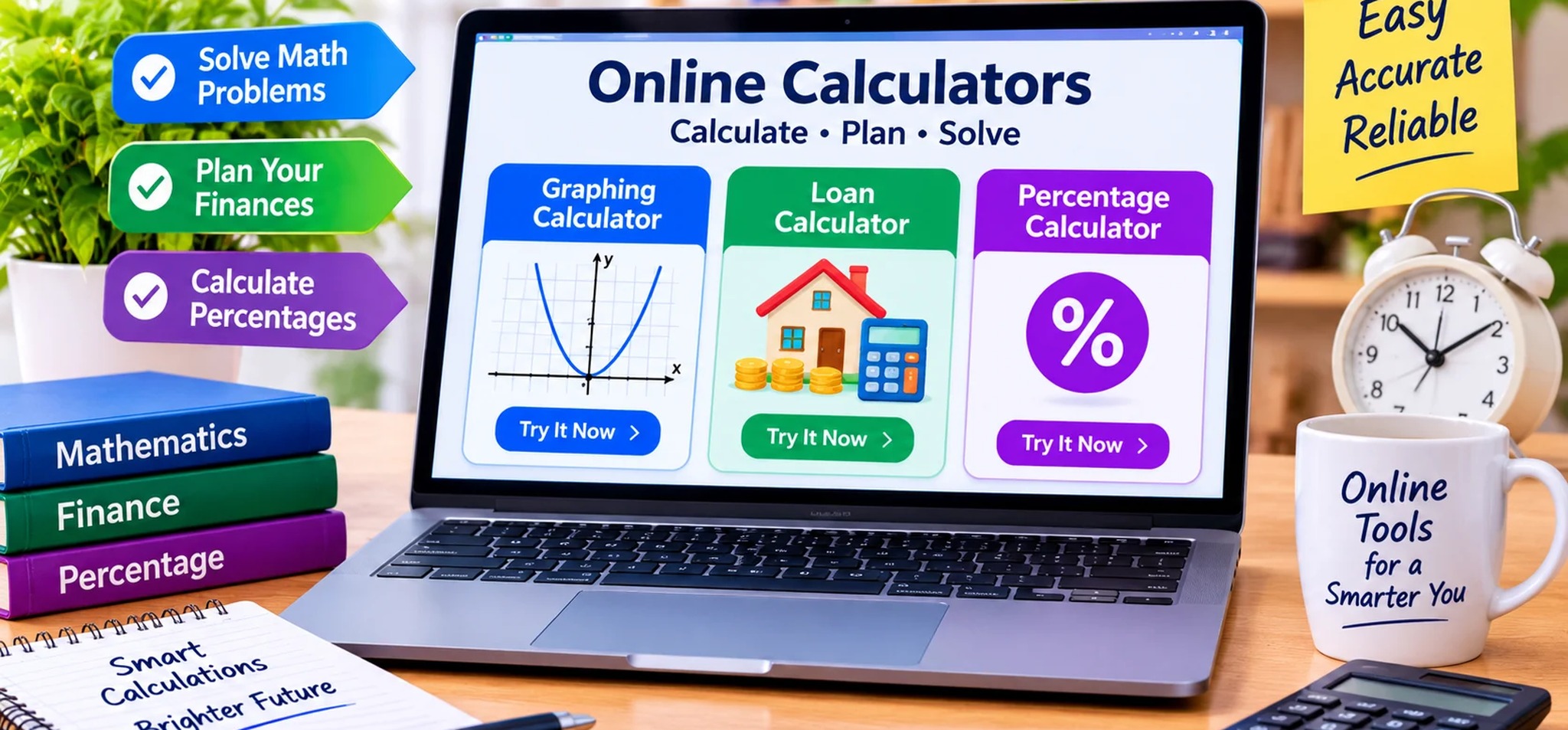
Online calculators have become valuable digital tools for people who want to solve mathematical problems, manage financial decisions, and complete everyday calculations more efficiently. From students working on algebra equations to homeowners planning loan repayments, these tools make complicated calculations easier to understand and manage. Instead of spending time solving every problem manually, users can enter a few details and receive results within seconds.
Different calculators are designed to handle specific requirements. A Graphing Calculator helps users visualize mathematical equations, compare functions, and understand relationships between variables. A Loan Calculator, on the other hand, helps borrowers estimate monthly payments, understand interest costs, and compare different financing options.
Online calculators are useful in education, business, personal finance, and everyday activities. Their simple interfaces and practical features allow users with different levels of experience to perform calculations without needing advanced mathematical knowledge.
Why Online Calculators Are Important for Everyday Tasks
Mathematical calculations are part of many daily activities. People calculate shopping discounts, household expenses, examination scores, business profits, and monthly financial payments. Although basic calculations are relatively simple, more complicated problems can require additional time and attention.
Online calculators simplify these activities by providing dedicated tools for different mathematical and financial needs.
Some important advantages include:
- Save Time: Users can complete calculations within seconds instead of following lengthy manual steps.
- Improve Accuracy: Automated calculations reduce common mistakes associated with manual work.
- Easy Accessibility: Most online calculators are available through web browsers and work on computers, tablets, and smartphones.
- Support Learning: Students can experiment with different numbers and equations to understand mathematical concepts.
- Simplify Financial Planning: Specialized calculators help users estimate expenses, payments, interest, and savings.
- Increase Productivity: Professionals and business owners can complete routine calculations without interrupting their work.
These benefits make online calculators practical resources for students, professionals, business owners, and everyday users.
How a Graphing Calculator Helps Users Understand Mathematics
A Graphing Calculator is a mathematical tool that allows users to visualize equations, functions, and relationships between variables. Instead of looking only at numerical answers, users can see how mathematical expressions appear on a coordinate plane.
This visual approach makes complex mathematical concepts easier to understand, particularly for students studying algebra, geometry, and advanced mathematics.
For example, students can enter linear and quadratic equations into a graphing tool and compare their shapes, directions, and intersection points. Changing the values in an equation also helps them understand how different variables influence the resulting graph.
Comparing Two Mathematical Equations
Consider two mathematical functions:
- First equation: y = x²
- Second equation: y = 2x + 3
The first equation represents a quadratic function that creates a U-shaped curve called a parabola. The second equation represents a linear function that produces a straight line.
A graphing calculator allows users to display both equations on the same coordinate plane and compare their behavior.
For a clearer understanding, consider the following values:
| X Value | y = x² | y = 2x + 3 |
|---|---|---|
| -2 | 4 | -1 |
| -1 | 1 | 1 |
| 0 | 0 | 3 |
| 1 | 1 | 5 |
| 2 | 4 | 7 |
These values demonstrate how the two functions produce different results for the same input.
The equations also intersect at two points:
- First intersection: (-1, 1)
- Second intersection: (3, 9)
A graphing calculator makes these relationships easier to observe because users can see both functions together rather than calculating every point manually.
This practical example helps students understand quadratic functions, linear equations, coordinate values, and intersection points. It also demonstrates how visual mathematical tools can support learning and problem-solving.
Important Features of a Graphing Calculator
Different graphing tools offer features that make mathematical exploration more convenient.
- Function Graphing: Displays mathematical functions visually so users can understand how equations behave.
- Equation Comparison: Allows users to examine multiple equations on the same coordinate plane.
- Coordinate Visualization: Shows points and their positions on a graph.
- Variable Adjustments: Helps users observe how changing numerical values affects a function.
- Intersection Identification: Makes it easier to understand where different mathematical graphs meet.
- Mathematical Exploration: Supports learning through experimentation with different equations and values.
How Students and Teachers Benefit From Graphing Tools
Students often find mathematical concepts difficult when they only study formulas and textbook examples. Visual graphing tools make these subjects more interactive and easier to understand.
Some common educational applications include:
- Practicing algebra and quadratic equations.
- Understanding linear and nonlinear functions.
- Comparing different mathematical expressions.
- Learning how positive and negative values influence graphs.
- Exploring coordinate systems and intersection points.
- Checking mathematical solutions and practicing for examinations.
Teachers can also use graphing calculators to explain mathematical concepts during classroom lessons. By demonstrating equations visually, they can make difficult topics easier for students to follow.
How a Loan Calculator Makes Financial Planning Easier
Borrowing money is an important financial decision that requires careful planning. Whether someone wants to purchase a home, finance a vehicle, or obtain a personal loan, understanding the repayment amount is essential before accepting a loan agreement.
A Loan Calculator helps users estimate monthly installments by using important financial information, including the loan amount, annual interest rate, and repayment period.
For example, someone planning to borrow money for a vehicle can enter the expected borrowing amount, interest rate, and repayment term. The calculator then estimates the monthly payment based on these details.
Practical Loan Calculator Example
Suppose a person wants to borrow $10,000 and needs to understand the monthly repayment amount before applying.
The loan details are:
- Loan Amount: $10,000
- Annual Interest Rate: 6%
- Repayment Period: 3 years
- Payment Frequency: Monthly
- Estimated Monthly Payment: $304.22
Using a standard fixed-rate loan with monthly repayments, the estimated installment is approximately $304.22.
The calculation uses the following formula:
M = P × r(1 + r)ⁿ / ((1 + r)ⁿ − 1)
Where:
- M represents the monthly payment.
- P represents the original loan amount.
- r represents the monthly interest rate.
- n represents the total number of monthly payments.
For this example, the annual interest rate of 6% is divided by 12 to obtain a monthly rate of 0.5%. The repayment period of three years equals 36 monthly payments.
The estimated repayment breakdown is:
| Financial Detail | Amount |
|---|---|
| Original Loan Amount | $10,000.00 |
| Annual Interest Rate | 6% |
| Repayment Period | 36 Months |
| Estimated Monthly Payment | $304.22 |
| Total Payments (Approx.) | $10,951.90 |
| Total Interest (Approx.) | $951.90 |
These figures are rounded estimates based on a standard fixed-rate repayment schedule. The actual payment schedule may produce a small rounding difference.
This example shows how a loan calculator helps borrowers understand their financial commitments before making a decision.
Main Factors That Affect Loan Payments
Several factors influence the amount borrowers need to repay.
- Loan Amount: A higher borrowing amount generally results in higher monthly payments.
- Interest Rate: Higher interest rates usually increase the total borrowing cost.
- Repayment Period: A longer loan term may reduce monthly installments but can increase the total interest paid.
- Additional Fees: Processing charges, insurance, and other expenses can affect the overall cost.
- Interest Structure: Fixed and variable interest arrangements can produce different repayment amounts.
Understanding these factors helps borrowers evaluate their financial responsibilities and compare available options.
Practical Uses of a Loan Calculator
A loan calculator can support different financial decisions.
- Home Financing: Estimate monthly mortgage payments before purchasing a property.
- Car Financing: Understand expected installments when financing a vehicle.
- Personal Loans: Compare repayment amounts for different borrowing requirements.
- Budget Planning: Determine whether monthly installments fit within an available budget.
- Loan Comparisons: Evaluate different interest rates and repayment periods.
These calculations provide a useful starting point for financial planning, although borrowers should always review the final terms offered by their lenders.
How Percentage Calculations Help With Everyday Decisions
Percentages are used in shopping, education, banking, business, and personal budgeting. People frequently calculate discounts, examination scores, profit margins, interest rates, and price increases.
Online percentage calculators simplify these tasks by providing quick results without requiring users to remember complicated formulas.
Common Applications of Percentage Calculators
Shopping Discounts
Customers can calculate how much money they save during promotional sales. For example, a 20% discount on a $100 product reduces the purchase price by $20, making the final cost $80.
Business Profit Calculations
Business owners can calculate profit margins, compare revenue changes, and evaluate financial performance.
Academic Results
Students can calculate examination percentages and understand their academic performance.
Financial Planning
Percentage calculations help users understand interest rates, savings growth, and changes in monthly expenses.
Price Comparisons
Customers can compare original and discounted prices to identify better purchasing options.
Simple Percentage Calculation Example
Suppose a product costs $200 and a store offers a 15% discount.
The calculation is:
- Original Price: $200
- Discount Rate: 15%
- Discount Amount: $30
- Final Purchase Price: $170
This example demonstrates how percentage calculations help customers understand discounts and make informed purchasing decisions.
Choosing the Right Online Calculator for Your Needs
Different calculations require different tools. Selecting the appropriate calculator can help users obtain relevant results and complete tasks more efficiently.
Before choosing an online calculator, users should consider the following factors:
- Purpose: Identify whether the requirement involves mathematical, financial, percentage, or general calculations.
- Ease of Use: Choose a calculator with a simple and understandable interface.
- Accuracy: Look for tools that provide reliable results based on the information entered.
- Relevant Features: Select a calculator that includes the functions needed for a specific task.
- Device Compatibility: Check whether the tool works properly on computers, tablets, and mobile phones.
- Clear Results: Prefer calculators that present answers in an organized and understandable format.
Choosing a suitable calculator can make everyday calculations easier while reducing unnecessary effort.
Common Mistakes to Avoid When Using Online Calculators
Although online calculators simplify mathematical and financial tasks, users still need to enter accurate information and understand the results.
Some common mistakes include:
- Entering incorrect numbers or decimal values.
- Using the wrong interest rate when calculating loan payments.
- Confusing monthly and annual interest rates.
- Selecting an incorrect repayment period.
- Forgetting additional charges when estimating borrowing costs.
- Assuming that estimated loan payments always match the final lender agreement.
- Relying on results without checking the original information.
To avoid these problems, users should review their inputs before completing a calculation. For important financial decisions, it is also helpful to confirm estimates with the relevant lender or financial professional.
How Online Calculators Support Education and Professional Work
Online calculators are useful beyond academic assignments and personal financial planning. They also provide practical support in professional environments where accurate calculations are important.
Different professionals use these tools according to their individual requirements.
- Students: Solve mathematical problems, practice equations, and check examination calculations.
- Teachers: Explain mathematical concepts through visual examples and interactive exercises.
- Business Owners: Calculate expenses, profits, discounts, and revenue changes.
- Financial Professionals: Estimate loan payments, compare interest rates, and review financial scenarios.
- Engineers: Work with numerical relationships, measurements, and mathematical functions.
- Everyday Consumers: Calculate shopping discounts, monthly expenses, and personal budgets.
The availability of specialized calculators allows users to select tools according to their needs rather than relying on one basic calculator for every task.
Conclusion
Online calculators have made mathematical and financial calculations more accessible, convenient, and manageable. From comparing equations with a Graphing Calculator to estimating monthly installments with a Loan Calculator, these tools help users solve different problems with less effort. Percentage calculators also simplify everyday activities such as calculating discounts, business profits, examination results, and financial changes.
Practical examples demonstrate how these tools can support both mathematical learning and financial planning. By choosing the right calculator, entering accurate information, and understanding the results, users can save time and make better-informed decisions.
As digital technology continues to develop, online calculators will remain valuable resources for students, professionals, business owners, and anyone who needs quick and reliable calculations.







Comment